
How One of the World’s Most Studied Performance Supplements Became Much More Than a Bodybuilding Supplement
Creatine has been around so long that it is easy to dismiss it as old news. That would be a mistake. Few nutritional supplements have accumulated anything close to creatine’s research history, and creatine monohydrate remains one of the most extensively studied ergogenic aids available.
For decades, the conversation centered primarily on strength, power, muscle and athletic performance. More recently, however, researchers have begun exploring creatine in areas ranging from healthy aging and cognition to women’s health and other potential clinical applications. In other words, the supplement once associated almost exclusively with bodybuilders has developed a much broader résumé.
Ironically, after using and writing about creatine for decades, my own thinking about it has changed too.
For years, I followed a fairly simple philosophy: supplement what you need. If someone eats very little meat—or none at all—creatine supplementation makes obvious sense because meat and fish are the major dietary sources. Someone like me, who consumes plenty of meat, should theoretically have less to gain.
There is truth to that idea. It simply isn’t the whole story.
A change in the way I now use creatine has turned it into one of the more useful additions to my daily routine, and it has forced me to reconsider a supplement I once thought I had largely outgrown.
CREATINE 101: WHY IT WORKS
Creatine is produced naturally in the body and obtained through foods such as meat and fish. Most of the body’s creatine is stored in skeletal muscle, where the creatine-phosphocreatine system helps rapidly regenerate ATP—the immediate energy currency required for muscular contraction.
That becomes particularly important during brief, intense efforts such as heavy lifting, sprinting, jumping and repeated high-output sets. When ATP demand is enormous and immediate, greater phosphocreatine availability can help replenish it more rapidly.
That is why creatine earned its reputation as an ergogenic aid rather than merely another supplement backed by aggressive marketing. Decades of research have consistently supported creatine monohydrate for high-intensity performance and resistance-training adaptations.
Creatine does not replace hard training. It helps you get more from it.
BUT I EAT A LOT OF MEAT. DO I REALLY NEED CREATINE?
This was my argument for years.
Meat and fish contain creatine, whereas plant foods provide very little. Vegetarians and vegans therefore tend to begin with lower creatine stores than omnivores and often demonstrate a greater response when those stores are increased through supplementation.
If you eat no meat at all, the argument for supplemental creatine is particularly compelling.
I actually made this dietary distinction years ago in The Variability With Supplements, noting that a vegetarian may have considerably more to gain from creatine supplementation than a heavy meat eater. What has changed is my assumption that having a high dietary intake means there is little reason for someone like me to supplement at all.
But here’s the part I underestimated: eating a lot of meat does not necessarily mean your muscles are completely saturated with creatine.
There is a difference between obtaining creatine from the diet and maximizing tissue creatine stores. So although vegetarians may have more to gain, that does not mean an omnivore has nothing to gain.
That changed the way I started thinking about supplementation.
Rather than asking:
“Am I deficient?”
the better question may sometimes be:
“Could increasing availability beyond what my diet supplies provide a useful effect?”
Those are not the same question.
THE HYDRATION TWIST THAT CHANGED MY MIND
This is where things became more interesting for me.
I consume a meat-heavy, high-protein diet and train regularly. Under those conditions—particularly when carbohydrate intake is lower, sweating is significant or activity is high—fluid and electrolyte intake deserve attention.
For years, I looked at creatine primarily as something you took in a single dose, often around training. Eventually I started asking a different question:
Why not pair creatine with something I’m already doing throughout the day—drinking water?
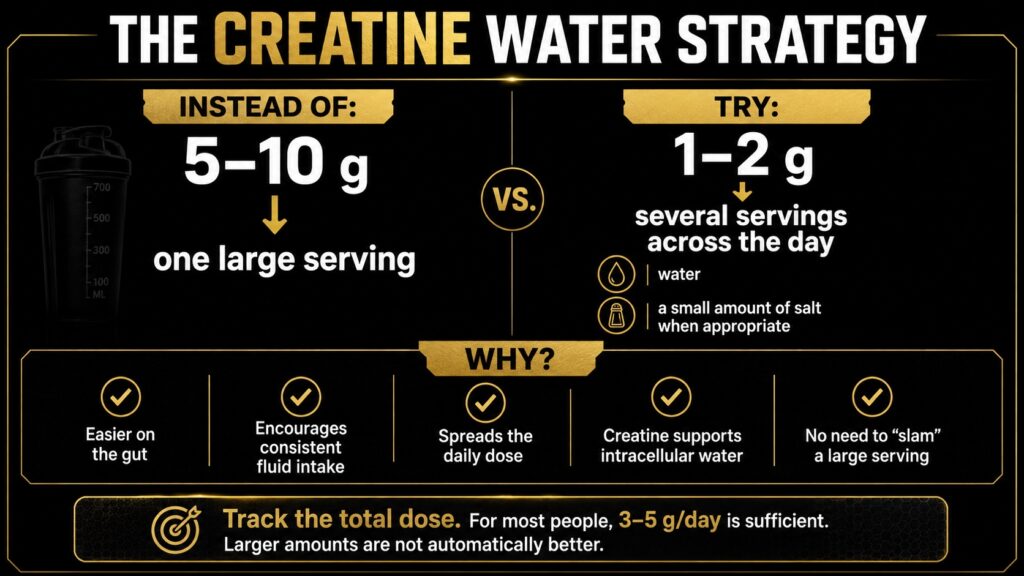
Instead of taking 5–10 grams in one shot, I began adding small amounts of creatine to individual glasses of water, usually along with a little sea salt.
A gram here. Another gram later. Perhaps two grams in another drink.
The important part is not the glass itself; it is keeping track of the planned daily total.
For me, this has been a game-changer. The creatine is spread across the day rather than hammering the digestive system with one larger serving, and every dose becomes another reminder to drink. I tolerate it exceptionally well this way, while simultaneously paying more attention to fluid and electrolyte intake.
That’s what I call a win-win.
I do want to distinguish between research and personal application here. I am not suggesting that creatine has been established as a treatment for dehydration, nor that everybody who eats a high-protein diet is automatically dehydrated. What we do know is that creatine affects body-water distribution and increases water associated with creatine-containing tissues; the old idea that creatine inherently causes dehydration has not held up well under controlled research.
So I think of this as a hydration strategy that incorporates creatine, rather than calling creatine itself a hydration supplement.
That distinction matters.
WHY SMALLER DOSES MAY MAKE SENSE
There is another reason I like dividing the dose: the intestinal tract sometimes objects when too much creatine arrives at once.
That does not make creatine dangerous. It simply means individuals have different gastrointestinal tolerance thresholds. A larger serving that causes bloating, loose stools or urgency may become completely uneventful when divided into several smaller servings.
If 10 grams in one shot disagrees with you, there is no prize for forcing it down. Five servings of 2 grams—or whatever distribution fits your intended daily total—may be considerably easier to tolerate.
There is also no need to pretend that micro-dosing creatine throughout the day has some magical metabolic advantage. The benefits here are much more practical: tolerance, consistency and adherence.
And sometimes the best protocol isn’t the one that looks most impressive on paper. It’s the one you can follow comfortably every day.
WHAT ABOUT THE SALT?
I usually add a little sea salt to the water as well.
The relevant component for hydration is sodium. Sea salt is simply the form I prefer; I would not pretend that it possesses magical properties that overturn basic physiology.
I’ve discussed this side of the equation in more detail in Hydration Essentials for High-Protein, Low-Carb Diets, where I cover the role that sodium, electrolytes and fluid intake can play when you’re training regularly and eating predominantly whole foods with fewer carbohydrates.
Sodium can become particularly relevant for people who sweat heavily, train in hot conditions, eat mostly whole foods with little processed food, or otherwise have circumstances that increase fluid and electrolyte requirements. The appropriate amount, however, varies tremendously from person to person.
The lesson isn’t “put huge amounts of salt in your water.”
It’s:
Pay attention to fluid and electrolytes rather than assuming water alone always tells the entire hydration story.
Anyone with a medical reason to restrict sodium should obviously follow the guidance of their healthcare provider rather than somebody else’s hydration protocol.
CREATINE IS NOT JUST ABOUT BIGGER MUSCLES
The muscle and performance benefits remain the foundation of creatine’s reputation. They simply aren’t the entire story anymore.
Strength and Power
Creatine’s strongest body of evidence remains its ability to support repeated high-intensity performance and enhance adaptations to resistance training. It doesn’t transform a poor training program into a good one, but it can help make an intelligently designed program more productive.
That distinction is worth remembering whenever supplements enter the discussion: training provides the stimulus, nutrition provides the building blocks, recovery allows adaptation, and creatine can support the process.
Muscle Growth
Creatine combined with resistance training can also support increases in lean mass. Some early changes on the scale may reflect additional intracellular water, but it would be overly simplistic to dismiss creatine’s long-term effects as nothing more than “water weight.”
If additional creatine allows you to perform more quality work, recover between repeated high-intensity efforts and progressively train more effectively over time, the benefits extend well beyond making the muscle temporarily hold more fluid.
Water can make a muscle heavier. Productive training makes it better. Creatine can participate in both processes.
Healthy Aging
This may eventually become one of creatine’s most important applications.
Age-related declines in muscle mass and strength threaten independence, metabolic health, mobility and quality of life. The combination of resistance training and adequate nutrition remains fundamental, but creatine has become increasingly interesting as an adjunct for older adults attempting to preserve muscle and physical function.
That does not make it an anti-aging pill. Nothing does.
But if a relatively inexpensive and well-studied supplement can help support the very training that protects strength and independence, the conversation has moved far beyond bodybuilding.
WHAT ABOUT THE BRAIN?
Skeletal muscle isn’t the only tissue with substantial energy requirements. The brain also relies on systems that rapidly buffer and regenerate cellular energy, which is why researchers have become increasingly interested in creatine and cognition.
The evidence here is intriguing, but it deserves more restraint than the muscle-performance literature. Research has reported potential benefits in areas such as memory and cognitive performance, with some populations and circumstances appearing more responsive than others.
Vegetarians are particularly interesting because lower dietary creatine intake can also influence creatine availability outside skeletal muscle. Sleep deprivation and other conditions that increase energetic stress are another area researchers have explored.
But I would not turn that into:
“Creatine makes you smarter.”
The more defensible interpretation is that creatine contributes to brain-energy metabolism and emerging evidence suggests potential cognitive applications worth continuing to investigate.
That’s plenty exciting without exaggerating it.
VEGETARIANS AND VEGANS MAY HAVE THE MOST OBVIOUS CASE
If there is one population where the nutritional rationale for creatine supplementation is particularly straightforward, it is people who consume little or no animal food.
Their dietary intake of creatine is extremely low compared with someone eating meat and fish regularly. Supplementation therefore fills a much clearer dietary gap.
That is why my old argument was not completely wrong. Baseline diet matters.
Where my thinking changed was assuming that a high-meat intake automatically eliminates any reason to supplement. It doesn’t necessarily do that, especially if the goal extends beyond simply avoiding deficiency.
WOMEN SHOULD NOT BE LEFT OUT OF THE CONVERSATION
Creatine spent decades being advertised primarily to young male bodybuilders, but that was marketing—not physiology.
Interest in creatine across the female lifespan has increased significantly, including its possible roles in exercise performance, body composition, healthy aging and the menopausal transition.
The evidence is not equally strong in every area, and some questions remain very much in the emerging stage. But there is no sensible reason to continue treating creatine as a “men’s supplement.”
DOES CREATINE DEHYDRATE YOU OR CAUSE CRAMPS?
The dehydration myth has remarkable staying power, which makes my current way of using creatine particularly ironic.
For years people warned that creatine would somehow pull water into muscle and leave the rest of the body dehydrated. Research has not supported the idea that appropriate creatine use inherently causes dehydration or makes exercise in the heat more dangerous.
Creatine can alter body-water distribution, but that is not synonymous with dehydration.
And it is one reason I find the transition from “creatine may dehydrate you” to “creatine has become part of my personal hydration routine” so interesting.
DOES CREATINE DAMAGE THE KIDNEYS?
The evidence in healthy people using conventional amounts is generally reassuring, but there is an important technical issue that sometimes creates confusion.
Creatine supplementation can influence serum creatinine, and serum creatinine is commonly used when estimating kidney filtration. Seeing creatinine rise on a blood panel can therefore trigger concern even when the change does not necessarily represent kidney injury.
A 2026 meta-analysis found that creatine can increase serum creatinine and make creatinine-based estimates of kidney filtration appear lower without corresponding deterioration when filtration was assessed using non-creatinine methods or other kidney-health markers.
That does not mean laboratory results should ever be ignored. It means they should be interpreted in context.
If you’re using creatine and having bloodwork performed, tell the physician or healthcare provider evaluating the results. Anyone with existing kidney disease or another condition affecting renal or fluid management should discuss supplementation with an appropriate healthcare professional first.
DOES CREATINE CAUSE HAIR LOSS?
This claim has frightened lifters for years, despite resting on surprisingly little direct evidence.
Much of the concern originated from an older study reporting changes in DHT rather than demonstrating actual hair loss. A 2025 randomized controlled trial directly examined the issue and found no significant differences in DHT or measured hair-growth outcomes after 12 weeks of 5 grams of creatine per day compared with placebo.
Will the myth disappear? Probably not—supplement myths have a way of surviving longer than most supplement companies.
DO YOU NEED TO LOAD CREATINE?
No. A traditional loading protocol can saturate muscle creatine stores more rapidly, but it isn’t mandatory. A smaller daily maintenance dose will gradually increase stores as well; it simply takes longer.
That makes loading primarily a question of speed, not necessity.
And if you’re somebody whose stomach already objects to larger servings, trying to force down a loading protocol merely because an old bodybuilding article told you to makes little sense.
HOW MUCH SHOULD YOU TAKE?
For most people using creatine primarily for exercise performance, roughly 3–5 grams per day remains a simple and practical approach. Larger individuals and some specialized applications may use more, but more is not automatically better.
My current hydration approach does not change that principle.
If you’re using 5 grams daily, you might divide it into five 1-gram additions to water.
If you have decided on a larger daily amount and tolerate smaller servings better, perhaps you use several 1–2 gram doses.
The key is knowing the planned total before the day begins.
Don’t dose according to how thirsty you happen to be.
Dose the creatine deliberately and use the water as the delivery system.
DO YOU NEED TO CYCLE IT?
This is another area where my thinking has evolved. In How to Periodize Workout Supplements for Better Gains and Recovery, I recommended cycling creatine with different phases of training. You can still do that as a programming strategy if you have a reason, but I no longer view cycling as a physiological requirement for healthy users.
That is an important distinction.
Something can be a useful strategy without being a biological requirement.
If cycling fits your training organization, fine. If daily supplementation fits your objectives better, there is no need to invent a mandatory “off” period simply because that was common bodybuilding advice thirty years ago.
PRE-WORKOUT OR POST-WORKOUT?
I’ve traditionally favoured post-workout creatine. In fact, My Workout Supplement Ritual shows how I’ve incorporated creatine into a broader post-workout strategy along with protein, amino acids and other recovery nutrients. There have also been interesting discussions over the years about whether timing creatine around training provides a meaningful advantage.
At this stage, however, the practical message is less exciting than supplement marketers might prefer:
Consistent intake probably matters considerably more than obsessing over the exact minute you swallow it.
If taking creatine after training guarantees that you remember it, that’s a good strategy; if putting small servings into water across the day makes adherence effortless, that’s also a good strategy. Consistency beats the clock.
My older Periodization of Post-Workout Juice article also reflects how I used to approach creatine—pairing it after training with carbohydrate and added salt. I still see value in that strategy when it fits the individual, but I no longer believe the post-workout window is the only logical place for creatine.
WHICH FORM OF CREATINE IS BEST?
This is where supplement marketing can make something simple unnecessarily complicated.
For the overwhelming majority of people, I continue to favour creatine monohydrate. It is the form with the deepest research history, widespread availability and very little reason to abandon it simply because somebody puts a more exotic chemical name on another bottle.
There are, however, many reputable brands.
One premium version that many consumers and athletes favour is Creapure®, the German-manufactured form of creatine monohydrate. Creapure is produced in Germany under a dedicated manufacturing and testing system focused on purity and consistency.
For example, PVL Creapure German Creatine Monohydrate is one option for someone who wants a standalone micronized creatine product. The current product is German-sourced Creapure creatine monohydrate and is marketed in a micronized powder format.
I would not claim that Creapure builds more muscle or produces more strength than an equally pure, accurately dosed creatine monohydrate. Its appeal is primarily the confidence associated with the source, manufacturing standards and quality-control process.
Fancy chemistry isn’t necessary.
Quality is.
THE CREATINE I PERSONALLY USE
There is another option for people who already incorporate creatine into their post-workout nutrition.
I personally use Post-Workout Formula 2.0 from Catanzaro Supplements. A full serving currently contains 5 grams of creatine monohydrate, along with D-ribose, glutamine, vitamin C and a mineral/electrolyte blend that includes sodium, magnesium and potassium.
That makes it particularly useful in my own routine because it combines several ingredients I would otherwise be taking separately after training.
There is an important practical point here, though.
If you take a product that already supplies 5 grams of creatine, count that toward your daily total. Do not consume a full creatine-containing post-workout formula and then mindlessly add another 5–10 grams to your drinking water unless that larger intake is intentional.
This is where supplementation can become needlessly complicated.
Know what is already in your formulas. Then fill the gaps rather than blindly stacking products.
That is the same “supplement what you need” philosophy I’ve always used—just applied with a more complete understanding of what creatine may offer.
WHAT I USE
STANDALONE CREATINE
PVL Creapure® German Creatine Monohydrate
A simple option if you want pure, standalone creatine monohydrate. Creapure® is manufactured in Germany and is widely recognized for its purity and quality-control standards.
MY POST-WORKOUT OPTION
Post-Workout Formula 2.0
This is the formula I personally use. A full serving provides 5 grams of creatine monohydrate along with additional post-workout nutrients and electrolytes.
WHAT RECENT SAFETY RESEARCH TELLS US
Creatine’s longevity is one of its greatest advantages. A 2025 analysis of 685 clinical trials involving more than 12,800 participants found no significant overall difference in reported side effects between creatine and placebo groups.
A supplement that has been consumed and studied across so many different populations gives researchers considerably more information than a new ingredient supported by two manufacturer-funded trials and six months of social-media hype.
That does not mean every individual will tolerate every dose. Gastrointestinal discomfort can occur, particularly with larger servings. Body weight may increase. Some individuals simply don’t enjoy how a particular protocol feels.
But there is a world of difference between:
“This serving is too large for my stomach.”
and:
“Creatine is dangerous.”
That distinction gets lost far too often in supplement discussions.
MY UPDATED CREATINE STRATEGY
So after decades of using, recommending, cycling, discontinuing and writing about creatine, here’s where I’ve landed.
I still believe strongly in the principle supplement what you need. I’ve simply expanded my definition of what need can mean.
Because I eat plenty of meat, I likely begin with higher creatine availability than someone who follows a vegetarian diet. But that does not automatically mean my tissue stores are maximized, nor does it address the expanding research into applications beyond skeletal muscle.
I am now interested in creatine from several angles at once: performance, muscle preservation, healthy aging, brain-energy metabolism and—through the way I personally use it—hydration management and consistency.
Rather than hitting my digestive system with one large standalone serving, I’ll often add small quantities to water at different points throughout the day, usually with a little sea salt, while keeping track of the total amount I’m consuming. On training days, I may also obtain creatine through my Post-Workout Formula 2.0, so that amount becomes part of the calculation rather than something added on top automatically.
The result is a strategy that fits the way I actually live and train.
Better tolerance. More consistent fluid intake. A deliberate daily creatine dose. And access to the other potential physical and mental benefits along the way.
For me, that’s a win-win.
THE BOTTOM LINE
Creatine has survived something very few supplements survive: time.
Products come and go. Ingredients become fashionable, disappear and then return twenty years later under a new name. Creatine monohydrate is still here because the evidence has continued to accumulate while its potential applications have expanded.
Its strongest foundation remains strength, repeated high-intensity performance and resistance training. But the conversation now includes healthy aging, preservation of muscle, cognition, women’s health and other areas researchers are continuing to explore.
You don’t need the newest designer form. You don’t need to obsess over whether you took it at 4:47 or 5:13 in the afternoon. And you don’t necessarily need to take your entire dose at once.
You need a quality creatine monohydrate, a sensible total intake, consistency and realistic expectations.
Creatine isn’t magic. It doesn’t replace resistance training, sufficient protein, sleep, hydration or a good diet. It simply has the potential to make several of those efforts more productive.
And after all these years, that may be the most impressive thing about it.
SELECTED REFERENCES
- Safety of Creatine Supplementation: Analysis of the Prevalence of Reported Side Effects in Clinical Trials and Adverse Event Reports
- Impact of Creatine Supplementation on Kidney Health
- Does Creatine Cause Hair Loss? A 12-Week Randomized Controlled Trial
- The Effects of Creatine Supplementation on Cognitive Function in Adults: A Systematic Review and Meta-Analysis
- Creatine in Women’s Health: Bridging the Gap From Research to Real-World Application
- The Impact of Creatine Supplementation Associated With Resistance Training in Older Adults
- Effects of Creatine Supplementation and Resistance Training on Muscle Strength.

Pre-Meal BCAAs After 50: Can Leucine Help Overcome Anabolic Resistance?
As we age, muscle becomes less responsive to smaller doses of dietary protein. Leucine can help strengthen that anabolic signal, but BCAAs are not a replacement for complete protein, and the popular “30 minutes before a meal” strategy is more plausible than proven.

How to Periodize Workout Supplements for Better Gains and Recovery
Supplements do not need to be taken the same way all year. Rotating tools like creatine, caffeine, aminos, and nootropics around training phases can make supplementation more strategic.

Why the FDA’s Red Dye Ban Should Make You Rethink Your Vitamins
The red dye ban raises a bigger question: what exactly is hiding in your supplements? Vitamins should support health, not come loaded with questionable colors, fillers, and shortcuts.