
A 30-minute amino-acid head start may help older muscle get more from a meal. Here is when the strategy makes sense, when it probably does not, and how to use it without turning BCAAs into another supplement gimmick.
Thirty minutes before you eat your steak, take some BCAAs.
That was one of the more interesting recommendations exercise physiologist Jim Stoppani made during an appearance on Gary Brecka’s Ultimate Human Podcast. At first glance, it sounds like another supplement hack looking for a mechanism. Except this one has legitimate physiology behind it.
As we get older, the muscle-building response to a meal can become less robust, particularly when that meal contains a modest amount of protein. Leucine plays an important role in switching on muscle protein synthesis, so Stoppani’s idea is simple: take a rapidly available dose of leucine-rich BCAAs before eating, let that anabolic signal get started, then allow the meal to deliver the rest of the amino acids needed to actually build muscle.
The concept is compelling and the science behind leucine is strong. The exact 20-to-30-minute pre-meal timing, however, is better viewed as a practical strategy than a proven magic window. That distinction is what makes this worth exploring.
WHY OLDER MUSCLE NEEDS A LOUDER SIGNAL
One of the nutritional challenges that accompanies aging is anabolic resistance, a reduced sensitivity of skeletal muscle to anabolic stimuli such as dietary protein and resistance exercise. There is nothing magical about turning 50. You do not blow out the candles and suddenly become anabolic resistant. It develops along a continuum influenced by age, activity, muscle mass, health, habitual protein intake and, importantly, whether you continue to challenge your muscles with resistance training.
But the dose-response does change. Research comparing younger and older men found that older adults needed a greater relative amount of high-quality protein to maximize the muscle protein synthetic response to a meal. A useful research-based starting point was approximately 0.4 grams of protein per kilogram of body weight per meal in healthy older men.¹ For an 80-kilogram or 176-pound individual, that works out to roughly 32 grams of protein.
This does not mean everybody over 50 needs to start weighing chicken breasts. It means the small protein serving you got away with when you were younger may no longer generate quite the same anabolic response. As I discussed previously in Moderate Protein Intake Is Best, the goal is not to shovel protein into every meal indiscriminately. It is to consume enough high-quality protein, distributed intelligently, to support your needs.
And this is where leucine becomes especially interesting.
LEUCINE: THE ANABOLIC TRIGGER
Leucine is one of the three branched-chain amino acids, along with isoleucine and valine. All three are essential amino acids, but leucine has a particularly important signalling role in the molecular machinery involved in muscle protein synthesis, including activation of the mTORC1 pathway.
Think of leucine as the finger that presses the START button.
In a classic study, younger and older subjects consumed an essential-amino-acid mixture containing either a normal proportion of leucine or a leucine-enriched version. Both mixtures stimulated muscle protein synthesis in the younger subjects. In the older subjects, however, the lower-leucine mixture failed to significantly raise muscle protein synthesis while the leucine-enriched version succeeded.²
That does not mean leucine is the only thing that matters. Newer research has made the so-called “leucine trigger” hypothesis more nuanced, particularly when whole foods and mixed meals are involved. But the relationship appears especially relevant in older adults, where a stronger leucine signal may help compensate for reduced anabolic sensitivity.⁹
There is another piece to the story. Older adults can also display greater first-pass splanchnic extraction of ingested amino acids, meaning the gut and liver take up a greater proportion before those amino acids reach the peripheral circulation.³ That is the physiology behind Stoppani’s colourful description that the intestines begin to “steal” more leucine as we age.
The important point is not that older people stop absorbing protein. They do not. The practical issue is that older muscle may benefit from a larger, more leucine-rich amino-acid signal.
CAN A LEUCINE TOP-UP HELP?
This is where the evidence gets useful.
Researchers studying healthy men between 65 and 85 years old added 5 grams of leucine to each of their three main meals. The additional leucine increased integrated myofibrillar protein synthesis over several days, including in exercised muscle.⁴ Another trial in older women compared two beverages containing the same amount of protein but very different amounts of leucine. The leucine-enriched drink produced a stronger muscle protein synthetic response despite total protein being identical.⁵
Perhaps even more relevant to the “top-up” idea, researchers gave older men only 15 grams of protein after resistance exercise, a relatively modest dose. Adding just 1.5 grams of free leucine increased post-exercise myofibrillar protein synthesis by approximately 16 to 19 percent compared with the same protein dose without the extra leucine.⁶
That is the part of the research that interests me most.
You do not necessarily have to replace the meal, make another shake or dramatically increase total protein. If the meal is already providing protein but appears to fall short of producing a strong anabolic signal, a relatively small leucine top-up may improve the response.
Now we have an interesting nutritional hack.
BUT BCAAs STILL NEED THE REST OF THE TEAM
This is where BCAA marketing often goes off the rails.
Leucine can help switch on muscle protein synthesis, but you cannot construct complete new muscle proteins from leucine, isoleucine and valine alone. Humans require nine essential amino acids, and all of them ultimately need to be available. I have covered this distinction before in Very Important Information About BCAAs.
A good way to picture it is this:
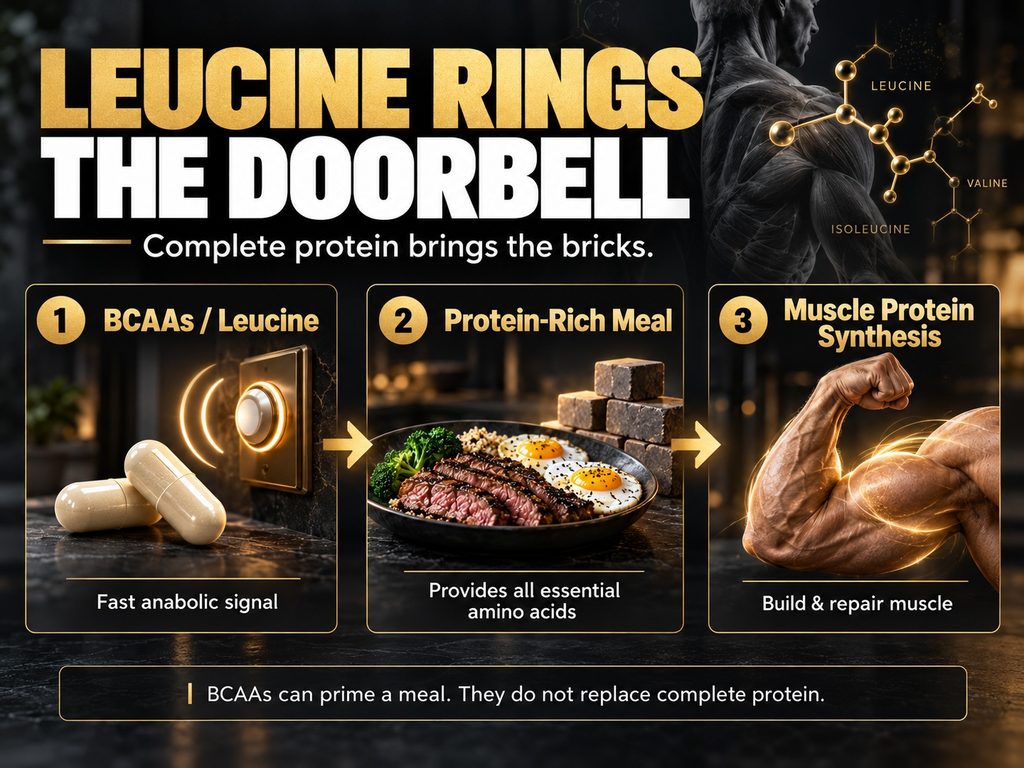
Leucine can ring the doorbell. The other essential amino acids still have to show up with the bricks.
BCAAs themselves are not useless. A study using 5.6 grams of BCAAs after resistance exercise found a roughly 22 percent increase in myofibrillar protein synthesis compared with placebo.⁷ But a recent review of the human evidence reached an important conclusion: BCAAs can activate anabolic signalling and transiently stimulate muscle protein synthesis, but the response is smaller than what occurs when a complete protein or amino-acid source supplies the full complement of indispensable amino acids.⁸
That is exactly why the pre-meal concept makes more sense than using BCAAs instead of a meal. The BCAAs provide the signal. The meal provides the building material.
THE 30-MINUTE PRE-MEAL HACK
Stoppani recommends taking BCAAs roughly 20 to 30 minutes before a whole-food meal. Free-form amino acids are rapidly available, so the theory is that leucine rises first and starts the anabolic signalling process while the more slowly digested meal follows with the remaining amino acids.
Physiologically, that is reasonable. What we do not yet have is strong evidence showing that 30 minutes before eating is definitively superior to taking the same amino acids with the meal. In fact, some of the strongest studies demonstrating a benefit from added leucine gave it with the meal or protein source.
So I would not obsess over a stopwatch. Think of 20 to 30 minutes as a practical head start, not a biological commandment.
The more important question is whether the meal needs help in the first place.
WHEN THIS HACK MAKES THE MOST SENSE
A 12-ounce steak probably does not need an amino-acid chaperone. A couple of eggs and coffee might.
That is how I would approach this strategy. A large serving of meat, fish, eggs, dairy or another leucine-rich complete protein may already supply enough protein and leucine to generate a robust anabolic response. Piling more BCAAs on top may accomplish very little.
The hack becomes more attractive when the meal is almost there, but not quite. Examples include a smaller breakfast, a light lunch, a plant-heavy meal, periods of calorie restriction, or an older trainee whose appetite makes 30 or 40 grams of protein at every sitting unrealistic. This is particularly relevant early in the day, when many people eat very little protein and then try to compensate with a huge dinner. My article Eat Breakfast Before Weight Training discusses another reason I prefer giving the body more nutritional support earlier rather than saving everything for later.
Here is the practical approach I would use:
- Build the meal around protein first. Aim for a meaningful serving of high-quality protein rather than relying on supplements to rescue a poor diet.
- Look for the weak meals. If the meal is clearly light in protein or likely to fall short of roughly 2.5 to 3 grams of leucine, that is where a top-up becomes most interesting.
- Take the BCAAs about 20 to 30 minutes beforehand if you want to use the Stoppani protocol. You do not need to panic if the timing is 15 minutes or 35 minutes. The exact window has not been established.
- Eat the complete-protein meal. This is essential. The BCAAs are the primer, not the construction crew.
That is the entire hack: no complicated nutrient-timing schedule, no giant amino-acid drink and no replacing real food. Just strengthen a meal that could use a little anabolic help.
WHERE OUR PERI-WORKOUT FORMULA FITS
This concept also gives our Peri-Workout Formula another practical application beyond the workout window.
A five-capsule serving provides:
L-Leucine: 1,000 mg
L-Isoleucine: 500 mg
L-Valine: 500 mg
It also contains glutamine, lysine, vitamin C and vitamin B6. The BCAAs are supplied in the traditional 2:1:1 leucine:isoleucine:valine ratio.
The important number for this discussion is the 1 gram of leucine. I would not pretend that one serving is equivalent to the larger supplemental leucine doses used in some studies. It is not. What makes it potentially useful is precisely its role as a top-up.
If a meal is already bringing a couple of grams of leucine to the table, another gram of rapidly available supplemental leucine may help strengthen the meal’s amino-acid profile. And because it is delivered in capsules, you can do it without adding another shake or a significant number of calories.
That is how supplementation should work: identify the nutritional gap, then fill it.
The same principle applies to workout supplementation. More is not automatically better; timing, dose and context matter. I discuss that philosophy in How to Periodize Workout Supplements for Better Gains and Recovery and My Workout Supplement Ritual.
DO NOT LET THE HACK DISTRACT YOU FROM THE BIG STUFF
There is an obvious danger with any nutritional hack: people obsess over the final 5 percent while ignoring the first 95.
Pre-meal BCAAs will not rescue a chronically low-protein diet, compensate for poor resistance training, inadequate calories, poor sleep or inconsistent habits. Nor do they mean whole-food protein suddenly becomes less important after age 50.
The priorities remain straightforward: resistance train consistently, consume adequate total protein, distribute that protein reasonably across the day, and make sure your major meals contain meaningful amounts of high-quality protein. Once those fundamentals are covered, you can start looking for smaller opportunities to optimize.
That is where leucine becomes interesting.
THE BOTTOM LINE
I went into this topic expecting the usual supplement claim: an interesting mechanism stretched far beyond the evidence. I came away more convinced than that.
The leucine top-up is a reasonable strategy. The 30-minute timing is the experimental part.
Older muscle often requires a stronger anabolic signal from food. Leucine is an important part of that signal, and human studies show that adding leucine can improve the muscle protein synthetic response when the underlying protein dose is modest.
BCAAs do not make you “absorb more protein,” and they do not replace complete protein. But taken shortly before a meal that is a little light on protein or leucine, they may provide what that meal is missing: a stronger anabolic trigger.
If your meal is already loaded with high-quality protein, save the capsules. If it needs a little help, prime it.
Ring the doorbell with leucine. Then make sure the bricks are coming.
ADDITIONAL READING
Very Important Information About BCAAs
How to Periodize Workout Supplements for Better Gains and Recovery
Periodize Your Workout Supplements
A Great Way to Reduce Post-Workout Soreness
REFERENCES
- Moore DR, Churchward-Venne TA, Witard O, et al. Protein ingestion to stimulate myofibrillar protein synthesis requires greater relative protein intakes in healthy older versus younger men. Journal of Gerontology: Biological Sciences. 2015;70(1):57-62. doi:10.1093/gerona/glu103.
- Katsanos CS, Kobayashi H, Sheffield-Moore M, Aarsland A, Wolfe RR. A high proportion of leucine is required for optimal stimulation of the rate of muscle protein synthesis by essential amino acids in the elderly. American Journal of Physiology-Endocrinology and Metabolism. 2006;291(2). doi:10.1152/ajpendo.00488.2005.
- Volpi E, Mittendorfer B, Wolf SE, Wolfe RR. Oral amino acids stimulate muscle protein anabolism in the elderly despite higher first-pass splanchnic extraction. American Journal of Physiology-Endocrinology and Metabolism. 1999;277(3). doi:10.1152/ajpendo.1999.277.3.E513.
- Murphy CH, Saddler NI, Devries MC, McGlory C, Baker SK, Phillips SM. Leucine supplementation enhances integrative myofibrillar protein synthesis in free-living older men consuming lower- and higher-protein diets: a parallel-group crossover study. American Journal of Clinical Nutrition. 2016;104(6):1594-1606. doi:10.3945/ajcn.116.136424.
- Devries MC, McGlory C, Bolster DR, et al. Protein leucine content is a determinant of shorter- and longer-term muscle protein synthetic responses at rest and following resistance exercise in healthy older women: a randomized, controlled trial. American Journal of Clinical Nutrition. 2018;107(2):217-226. doi:10.1093/ajcn/nqx028.
- Holwerda AM, Paulussen KJM, Overkamp M, et al. Leucine coingestion augments the muscle protein synthetic response to the ingestion of 15 g of protein following resistance exercise in older men. American Journal of Physiology-Endocrinology and Metabolism. 2019;317(3). doi:10.1152/ajpendo.00073.2019.
- Jackman SR, Witard OC, Philp A, Wallis GA, Baar K, Tipton KD. Branched-chain amino acid ingestion stimulates muscle myofibrillar protein synthesis following resistance exercise in humans. Frontiers in Physiology. 2017;8:390. doi:10.3389/fphys.2017.00390.
- Kaspy MS, Hannaian SJ, Bell ZW, Churchward-Venne TA. The effects of branched-chain amino acids on muscle protein synthesis, muscle protein breakdown and associated molecular signalling responses in humans: an update. Nutrition Research Reviews. 2024;37(2):273-286. doi:10.1017/S0954422423000197.
- Zaromskyte G, Prokopidis K, Ioannidis T, Tipton KD, Witard OC. Evaluating the leucine trigger hypothesis to explain the post-prandial regulation of muscle protein synthesis in young and older adults: a systematic review. Frontiers in Nutrition. 2021;8:685165. doi:10.3389/fnut.2021.685165.

The Ultimate Creatine Guide: Muscle, Brain, Aging, Hydration & What the Research Really Says
Creatine isn’t just for bodybuilders. This ultimate guide examines the latest research on creatine for muscle, strength, cognition, healthy aging, hydration and safety—and introduces a practical way to spread your daily dose for better tolerance.

How to Periodize Workout Supplements for Better Gains and Recovery
Supplements do not need to be taken the same way all year. Rotating tools like creatine, caffeine, aminos, and nootropics around training phases can make supplementation more strategic.

Why the FDA’s Red Dye Ban Should Make You Rethink Your Vitamins
The red dye ban raises a bigger question: what exactly is hiding in your supplements? Vitamins should support health, not come loaded with questionable colors, fillers, and shortcuts.