
Wearables, apps and influencers are climbing the rankings. But beneath the technology, hype and changing delivery systems, the fundamentals of effective training have changed remarkably little.
Every year, the American College of Sports Medicine releases its Worldwide Survey of Fitness Trends, and every year the rankings generate headlines about what is supposedly coming next.
For 2027, wearable technology once again sits at the top. Mobile exercise apps have climbed to second. Balance, flow and core strength is third. Programs for older adults, traditional strength training, weight management, group fitness, data-driven training, mental health and influencer-led fitness complete the top ten.
It is an interesting list, but before you redesign your business, buy another piece of technology or start teaching Pilates on Instagram, there is an important point to keep in mind.
A trend tells you what is getting attention. It does not necessarily tell you what deserves your attention.
The ACSM survey asks fitness professionals what they are seeing across the industry; it is not a contest to determine which training method builds the most muscle, improves health the most or produces the best long-term results. Trends change quickly. Human physiology does not.
THE 2027 TOP TEN
For context, here is the ACSM ranking:
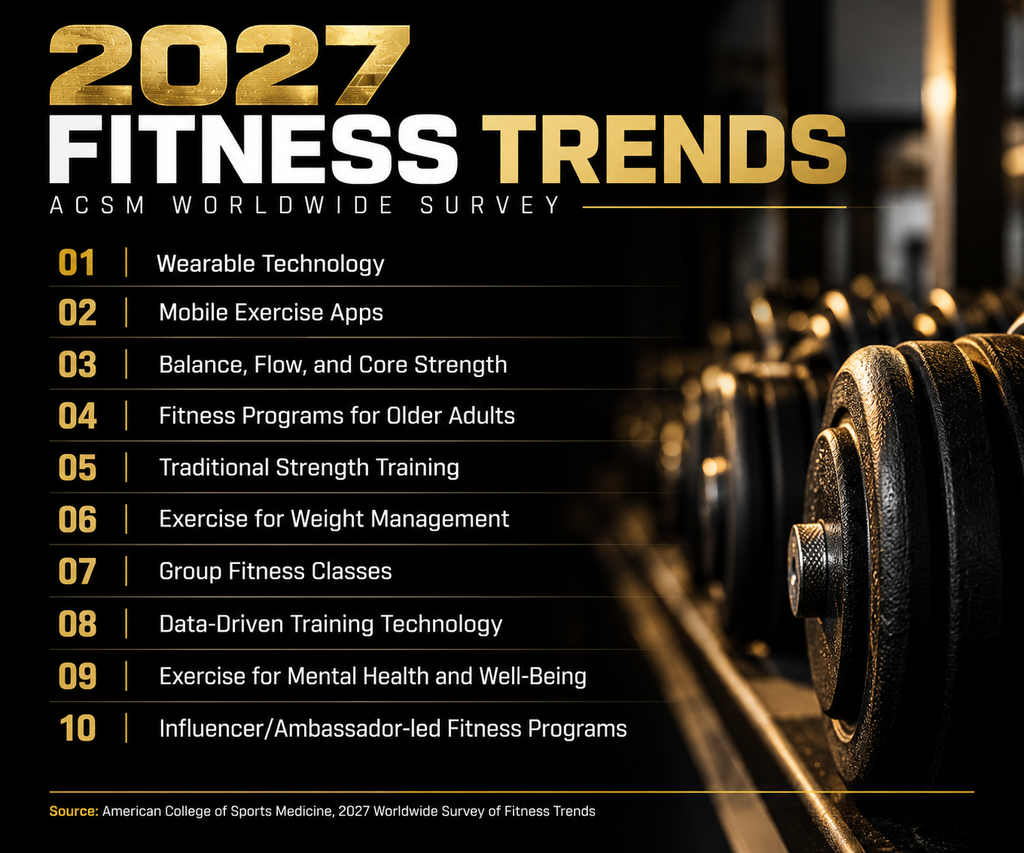
Some deserve considerable attention. Others are simply new delivery systems for things good trainers have been doing for decades, and a few require a healthy dose of skepticism.
TECHNOLOGY DOMINATES THE RANKINGS
Three of the top eight trends involve technology: wearables, mobile exercise apps and data-driven training. That should surprise no one.
Smartwatches measure heart rate, steps, sleep, activity and recovery. Rings generate readiness scores. Apps deliver workouts, track nutrition and remind you when to move. Coaches can monitor clients remotely and collect more information in a day than trainers once gathered in a month.
Used well, this can be tremendously useful; used poorly, it can become tremendously distracting. I discussed this recently in Your Fitness Tracker Is Not Your Doctor. The problem is not the technology. The problem begins when the measurement becomes more important than the person being measured.
Your watch may say your recovery is poor, but how do you actually feel? Your sleep score may have dropped, but how did you sleep? Your readiness score may be excellent, but how is your warm-up moving? How does the weight feel in your hands? How are your joints responding?
Data should add information to the coaching process, not replace the coaching process. That is equally true of No. 8, data-driven training technology. Heart-rate variability, resting heart rate, training load, sleep quality, velocity, glucose, steps and recovery scores can all provide useful information, but only if that information changes a decision.
The useful question is not, “What else can I measure?” It is, “Will this measurement change what I do?” If the answer is no, the number may simply be noise.
The trainer of the future does not need to compete with technology; the job is to become better at interpreting it. Collecting more data is easy. Knowing what to do with it is the skill.
MOBILE APPS ARE TOOLS, NOT COACHES
Mobile exercise apps moving into the No. 2 position tells us something useful about the fitness industry: people increasingly expect training to fit around their lives rather than rearranging their lives around training.
That is largely positive. A client travelling for work can still access a program. Someone with a busy family schedule can train at home. A trainer can deliver exercise demonstrations, monitor workouts and adjust programming without requiring every interaction to occur face-to-face.
But an app cannot fully replicate observation, judgement and experience. It may not recognize whether a sudden change in technique is caused by fatigue, fear, pain, inappropriate loading or misunderstanding an instruction.
Technology is excellent at delivering information, but coaching is still required to interpret the person. Use the app to extend your reach, not outsource your expertise.
BALANCE, FLOW AND CORE TRAINING AT NUMBER THREE
The rise of Pilates, yoga, barre, mobility and related training into the No. 3 position is one of the more interesting developments this year, and much of that is positive.
People are recognizing that fitness involves more than calories burned and muscles built. Mobility, balance and coordination matter, as does the ability to control your body through useful ranges of motion.
I recently explored this in How Old Is Your Balance? What the One-Leg Stand Test Can and Can’t Tell You. Balance tends to decline with age and can improve with practice, particularly in older adults. Mobility and movement control can also be valuable components of a complete program.
But this is where fitness trends have a habit of getting carried away. If some balance is useful, more instability must be better. If mobility is important, every workout must become a mobility session. If core training matters, every exercise apparently needs to be performed on one leg while holding a kettlebell upside down.
That logic is backwards. Instability is a variable, not a virtue. The same applies to mobility, flexibility and core training: use them where they solve a problem; do not create a problem simply so you can use them.
THE BIGGEST OPPORTUNITY MAY BE NUMBER FOUR
Fitness programs for older adults have remained near the top of the ACSM rankings for several years, and this is one trend I would take very seriously—not because training older adults requires an entirely new form of exercise, but almost for the opposite reason.
Older adults need many of the qualities proper training has always developed: strength, muscle, balance, mobility, cardiovascular fitness and confidence in movement. The mistake is assuming that aging automatically requires weak training.
An older person may require modifications because of arthritis, reduced mobility, lower exercise tolerance, medical conditions or decades of inactivity. Age by itself, however, is not a reason to abandon progressive resistance training.
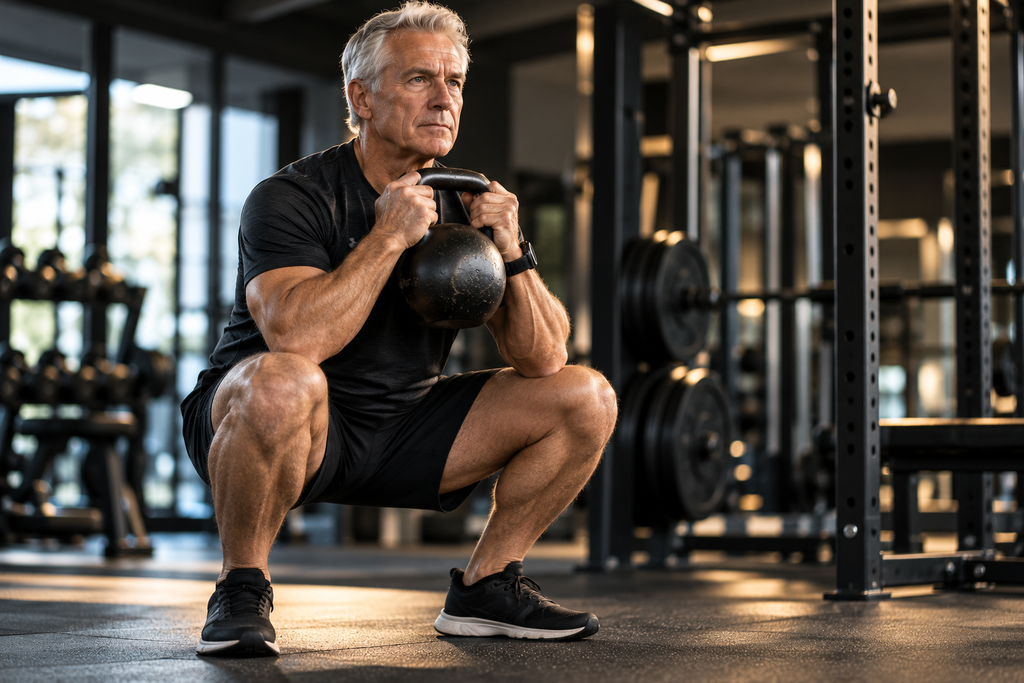
In Growing Older Is Inevitable. Growing Weaker Doesn’t Have to Be and 55: Don’t Let the Old Man In, I approached the same principle from two different perspectives. The objective is not to make a 70-year-old train like a 25-year-old athlete. It is to help the 70-year-old preserve as much physical capacity as possible.
Getting off the floor matters. Climbing stairs matters. Carrying groceries matters. Catching yourself when you stumble matters. Having enough strength and muscle reserve to tolerate illness, surgery or periods of inactivity matters.
The fitness industry has spent decades selling exercise as a way to look better. The aging population gives trainers an opportunity to sell something far more valuable: independence.
STRENGTH TRAINING AT NUMBER FIVE IS HARDLY A TREND
Traditional strength training moved from seventh in 2026 to fifth for 2027.
Good. But calling strength training a trend feels a little like calling sleep a wellness innovation.
Barbells still work. Dumbbells still work. Progressive overload still works. Good technique still matters. And after decades of new equipment, certification systems, apps and training philosophies, a surprisingly large percentage of productive resistance training still comes down to performing basic movements consistently and gradually asking the body to do more.
That is also why I would not obsess over strength training being ranked below Pilates, apps or wearable technology. Popularity does not establish hierarchy.
The renewed interest in traditional strength training may actually reflect something encouraging. After years of complexity, people may be rediscovering that training does not need to resemble a circus act to be effective.
Consistency beats novelty far more often than the fitness industry likes to admit.
WEIGHT MANAGEMENT HAS CHANGED IN THE GLP-1 ERA
Exercise for weight management comes in at No. 6, but the conversation surrounding this category is changing rapidly.
For decades, exercise was often marketed for weight loss primarily because it burned calories. That was always an incomplete argument. Today, with GLP-1 medications capable of producing substantial weight loss, the role of training becomes even clearer.
Exercise is not simply there to make the scale move. It helps determine what kind of body remains after the weight comes off.
That was the central message of Ozempic Can’t Lift Weights for You. When body weight drops substantially, preserving muscle, strength and function becomes extremely important. Resistance training supplies the mechanical stimulus that tells muscle it is still needed. Adequate protein provides the raw material. Regular movement and cardiovascular training support overall fitness.
The objective should not simply be to become lighter. It should be to become healthier, stronger and more capable.
The GLP-1 era may ultimately force the fitness industry to stop treating calorie expenditure as exercise’s most important benefit. That would be progress.
GROUP FITNESS IS REALLY ABOUT SOMETHING ELSE
Group fitness jumped from No. 13 to No. 7. The obvious interpretation is that classes are popular again. The more useful interpretation is that people like doing difficult things with other people.
Accountability matters. Shared effort matters. Knowing that somebody expects you to show up matters. You do not need to teach a 30-person class to apply that lesson. Personal trainers can build community, online coaches can create accountability, training partners can support consistency and small groups can combine individualized programming with social reinforcement.
The programming still needs to be good, but adherence is part of program design. The greatest workout in the world accomplishes nothing if the client stops doing it.
EXERCISE FOR MENTAL HEALTH DESERVES ITS PLACE
Exercise for mental health and well-being remains inside the top ten, reflecting a welcome broadening of how people think about training. People do not always exercise because they want larger arms or lower body fat. Sometimes they simply feel better when they move.
Resistance training, aerobic exercise, walking, recreational activity and mind-body practices can contribute to psychological well-being while also providing routine, mastery, social connection and a sense of progress.
For trainers, however, scope still matters. We prescribe exercise; we do not diagnose or treat psychiatric disorders unless appropriately qualified to do so. The trainer does not need to become a therapist to recognize that mental well-being is a legitimate reason people exercise and to create an environment that supports it.
INFLUENCERS ARE BACK IN THE TOP TEN
Influencer and ambassador-led fitness programs return to the top ten after falling out of the top 20 in 2026.
This may be the trend trainers should study most carefully—not necessarily follow, but study—because it shows where people are getting much of their fitness advice.
A person with two million followers can influence more exercise decisions in one afternoon than many highly qualified professionals will influence in a career. That does not make the influencer wrong, and it certainly does not make the influencer right.
Social media rewards attention. Science rewards accuracy. Those incentives do not always point in the same direction.
For legitimate fitness professionals, complaining about influencers solves nothing. The better response is to learn how to communicate sound advice just as effectively. Make the science understandable. Make the advice practical. Demonstrate exercises clearly. Explain why something works. Correct bad information without turning every post into a lecture.
Expertise hidden in a textbook helps fewer people than expertise communicated well.
SO WHAT SHOULD A TRAINER ACTUALLY DO IN 2027?
The rankings look modern, but my recommendations are remarkably traditional. Use technology, but do not worship it. Let wearables and apps help you collect information, deliver programs and improve accountability while observation and judgement remain central. Train strength throughout the lifespan. Include mobility and balance when the person needs them, without confusing novelty with function or instability with advancement.
Treat weight management as a question of body composition and health, not simply a calorie-burning contest. In the era of powerful weight-loss medications, protecting muscle and physical function deserves greater emphasis, not less. Build connection into the training process because adherence improves when people feel supported and accountable.
Perhaps most importantly, learn to communicate. In a world of apps, algorithms, influencers and unlimited fitness content, the value of a knowledgeable trainer is no longer access to information; everyone already has it. The value is knowing what matters, how to apply it and when to ignore the rest.
THE BOTTOM LINE
The 2027 fitness trends tell an interesting story. The industry is becoming more digital, measurable and connected while people are simultaneously showing greater interest in strength, mobility, healthy aging, mental well-being and physical function. That combination is encouraging, but do not confuse the delivery system with the training principle.
A wearable can monitor the workout. An app can deliver it. An influencer can promote it. A group can make it more enjoyable. None of those things replaces the workout itself.
Bodies still adapt to stress. Muscles still respond to tension. Skills still improve through practice. Progress still requires consistency, recovery still matters, and results still accumulate from what you do repeatedly over months, years and decades.
The future of fitness may look increasingly digital, but the fundamentals remain stubbornly analog. That may be the most important fitness trend of all.
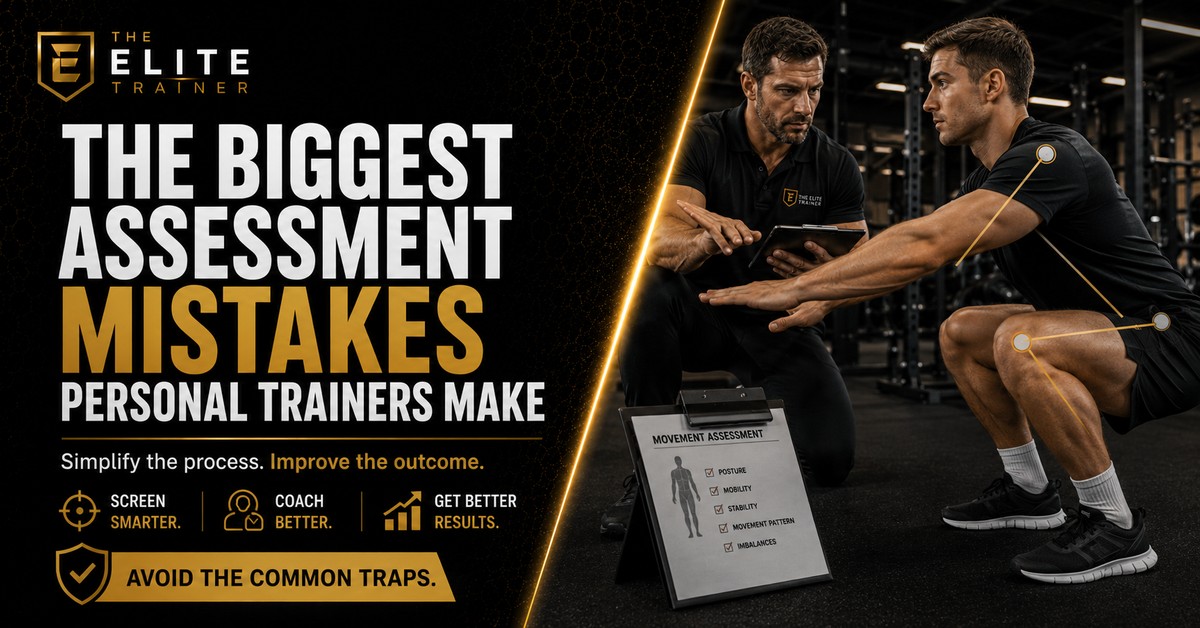
The Biggest Assessment Mistakes Personal Trainers Make
Too many assessments can bury the training process in screens, labels, and data points that do little to improve the program. Explore the biggest mistakes personal trainers make when assessing clients and how to keep evaluations practical, useful, and within scope.
I Don’t Plan to Retire in Four Years… But I Could If I Wanted To
Retirement is not always about age — sometimes it is about options. This career-focused piece looks at business longevity, financial control, and building a fitness career that can support freedom.

Thirty Years as a Personal Trainer: A Day in the Life of a Seasoned Coach
Thirty years in personal training reveals what the career really looks like beyond the highlight reel. Coaching, business, client management, and longevity all show up in a seasoned trainer’s day.