
A simple balance test can reveal useful information about aging and function, but don’t confuse a stopwatch with a biological-age calculator.
Every so often, a chart makes the rounds online that is just believable enough to make you stop scrolling. One of the latest asks a simple question: “What’s your balance age?”
Stand on one leg, time yourself, compare your result with an age chart, and apparently you can discover whether your balance belongs to someone who is 35, 55 or 75. I understand the appeal. The test takes less than a minute, requires no equipment, and balance does decline with age. There is also legitimate research showing that one-leg standing performance can provide useful information about physical function and health.¹˒²
But this is where we need to separate a useful assessment from an entertaining internet score. The one-leg stand can tell you something about your balance. It cannot tell you your biological age.
THE CHART THAT STARTED THIS CONVERSATION
The chart that caught my attention provides separate target times for men and women by decade. A man in his 30s is expected to stand for 59 seconds, for example, while a man over 80 is given a target of 13 seconds.
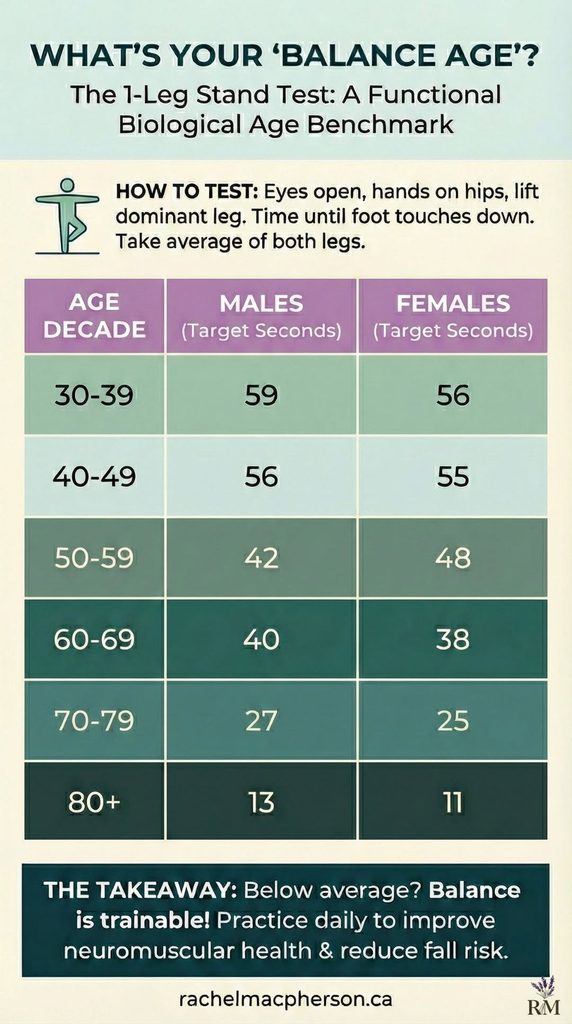
The general direction makes sense: one-leg standing ability tends to decline as we age. Research dating back decades has demonstrated an inverse relationship between age and timed single-leg balance, and more recent normative work confirms the same pattern.¹˒³
The exact numbers on this particular chart are another story. I could not verify those specific age-and-sex targets against the better-established peer-reviewed normative datasets. In one frequently cited study, 549 healthy adults performed the unipedal stance test with their eyes open and closed. Average eyes-open performance declined from roughly 43 seconds among adults 18 to 39, to about 27 seconds at 60 to 69, 15 seconds at 70 to 79, and approximately six seconds among those 80 to 99. The investigators found a strong age-related decline, but gender did not appear to meaningfully determine performance.²
That does not necessarily make every number on the social-media chart wrong. Different testing protocols, stopping rules, surfaces, footwear, arm positions and maximum test durations can produce very different results. It does mean I would not label somebody’s biological age from that chart. Use it as a conversation starter, not a diagnosis.
WHAT THE ONE-LEG STAND ACTUALLY TESTS
At its simplest, the single-leg stance test measures static postural control: your ability to keep your centre of mass over a dramatically reduced base of support.
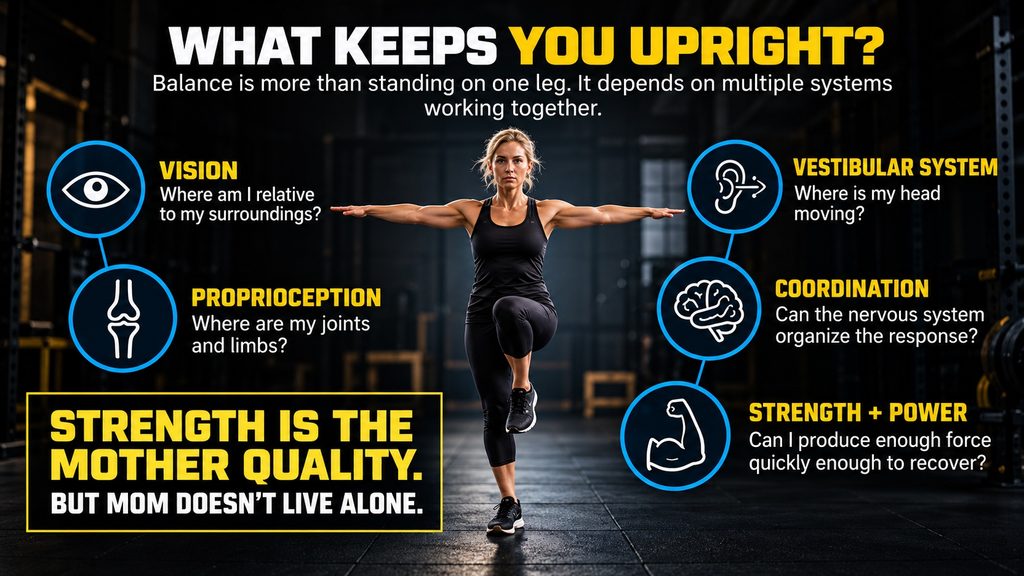
That apparently simple task requires several systems to cooperate. Your eyes provide visual information about your position. The vestibular system in your inner ear contributes information about head movement and orientation. Proprioceptors in muscles, tendons and joints tell the nervous system where your body is in space, while your feet, ankles, hips and trunk make constant muscular corrections to keep you upright.
In other words, balance is not just “strong ankles,” and it is not a single isolated quality. That is also why a poor score does not automatically tell you why someone performed poorly. Was it strength? Coordination? Pain? Reduced sensation? Vision? Vestibular function? Fear? Fatigue? An unfamiliar task?
An assessment gives you information. It should not tempt you into diagnosing something the test cannot diagnose. That principle runs throughout The Personal Trainer’s Blueprint for Assessments: assessment is supposed to improve the training prescription, not become an end in itself. The goal is to determine what a client can safely do, what may need improvement and where the program should begin, not to bury the client in labels and data.
HOW I WOULD PERFORM THE TEST
If you want to try a basic single-leg stance assessment, standardize it as much as possible so your future scores actually mean something.
Stand on a firm, level surface with your eyes open and hands on your hips. Lift one foot off the floor and start the timer. Stop when the raised foot touches the ground or standing leg, the stance foot shifts substantially, or a hand leaves the hip. Then test the other leg.²
For safety, perform the test beside a sturdy counter, wall or rack that you can grab if necessary, particularly if you are older, unfamiliar with balance testing, or have any history of falls. Don’t turn it into an ego contest by closing your eyes, standing on a cushion, holding a weight or climbing onto a wobble board. Those variations do not make the assessment more legitimate. They simply change the test.
Record the conditions along with the time so you can reproduce them later.
TEN SECONDS MAY TELL US SOMETHING IMPORTANT
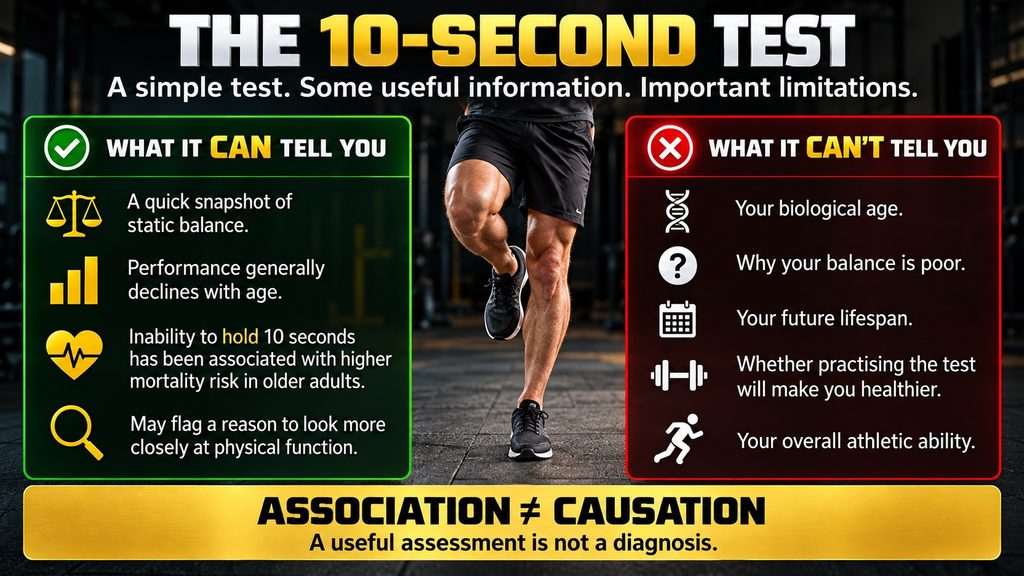
The one-leg test received considerable attention after a 2022 study followed 1,702 adults between 51 and 75 years of age. Participants were asked to maintain a one-legged stance for 10 seconds, and about 20% could not complete it.
Over a median follow-up of seven years, 17.5% of those who could not complete the test died compared with 4.6% of those who could. Even after adjusting for age, sex, body mass index and several health conditions, those unable to perform the 10-second stance had an approximately 84% higher hazard of all-cause mortality during follow-up.⁴
That’s certainly interesting, but this is where internet headlines tend to outrun the science. The study does not show that failing to stand on one leg for 10 seconds causes early death, nor does it prove that practising until you reach 10 seconds will extend your life.
Balance may simply capture several characteristics associated with healthier aging, including physical activity, neurological function, strength, coordination, mobility and general health. Think of it as another piece of information on the dashboard, not the entire engine.
BALANCE IS TRAINABLE, BUT THERE’S A CATCH
This is one area where I would revise some of my older writing.
Years ago, I described balance as “not terribly trainable” and argued that athletes were usually better served spending their limited training time developing other qualities. The practical point behind that argument still has merit, but the broader statement is too strong based on the evidence we have today.
Balance can absolutely improve with training. A systematic review examining single-leg balance training found improvements in balance control with programs ranging from a single 10-minute exposure to much longer training interventions.⁵ Other reviews involving older adults have also found meaningful improvements in static and dynamic balance following exercise.⁶
The catch is specificity. A major review on balance-training specificity found the largest improvements in the tasks that were actually practised, while transfer to untrained balance tasks was considerably smaller.⁷ Later research suggests some transfer can occur, but the overall lesson remains useful: if you practise standing on one leg, you will get better at standing on one leg.
That does not automatically mean you will become equally better at recovering from a trip, skiing down a mountain, changing direction during a tennis match or catching yourself after stepping off a curb. Those are different problems.
DON’T TRAIN THE TEST AND CONFUSE IT WITH HEALTH
This is an important assessment principle.
If I test you today and you can stand on one leg for 12 seconds, then you practise the exact test every morning for six weeks and reach 35 seconds, what have we learned? Your balance on that particular test improved, which is useful, but if the only goal was to make the assessment number look better, we may simply have taught you how to pass the test.
I made this point years ago in Attention All Personal Trainers: Guess, Do Not Assess! A test can improve because someone has become better at performing that specific test, not necessarily because every underlying fitness quality has improved.
Assessment should therefore serve programming. It should never become the program.
STRENGTH IS STILL THE MOTHER QUALITY
I’ve said for years that strength is the mother quality, and I still believe that is one of the most useful principles in program design because strength gives you physical reserve.
If you stumble, you need enough leg and hip strength to catch yourself. If you lose your centre of gravity, you need sufficient force and rate of force development to reposition the body. If you need to climb stairs, rise from a chair, carry groceries or get off the floor, strength gives you options.
In my old Balance Training and a Rock Star series, I described a client whose training revolved around squats, deadlifts, pull-ups, dips, presses and rows. We performed no circus-style balance training, yet his ability to surf and ski improved along with his overall physical capacity. That was an observation, not a controlled experiment, but it shaped the way I thought about programming.
Modern research adds an important qualification. Strength training alone has not consistently shown a superior effect on fall risk, whereas multicomponent programs incorporating strength, balance and functional work have repeatedly demonstrated benefits in older populations.⁸˒⁹
So I would phrase the principle this way today:
Strength is the mother quality, but Mom does not live alone.
Vision, proprioception, vestibular function, coordination, mobility, reaction ability and task-specific practice still matter.
THE PROBLEM WITH “BALANCE TRAINING”
When I criticize balance training, I am not criticizing the act of standing on one leg. I’m criticizing what the fitness industry often does to a simple concept.
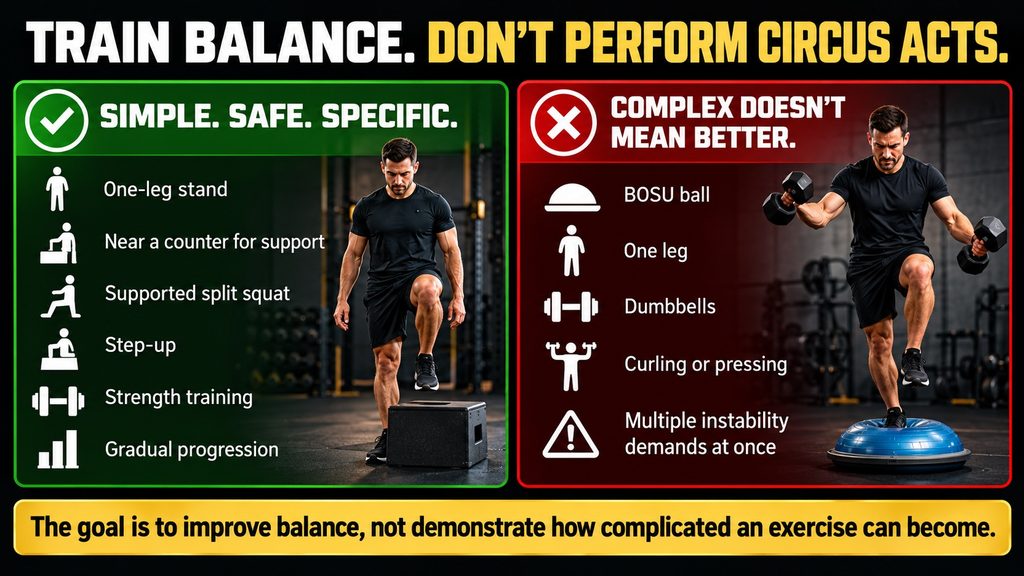
Put somebody on a BOSU ball. Make them stand on one foot. Give them dumbbells. Make them curl. Perhaps have them catch a medicine ball at the same time. Congratulations, you’ve created an exercise that photographs well on Instagram.
But have you created a better training stimulus?
Unstable-surface resistance exercise can increase stabilization demands, but instability generally reduces the amount of external force and power someone can produce. Reviews comparing unstable and stable resistance training have found limited additional benefit from adding unstable surfaces when the objective is improving performance on stable surfaces.¹⁰˒¹¹
That does not mean unstable training is useless. Rehabilitation, certain sports and specific balance applications may justify it, and research in older adults suggests that properly designed instability training can improve some balance and functional outcomes. But there is a big difference between controlled balance practice and loading someone with weights on an unstable device simply because it looks advanced.
WHEN THE RISK EXCEEDS THE REWARD
In Is Balance Training Worth the Risk?, I discussed actress Brooke Shields fracturing her femur after falling from a balance board in a gym. One accident does not prove that balance boards are inherently dangerous, but it illustrates something trainers should always consider:
What happens if this exercise goes wrong?
A 25-year-old athlete stepping off a wobble board may laugh it off. A 70-year-old with reduced bone density may not. The older the client, the less tolerance I have for exercises where the consequence of losing balance is potentially greater than the benefit we’re trying to obtain.
You do not need to expose somebody to a dangerous fall in order to help them avoid falls.
THE SIMPLEST BALANCE EXERCISE I KNOW
For most healthy people, I like something far less exciting: stand on one leg while brushing your teeth.
You already brush your teeth every day, so there is no additional trip to the gym, no equipment and virtually no programming complexity. Stand near the sink or counter so support is immediately available. Start with the easier leg, then switch. Keep your eyes open and use the free hand for the toothbrush rather than putting both hands on your hips.
If necessary, begin with a fingertip touching the counter and gradually reduce assistance. You could also practise while waiting for the kettle to boil or while standing at the kitchen counter.
A few minutes of accumulated single-leg practice can improve the thing you’re practising without stealing meaningful time or recovery resources from your actual training. That’s training economy.

SHOULD EVERYONE PRACTISE BALANCE?
Not necessarily in the same way or to the same degree.
A healthy 25-year-old athlete who runs, jumps, cuts, plays sports and strength trains may already receive plenty of balance challenge through normal activity. Spending 20 minutes wobbling on unstable devices could be a poor use of limited training time.
For an older adult who has become increasingly sedentary, however, maintaining the ability to stand on one leg, walk confidently, step over obstacles and recover from small disturbances has obvious practical value. For older adults, exercise programs emphasizing balance and functional training reduce falls, while programs combining those elements with resistance exercise probably reduce falls as well. In frail older adults, exercise can also improve strength and aspects of mobility and function, although results vary and the optimal program remains uncertain.⁶˒⁸˒⁹
The training should match the need, not the trend.
STATIC BALANCE IS ONLY ONE KIND OF BALANCE
Standing motionless on one leg is static balance, but life frequently demands something else.
You trip over a curb and take a fast recovery step. Someone bumps into you. You slip on ice or reach outside your base of support. Those situations require reactive balance, coordination and rapid force production.
Recent research on perturbation-based balance training, which involves controlled practice recovering from unexpected disturbances, adds another dimension. A 2026 systematic review found that this type of training reduced fall rates by 23% and injurious falls by 24% in older adults, although the certainty of evidence for some outcomes was low.12 That does not mean I’m recommending that the average personal trainer start shoving senior citizens unexpectedly. It means balance is not one single quality, and one static test cannot fully characterize it.
Again, this is why calling one stopwatch result your “balance age” oversells what the test can tell us.
ASSESS, THEN DO SOMETHING USEFUL WITH THE INFORMATION
This is where the test actually becomes valuable.
Suppose a client in their 60s struggles to maintain a one-leg stance for even a few seconds. I would not immediately conclude, “You have the balance of an 85-year-old.” I would ask a much better question:
Does this result change what I do in the gym?
Perhaps I begin with supported split squats, step-ups and other unilateral exercises. I may include some simple single-leg standing practice near a stable support and spend more time on lower-body strength, foot and ankle function, getting up and down from the floor, and movements that build confidence.
Then I observe.
As I discussed in The Biggest Assessment Mistakes Personal Trainers Make, the best trainers continue assessing while they train. Performance tells you whether your prescription is working and whether it needs to be modified.
If the person experiences unexplained dizziness, repeated falls, sudden balance changes, numbness, significant asymmetry or symptoms that extend beyond a trainer’s scope of practice, that is different. Refer out. A trainer’s job is to train, not diagnose neurological or vestibular disorders.
THE BEST ASSESSMENT IS ONE THAT CHANGES THE PROGRAM
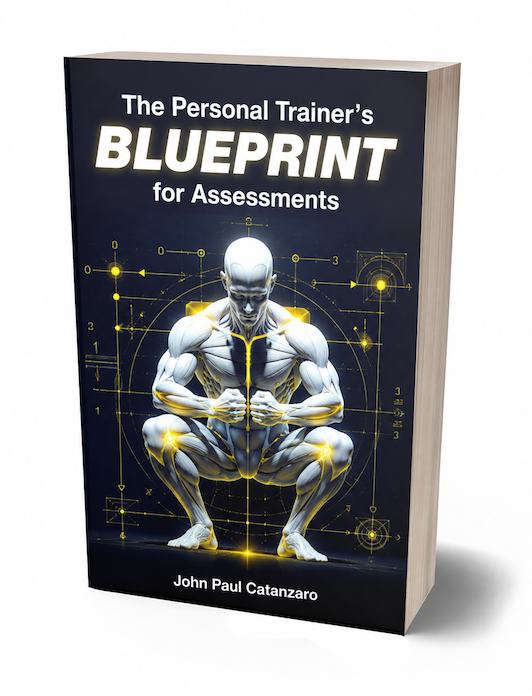
That’s ultimately why I wrote The Personal Trainer’s Blueprint for Assessments.
After three decades of assessing clients, I’ve become far less interested in collecting numbers simply because a textbook says they can be measured. I want information I can use.
A good assessment should tell me what the person can safely do, what qualities deserve attention, where the program should begin, whether the client is improving, and whether anything warrants referral to another professional.
The single-leg stance test can fit perfectly into that philosophy. It is quick, free and requires no special equipment. If the result influences your programming, it has value.
If you merely use it to tell somebody that their “balance age” is 17 years older than their driver’s licence says, you’ve turned an assessment into entertainment.
THE BOTTOM LINE
Your ability to stand on one leg tends to decline with age, and very poor performance may provide useful information about physical function and health. In middle-aged and older adults, inability to maintain a 10-second stance has even been associated with higher subsequent mortality risk.2,4
But a single-leg test is not a biological-age calculator, and a better test score does not automatically mean every aspect of your balance or your health has improved.
Balance is trainable, but much of that improvement is specific to the task being practised. Strength remains foundational, while effective fall prevention and healthy aging involve more than strength alone.
So test your balance if you’re curious, practise it if you need it, keep the exercise appropriate to the person standing in front of you, and don’t turn a useful assessment into a circus act.
The goal isn’t to win the balance test. It’s to stay strong, capable and independent enough to keep winning at life.
ADDITIONAL READING
For more on balance, assessment and intelligent program design, see:
Is Balance Training Worth the Risk?
Balance Training and a Rock Star, Part 1
Balance Training and a Rock Star, Part 2
Balance, Agility, and Plyometric Training for Sport
The Biggest Assessment Mistakes Personal Trainers Make
Attention All Personal Trainers: Guess, Do Not Assess!
WANT THE COMPLETE ASSESSMENT SYSTEM?
The one-leg stand is one assessment. The real skill is knowing what to test, when to test it and what to do with the result.
That’s the focus of my book, The Personal Trainer’s Blueprint for Assessments, a streamlined, practical system developed from three decades of assessing and training real clients. It covers body composition, posture and movement, flexibility and mobility, core strength and stability, muscular endurance, strength, power, aerobic fitness and athletic performance, along with how to interpret the results and turn them into better programs.
References
- Bohannon RW, Larkin PA, Cook AC, Gear J, Singer J. Decrease in Timed Balance Test Scores with Aging. Physical Therapy. 1984;64(7):1067–1070.
- Springer BA, Marin R, Cyhan T, Roberts H, Gill NW. Normative Values for the Unipedal Stance Test with Eyes Open and Closed. Journal of Geriatric Physical Therapy. 2007;30(1):8–15.
- Riis J, Eika F, Blomkvist AW, et al. Lifespan Data on Postural Balance in Multiple Standing Positions. Gait & Posture. 2020;76:68–73.
- Araújo CG, de Souza e Silva CG, Laukkanen JA, et al. Successful 10-Second One-Legged Stance Performance Predicts Survival in Middle-Aged and Older Individuals. British Journal of Sports Medicine. 2022;56(17):975–980.
- Marcori AJ, Monteiro PHM, Oliveira JA, Doumas M, Teixeira LA. Single Leg Balance Training: A Systematic Review. Perceptual and Motor Skills. 2022;129(2):232–252.
- Lesinski M, Hortobágyi T, Muehlbauer T, Gollhofer A, Granacher U. Effects of Balance Training on Balance Performance in Healthy Older Adults: A Systematic Review and Meta-analysis. Sports Medicine. 2015;45:1721–1738.
- Kümmel J, Kramer A, Giboin LS, Gruber M. Specificity of Balance Training in Healthy Individuals: A Systematic Review and Meta-Analysis. Sports Medicine. 2016;46(9):1261–1271.
- Sherrington C, Fairhall NJ, Wallbank GK, et al. Exercise for Preventing Falls in Older People Living in the Community. Cochrane Database of Systematic Reviews. 2019;(1):CD012424.
- de Labra C, Guimaraes-Pinheiro C, Maseda A, Lorenzo T, Millán-Calenti JC. Effects of Physical Exercise Interventions in Frail Older Adults: A Systematic Review of Randomized Controlled Trials. BMC Geriatrics. 2015;15:154.
- Behm DG, Anderson KG. The Role of Instability With Resistance Training. Journal of Strength and Conditioning Research. 2006;20(3):716–722.
- Behm DG, Muehlbauer T, Kibele A, Granacher U. Effects of Strength Training Using Unstable Surfaces on Strength, Power and Balance Performance Across the Lifespan: A Systematic Review and Meta-analysis. Sports Medicine. 2015;45:1645–1669.
- Sharma S, Szabo IZ, Danielsen MB, et al. Perturbation-Based Balance Training Reduces Falls and Fall Injuries in Older People: Insights on Mechanisms and Training Parameters From a Systematic Review. Journal of the American Medical Directors Association. 2026;27(8):106316.
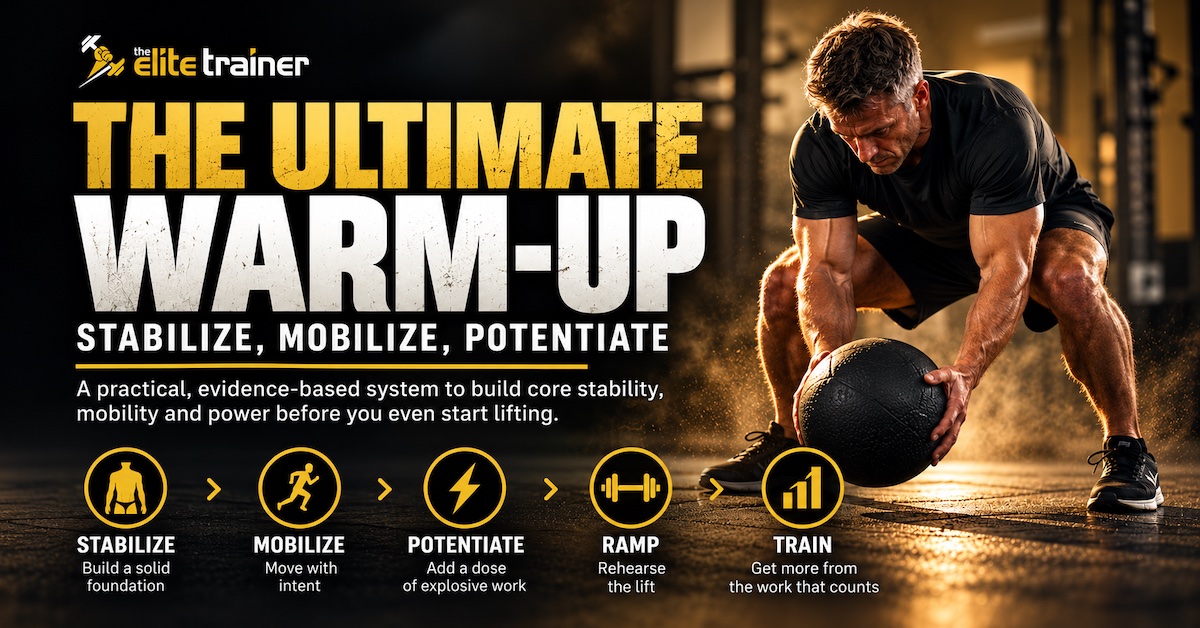
The Ultimate Warm-Up: Stabilize, Mobilize, Potentiate
Most warm-ups either do too little or become workouts of their own. This three-stage system combines core stability, dynamic mobility and explosive potentiation to prepare you for more productive strength training without creating unnecessary fatigue.
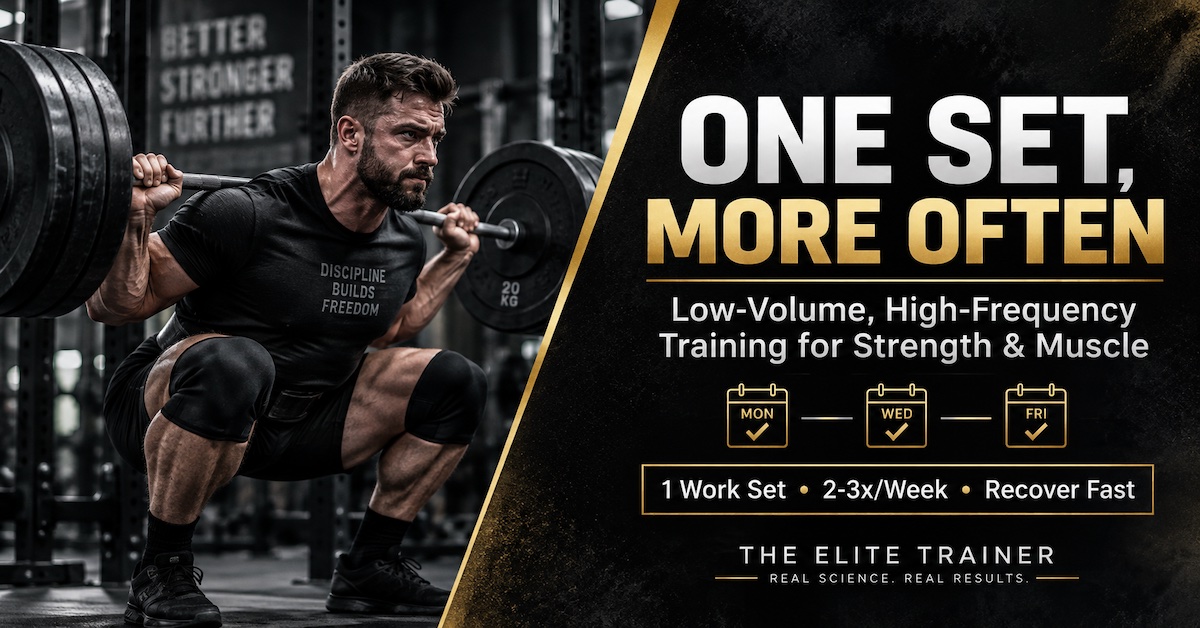
One Set, More Often: The Low-Volume, High-Frequency Method for Strength and Muscle
Can one hard set build serious strength and muscle? Discover how low-volume, high-frequency training uses quality work, faster recovery and frequent exposure to keep progress moving.
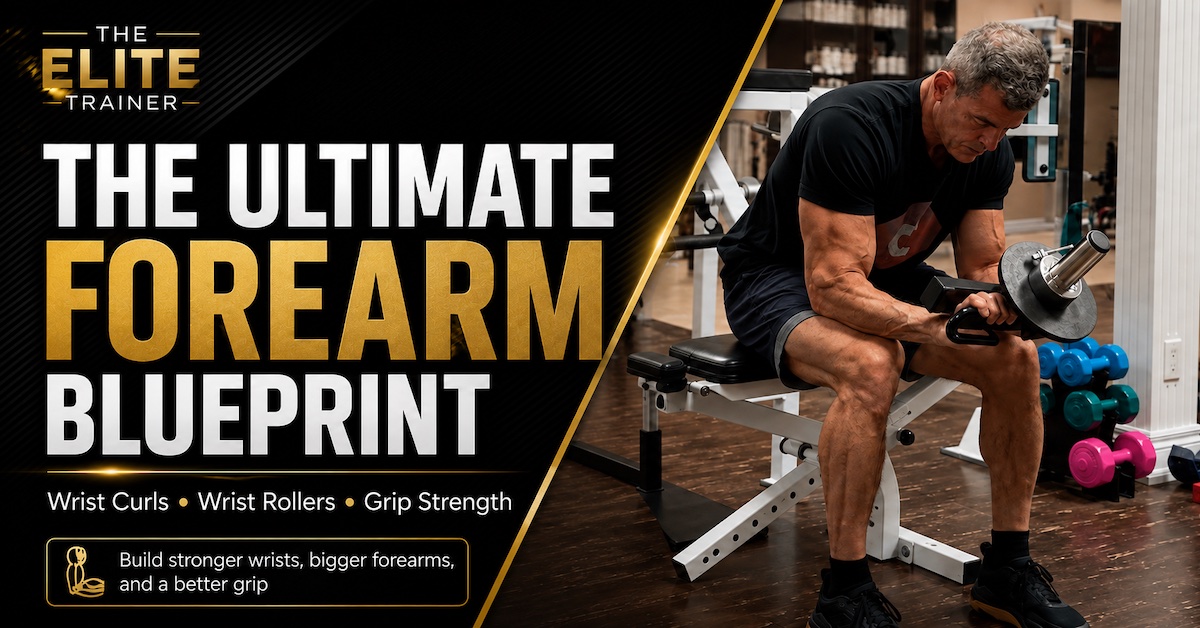
The Ultimate Forearm Blueprint: Wrist Curls, Wrist Rollers & Grip Strength
Most lifters train their forearms as an afterthought. This complete guide covers wrist curls, reverse wrist curls, wrist rollers, radial and ulnar deviation, pronation, supination, The Formulator, and a 10-phase plan for building stronger wrists, bigger forearms, and a better grip.