
Do less at each workout, recover faster, and come back ready to perform again.
We learn more with time, and strength training is no exception. For decades, muscle-building advice revolved around a fairly simple equation: more work equals more growth. Perform enough sets, accumulate enough volume, create enough fatigue, and eventually the body will adapt by getting bigger and stronger.
There is truth in that, but volume is not the entire story. Modern resistance-training research has sharpened our understanding of what actually drives adaptation. Mechanical tension appears to be the primary stimulus behind load-induced skeletal muscle hypertrophy, while many things lifters once treated as major growth mechanisms—extreme soreness, muscle damage, transient hormonal spikes, and simply chasing a massive pump—are better viewed as secondary phenomena rather than goals in themselves.1
That raises an interesting question: what if you could create a high-quality stimulus, stop before fatigue turns productive work into mediocre work, recover quickly, and stimulate the muscle again sooner?
That is the idea behind the method I have been experimenting with lately: one serious work set, then come back and do it again.
Heavy for Strength. Hard for Hypertrophy.
Strength and hypertrophy overlap, but they are not identical adaptations. For maximizing strength, heavier loads have a clear advantage because strength is highly specific to force production. For hypertrophy, however, the picture is more flexible. Muscle can grow across a wide range of loads provided the working sets are sufficiently challenging.2
And “sufficiently challenging” does not necessarily mean crawling out from under the machine after absolute failure. Research examining proximity to failure suggests that getting reasonably close is important, but momentary muscular failure itself is not required to maximize growth.3,4 A recent single-set study in resistance-trained men and women found that both training to failure and stopping approximately two repetitions short produced meaningful muscular adaptations. Failure modestly favoured some hypertrophy outcomes, but strength gains were similar.5
That fits the way I prefer to use this system. Use a serious weight, perform quality repetitions, and as rep speed begins to slow involuntarily and you know there may be only another repetition or two available, shut it down. You stimulated the muscle. You do not have to murder it.
Hot Off the Press: Spread the Work Out
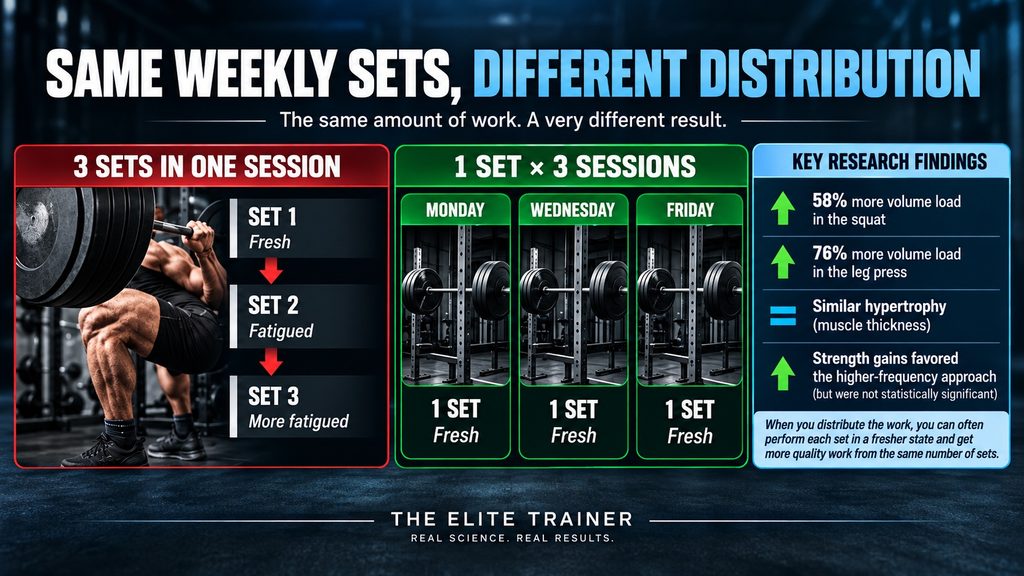
A study published in September 2026 provides one of the most interesting pieces of evidence for this approach. Researchers took trained men and assigned the same weekly number of sets in two different ways. One group performed three sets of each lower-body exercise during one weekly session, while the other performed one set of each exercise across three separate weekly sessions.
The weekly set count was identical, but the distribution produced a striking difference in performance. The group that spread the work across three sessions achieved 58% more volume load in the squat and 76% more in the leg press. Strength improvements numerically favoured the higher-frequency approach on those exercises, although the between-group differences did not reach conventional statistical significance. Muscle thickness increased in both groups without a significant advantage for either strategy.6
That last point is important. This study does not prove that one set three times per week builds more muscle than three sets once per week. What it shows is that when you distribute the work, you may be able to perform each set in a fresher state and get more quality work from the same number of prescribed sets.
That matters.
There is a practical bonus here, too. If you normally spend several sets on the same exercise, this approach can shorten the workout considerably. You can take the time savings and get out of the gym sooner, or use some of that extra capacity to perform another carefully selected exercise and train the muscle from a different angle. Either way, you are trying to get more productive work—not simply more work.
Frequency Is a Tool, Not Magic
There is a biological argument for training a muscle more than once a week. Muscle protein synthesis increases after resistance training and can remain elevated for roughly a day or two depending on training status, the workout, the muscle being studied, nutrition, and other variables. Classic research has shown substantial elevations during the first 24–36 hours after heavy resistance exercise.7
But we should be careful with the way that information gets presented. Muscle protein synthesis returning toward baseline does not mean your muscle suddenly starts wasting away on Wednesday because you trained it Monday. The body is more complicated than that, and an acute MPS response should not be used as a stopwatch telling you precisely when another workout is required.
Training frequency is probably better viewed as a way to distribute productive weekly training. Earlier research suggested that training a muscle twice weekly could outperform once-weekly training for hypertrophy.8 Later analyses, however, found that once total weekly volume is matched, frequency by itself has much less influence.9 The latest dose-response analysis, published in 2026, reached a similar conclusion: increasing weekly volume was positively associated with hypertrophy, while training frequency alone had little additional effect on muscle growth. Strength, on the other hand, showed a clearer positive relationship with greater frequency, probably in part because more frequent exposure also means more opportunities to practise and express the lift while fresh.10
So why train more often? Not because there is some magical 48-hour anabolic alarm clock, but because spreading the work can improve its quality.
The Catch: One Set Is Not Necessarily Optimal
Now we need to address the elephant in the weight room. If one set works, does that mean multiple sets are useless?
Absolutely not. Multiple-set training generally produces greater strength and hypertrophy than a single-set approach when you look at the research as a whole. Older meta-analyses found an advantage for multiple sets,11 and the updated 2026 ACSM position stand—an overview of 137 systematic reviews involving more than 30,000 participants—still concludes that higher weekly volume tends to maximize hypertrophy, with approximately 10 weekly sets per muscle group providing a useful general target.2
The newer dose-response work tells essentially the same story with an important qualification: more volume generally produces more growth, but with diminishing returns.10
That distinction is everything because there is a difference between the minimum effective dose and the maximum useful dose. This article is about finding the former.
For someone short on time, carrying a lot of fatigue, dealing with high life stress, training around cranky joints, or simply looking for a productive lower-volume phase, one quality work set can be incredibly useful. If your sole objective is squeezing every possible millimetre of hypertrophy from a muscle and you have the recovery capacity to support it, more weekly volume may be appropriate.
Different goal. Different dose. Different tool.
Why High Volume Feels So Productive
This is where psychology gets involved. Do six hard sets and leave the gym staggering around with a pump, and you feel like you accomplished something. Do one hard set, put the weight away while you still feel human, and part of your brain wonders whether you did enough.
That feeling can be deceptive. As Sama Hoole has pointed out in his commentary on training volume, doing more work creates a powerful sense of productivity, but the adaptive return does not necessarily increase in proportion to the additional fatigue. The research supports the fatigue side of that argument. A 2025 systematic review found that acute fatigue rises as resistance-training sets move closer to failure and as volume and density increase.12
In other words, the fourth, fifth, and sixth hard sets are not free. They carry a recovery cost, and the real programming question is whether the extra benefit is worth that cost.
Sometimes it absolutely is. Sometimes it is not.
More is not always more. Sometimes more gets you less.
Muscle Swelling Is Not the Same as New Muscle
High-volume training produces another effect that can muddy the picture: swelling. Train a muscle with a lot of volume and it can look considerably larger immediately afterward as fluid shifts and inflammation contribute to the acute increase in muscle thickness.
That is not the same thing as saying high-volume training does not build muscle. It certainly can. In fact, early muscle swelling has even been associated with later hypertrophy in research, suggesting that the relationship is more complicated than simply dismissing the pump as meaningless.13
Other work in trained young men has shown that very high-volume resistance training can produce increases in muscle-fibre size accompanied by substantial changes in sarcoplasmic components.14
The practical lesson is simple: do not mistake looking enormous for 45 minutes after arm training with proof that your program is optimal. But do not mistake the opposite extreme for truth either. The pump is not the goal, but it is also not the enemy.
Doesn’t This Contradict GVT?
On the surface, yes. This sounds almost like the opposite of German Volume Training, and that is precisely why it is worth discussing.
Training methods are tools. A hammer is not wrong because sometimes you need a screwdriver. German Volume Training 2.0 deliberately uses high-volume accumulation phases to create a powerful hypertrophy and work-capacity stimulus, followed by intensification phases that shift the emphasis toward heavier loading and strength. The entire point of GVT 2.0 is that you do not perform endless 10×10 training indefinitely. You move through a structured six-phase system in which volume, intensity, fatigue, and recovery are manipulated over time.
That is periodization, and this one-set approach simply serves a different purpose. GVT creates a deliberately large training stimulus and then gives the body time and structure to adapt to it. Low-volume, high-frequency training creates a smaller hole, lets you fill it quickly, and then gives you another opportunity to train.
Both can work. The mistake is assuming you must choose one philosophy forever.
Research on modified GVT has shown that simply piling on more sets does not automatically produce more hypertrophy or strength; studies comparing five- and ten-set versions found no advantage to the larger dose and, in some outcomes, favoured the lower-volume condition. That does not invalidate GVT as a system—it reinforces why volume must be programmed rather than blindly accumulated.15
That is exactly why I rebuilt traditional GVT into a six-month system instead of telling people to perform 10×10 forever.
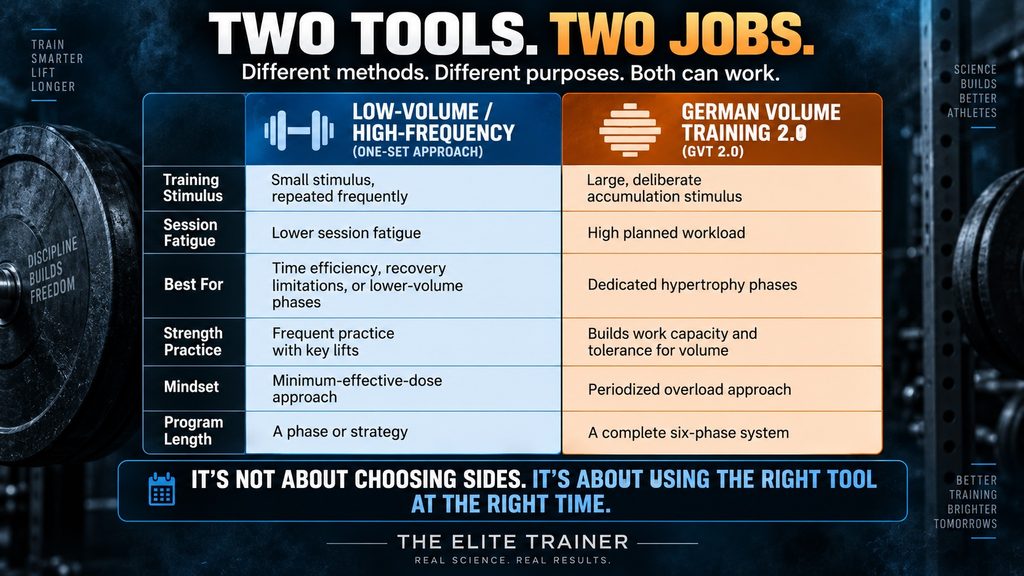
If you have been training hard for years, feel beaten up, are short on time, or need a lower-fatigue block, the one-set approach may be exactly what you need. If you have adapted to low-volume training, your recovery is good, and you need a serious hypertrophy stimulus to break a plateau, that may be the perfect time to swing the pendulum toward something like GVT 2.0.
Good programming is not about loyalty to one method. It is about knowing when to use it.
Dig Small Holes
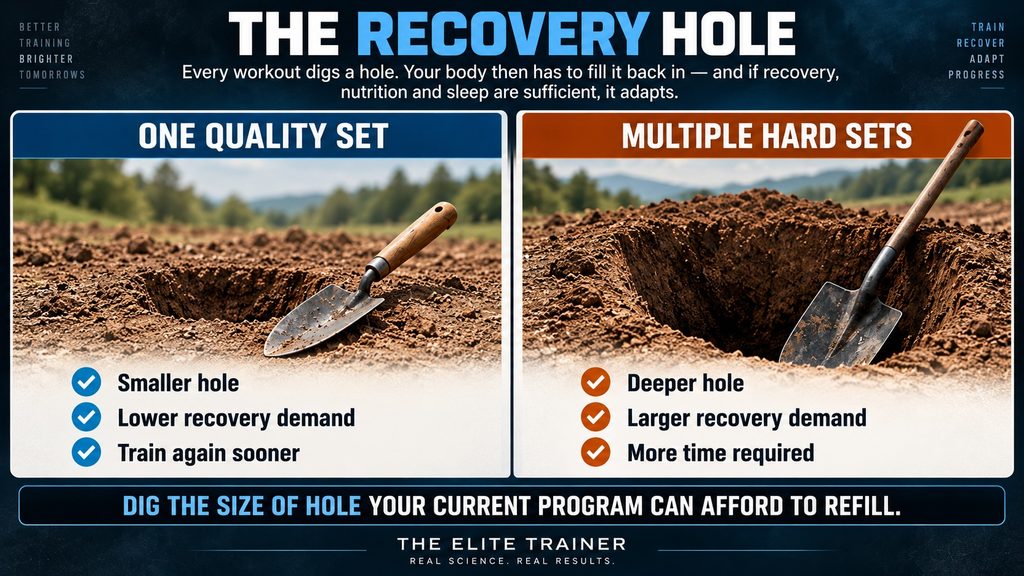
Here is the analogy I use. Imagine every workout requires you to dig a hole. Your body then has to fill that hole back in, and if recovery, nutrition, and sleep are sufficient, it does not simply restore what was lost—it adapts so it can better handle the next training stress.
One hard work set is like digging with a hand trowel. You create a manageable hole, the body fills it, and then a few days later you dig another one. A brutal multi-set workout taken repeatedly to failure is more like attacking the ground with a shovel. You dig a much deeper hole, and that hole requires more resources and more time to fill.
Research on trained lifters illustrates how long recovery from a demanding high-volume session can take. After a workout involving five sets of 10RM leg presses plus four sets of 10RM squats, maximal force and perceived physical readiness remained depressed for two days, while soreness and swelling were still elevated.16
Again, deeper is not automatically bad. Sometimes the deeper hole is exactly what you want. You just need enough time and resources to fill it.
The objective is not to prove how much punishment you can tolerate. Dig the size of hole you can recover from, refill it, and build again. Otherwise, you may literally be digging yourself into the ground.
The Hidden Benefit: You Leave Fresh
This is what surprised me most when I started experimenting with the method. I have been injured plenty of times over the years, and very often the problem appeared late in an exercise—not on the first work set, but after fatigue had accumulated.
That is an observation, not a controlled study, and I do not want to pretend otherwise. We do not have evidence showing that “one set prevents injuries,” but it is reasonable to recognize that fewer fatiguing work sets mean fewer repetitions performed while highly fatigued. Research also shows that proximity to failure and greater training volume increase acute neuromuscular and perceptual fatigue.12
For me, the practical result has been encouraging. I perform several progressive warm-up sets where necessary, gradually ramp the weight, perform one serious work set, record the result, and move on. Strength continues to progress, my size has held well and may have increased in some areas, and most importantly, I leave the gym feeling like I could train again rather than feeling like someone threw me down a flight of stairs.
At first, the whole thing can feel almost too easy—not because the work set was easy, but because you are no longer using exhaustion as proof that the workout was productive.
That takes some getting used to because many experienced lifters have learned to associate exhaustion with productivity. A productive workout, however, does not have to ruin the rest of your day.
One Work Set Does Not Mean One Set Total
This distinction is critical. When I say one set, I mean one work set.
If I am squatting, pressing, deadlifting, or performing another exercise where I need preparation before hitting a serious load, I still warm up. Those warm-up sets gradually rehearse the movement, increase readiness, and allow me to assess how the body feels that day. They should prepare you, not exhaust you.
Think of them as the runway leading to the set that counts. For more detail on that subject, my warm-up material goes much deeper into how to ramp properly without turning the warm-up into another workout.
Practice Still Requires Repetitions
There is another reason I would not hand this program to every beginner and tell them to perform one set forever: strength is a skill. Learning how to squat, press, row, deadlift, and perform pull-ups requires repetition. You need enough high-quality practice to develop technique, coordination, confidence, and consistency.
You need to put in the time and get enough quality repetitions under your belt to build both the skill and the structure. Once that foundation is established and your strength increases, you may be able to get far more out of fewer work sets.
That is why the training age of the lifter matters. Beginners often need more practice, while intermediate lifters need enough volume to continue developing both muscular and technical qualities. An experienced lifter who has accumulated tens of thousands of repetitions may be able to produce an enormous stimulus from one highly focused work set because the skill is already established and the loads are substantial.
The stronger you become, the more expensive each hard set becomes. That changes the equation and is one reason I have long emphasized moderate programming for long-term lifters: enough tension, enough repetition, enough work—but not mindless work for its own sake.
How to Use the One-Set Method
For most exercises, I like a range of approximately 5–10 repetitions. Some exercises fit better at the higher end. Leg extensions, wrist curls, lateral raises, and similar movements may work well around 10–20 reps, while exercises such as front squats and deadlifts often make more sense at roughly 4–6.
The work set should usually finish with approximately one or two good repetitions in reserve. If technique begins to deteriorate or rep speed slows dramatically, the set is over. Once you reach the top of the prescribed repetition range with good form, increase the load slightly at the next workout and return toward the lower end.
Do not force progression. Sometimes you increase the weight because you got stronger; other times you need to get stronger before you increase the weight. Patience matters.
A simple framework looks like this:
| Variable | Prescription |
|---|---|
| Work sets | 1 per exercise |
| Exercises | Approximately 6–8 per workout |
| Warm-up sets | 0–3 as required before the work set |
| Repetitions | Usually 5–10; adjust by exercise |
| Effort | Generally 1–2 reps in reserve |
| Frequency | Each muscle roughly 2× weekly; selected cases 3× |
| Progression | Add reps first, then load |
| Workout duration | Usually well under 60 minutes |
Do not confuse this with classic HIT or Heavy Duty training. One set taken near failure is very different from one extended torture session involving forced reps, negatives, rest-pause work, drop sets, partials, and every other intensity technique you can cram into one set.
The objective is a high-quality stimulus with a favourable stimulus-to-fatigue ratio—not survival.
Full Body or Upper/Lower?
There are two easy ways to organize it. A three-day full-body schedule works particularly well when you want frequent practice, moderate weekly training frequency, and plenty of recovery days. Monday, Wednesday, and Friday is the obvious real-world setup.
For stronger lifters using heavier loads, I often prefer an upper/lower approach performed four times per week. That provides two exposures per muscle group without requiring three full-body sessions—for example, upper body Monday and Thursday, lower body Tuesday and Friday.
The muscle may be capable of being trained again relatively quickly, but connective tissues, joints, systemic fatigue, and simply life outside the gym also need to be respected. Recovery is not just a muscle-protein-synthesis graph.
What About Older Lifters?
Low-volume training can be attractive as we get older because time, joints, outside responsibilities, and recovery all become more important. But there is a trap here: do not interpret that to mean older people should barely train.
Research in older adults makes it very clear that resistance training remains enormously valuable, and at least one controlled study suggests that older adults may require a higher maintenance dose than younger adults to preserve training-induced muscle hypertrophy.17
So the goal is not to undertrain. The goal is to remove unnecessary work while keeping the work that matters. That becomes increasingly valuable as training age—not just chronological age—increases.
Minimum Effective Does Not Mean Maximum Possible
This is the concept I want you to remember: a one-set approach is not a declaration that one set is the scientifically proven optimum for everyone. It is a minimum-effective-dose strategy, and that alone makes it tremendously valuable.
Time is one of the most commonly cited barriers to exercise, and research specifically examining time-efficient resistance training supports the idea that meaningful improvements can be achieved with surprisingly modest training doses when the important movements and effort levels are prioritized.18
That may be all a busy executive needs. It may be the perfect bridge between demanding programs, ideal during a calorie deficit, or well suited to an experienced lifter who can produce tremendous tension with one set. It may also be exactly what you need after a demanding GVT cycle.
Eventually, when your body has adapted and you are ready for a different challenge, you can increase the dose again.
That is programming.
No Pain, All Gain
Lee Haney had one of the best sayings in bodybuilding: “Stimulate, don’t annihilate.” There may be no better summary of this method.
Create enough tension to give the body a reason to adapt, then stop before fatigue turns the workout into punishment. Recover and come back ready to do it again. At first, you may walk out of the gym feeling strangely fresh and wonder whether you did enough, but then the logbook starts moving—another rep, another few pounds, another clean performance.
Eventually, you realize something that experienced lifters tend to learn the hard way: the workout that feels the hardest is not always the workout that works the best.
Results are the scoreboard, not exhaustion.
Additional Reading
For related approaches to training volume, intensity, recovery, and long-term program design, see Moderate Rules for Maximum Results, The Last Set: A Synergistic Combination of Volume and Intensity in Strength Training, Periodization vs. Programming: Are Researchers Testing the Right Thing?, The Ultimate Pull-Up Blueprint, and Why Most GVT Books Give You a Routine — and German Volume Training 2.0 Gives You a System.
References
- Van Every DW, Lees MJ, Wilson B, Nippard J, Phillips SM. Load-induced human skeletal muscle hypertrophy: Mechanisms, myths, and misconceptions. Journal of Sport and Health Science. 2026.
- Currier BS, D’Souza AC, Fiatarone Singh MA, et al. American College of Sports Medicine Position Stand: Resistance Training Prescription for Muscle Function, Hypertrophy, and Physical Performance in Healthy Adults: An Overview of Reviews. Medicine & Science in Sports & Exercise. 2026.
- Refalo MC, Helms ER, Trexler ET, Hamilton DL, Fyfe JJ. Influence of Resistance Training Proximity-to-Failure on Skeletal Muscle Hypertrophy: A Systematic Review with Meta-analysis. Sports Medicine. 2023.
- Grgic J, Schoenfeld BJ, Orazem J, Sabol F. Effects of resistance training performed to repetition failure or non-failure on muscular strength and hypertrophy: A systematic review and meta-analysis. Journal of Sport and Health Science. 2022.
- Hermann T, Mohan AE, Enes A, et al. Without Fail: Muscular Adaptations in Single-Set Resistance Training Performed to Failure or with Repetitions-in-Reserve. Medicine & Science in Sports & Exercise. 2025.
- Calzavara J, Barroso R. Effects of Weekly Set Distribution on Volume Load, Lower-Body Strength, and Quadriceps Muscle Thickness in Trained Men. Journal of Strength and Conditioning Research. 2026.
- MacDougall JD, Gibala MJ, Tarnopolsky MA, et al. The time course for elevated muscle protein synthesis following heavy resistance exercise. Canadian Journal of Applied Physiology. 1995.
- Schoenfeld BJ, Ogborn D, Krieger JW. Effects of Resistance Training Frequency on Measures of Muscle Hypertrophy: A Systematic Review and Meta-Analysis. Sports Medicine. 2016.
- Schoenfeld BJ, Grgic J, Krieger J. How many times per week should a muscle be trained to maximize muscle hypertrophy? A systematic review and meta-analysis of studies examining the effects of resistance training frequency. Journal of Sports Sciences. 2019.
- Pelland JC, Remmert JF, Robinson ZP, Hinson SR, Zourdos MC. The Resistance Training Dose Response: Meta-Regressions Exploring the Effects of Weekly Volume and Frequency on Muscle Hypertrophy and Strength Gains. Sports Medicine. 2026.
- Krieger JW. Single vs. multiple sets of resistance exercise for muscle hypertrophy: a meta-analysis. Journal of Strength and Conditioning Research. 2010.
- Varela-Olalla D, del Campo-Vecino J, Balsalobre-Fernández C. Influence of Proximity to Failure, Relative Intensity, and Volume on Voluntary Performance and Fatigue Symptoms After Resistance Training: A Systematic Review. Journal of Strength and Conditioning Research. 2025.
- Hirono T, Ikezoe T, Taniguchi M, et al. Relationship Between Muscle Swelling and Hypertrophy Induced by Resistance Training. Journal of Strength and Conditioning Research. 2022.
- Haun CT, Vann CG, Osburn SC, et al. Muscle fiber hypertrophy in response to 6 weeks of high-volume resistance training in trained young men is largely attributed to sarcoplasmic hypertrophy. PLoS ONE. 2019.
- Amirthalingam T, Mavros Y, Wilson GC, et al. Effects of a Modified German Volume Training Program on Muscular Hypertrophy and Strength. Journal of Strength and Conditioning Research. 2017.
- Ahtiainen JP, Lehti M, Hulmi JJ, et al. Recovery after heavy resistance exercise and skeletal muscle androgen receptor and insulin-like growth factor-I isoform expression in strength trained men. Journal of Strength and Conditioning Research. 2011.
- Bickel CS, Cross JM, Bamman MM. Exercise dosing to retain resistance training adaptations in young and older adults. Medicine & Science in Sports & Exercise. 2011.
- Iversen VM, Norum M, Schoenfeld BJ, Fimland MS. No Time to Lift? Designing Time-Efficient Training Programs for Strength and Hypertrophy: A Narrative Review. Sports Medicine. 2021.

The Ultimate Warm-Up: Stabilize, Mobilize, Potentiate
Most warm-ups either do too little or become workouts of their own. This three-stage system combines core stability, dynamic mobility and explosive potentiation to prepare you for more productive strength training without creating unnecessary fatigue.

How Old Is Your Balance? What the One-Leg Stand Test Can and Can’t Tell You
Can standing on one leg reveal your ‘balance age’? Learn what the one-leg stand test really tells you about aging, fall risk and balance, and why strength still matters.

The Ultimate Forearm Blueprint: Wrist Curls, Wrist Rollers & Grip Strength
Most lifters train their forearms as an afterthought. This complete guide covers wrist curls, reverse wrist curls, wrist rollers, radial and ulnar deviation, pronation, supination, The Formulator, and a 10-phase plan for building stronger wrists, bigger forearms, and a better grip.