
Aerobic exercise is good for you. But more is not automatically better, and for many people, weights plus walking already cover a lot of ground.
I’ve never been a big fan of doing cardio just for the sake of doing cardio. That does not mean aerobic exercise is useless. Regular physical activity improves cardiovascular health, aerobic fitness, metabolic health and longevity. The better question is whether somebody who already trains with weights several times a week and stays active throughout the day needs to keep piling formal cardio sessions on top.
My answer usually depends on one thing: What are you trying to accomplish?
Do a hard set of squats, deadlifts, lunges or loaded carries and your heart rate and breathing will tell you that resistance training has a cardiovascular and respiratory component. At the same time, you are building or preserving muscle, strength, bone and connective tissue. That does not make lifting equivalent to dedicated aerobic training. Aerobic exercise generally produces greater improvements in cardiorespiratory fitness such as VO₂max, but that is very different from saying everybody needs hours of formal cardio every week.
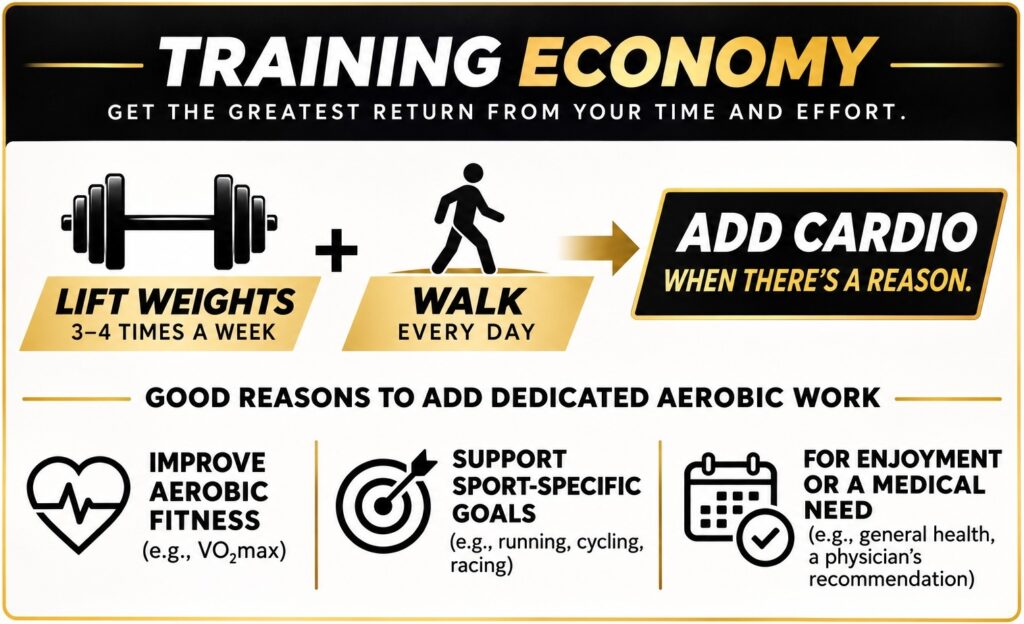
For most people who are not training for an endurance event, I prefer a simpler approach:
- Lift weights three or four times a week.
- Walk every day.
- Add dedicated aerobic work if your goals, health, sport or enjoyment justify it.
- If you still have time and recovery capacity, use it where you need it most: more aerobic work, mobility, yoga, Pilates, core work or simply more recovery.
I call that training economy: getting the greatest return from the time and effort you invest.
WEIGHTS DO MORE THAN BUILD MUSCLE
Years ago, I wrote Get More From Weights Than Aerobics, and I still believe strongly in the basic premise. Resistance training gives you an unusually large return on your training investment because one session can improve strength, preserve or build muscle, challenge the cardiovascular system, improve body composition and help maintain physical capacity as you age.
What I would qualify today is the idea that weights completely replace aerobic exercise. They don’t. If your goal is to maximize aerobic capacity, run a marathon, improve cycling performance or become a better endurance athlete, you need to train that quality specifically. Concurrent aerobic and resistance training can also work very well together when programmed intelligently. Current reviews generally find that combining the two does not meaningfully compromise hypertrophy or maximal strength, although fatigue management and some explosive or lower-body adaptations can become more sensitive as training demands rise.
If your priorities are strength, muscle, body composition, metabolic health and staying functional, however, resistance training should occupy a large part of the foundation. Then walk.
Walking may be the most underappreciated form of cardio precisely because it does not feel hard enough to count. It creates very little fatigue, requires minimal recovery and can be accumulated throughout the day. Walking after meals can also reduce post-meal glucose excursions, and you do not necessarily need a 60-minute block to benefit. Ten or fifteen minutes after meals, several short walks throughout the day, or one longer walk after dinner can all contribute. That is an excellent return for a very small recovery cost.
CARDIO AND FAT LOSS: AN IMPORTANT UPDATE
I published Cardio Can Make You Fat more than a decade ago. The title still gets attention, but I would explain the mechanism differently today.
Aerobic exercise does not inherently make you gain fat. Controlled trials generally show reductions in body weight, waist circumference and body fat when aerobic exercise is added, with larger weekly volumes often producing larger reductions. What still holds up is the warning that doing more cardio does not guarantee proportional fat loss. The human body compensates.
Some people become hungrier when they exercise more. Others unconsciously reduce their activity during the rest of the day. Energy expenditure and food intake can both change, which helps explain why actual weight loss from exercise is often smaller than a simple calculation of “calories burned” would predict.
There is also a programming issue. If increasingly large amounts of cardio begin to interfere with the quality of your resistance training, recovery or muscle retention while dieting, you may be working harder without improving the final result. Cardio does not magically make you fat, but more cardio is not automatically a better fat-loss strategy either.
YOU DON’T NEED TO GET TIRED BEFORE YOU START LIFTING
Another place where cardio is often used unnecessarily is the warm-up. In Insane Health & Fitness Traditions, I questioned the traditional approach of spending a long time on a treadmill, bike or elliptical before lifting, and I still do.
A warm-up should prepare you for what you are about to do, not become another workout. Research on aerobic exercise performed before resistance training shows that longer or harder aerobic work can acutely reduce subsequent strength performance. The practical solution is straightforward: if you are about to squat, warm up to squat. Increase temperature, move the relevant joints, rehearse the pattern and progressively increase the load rather than arriving at your first work set already fatigued.
A few easy minutes on a bike or treadmill are not the problem. Turning the warm-up into a separate cardio workout can be.
WHAT ABOUT YOUR JOINTS?
This is another area where we need to avoid going too far in either direction. It would be inaccurate to say that running automatically destroys your knees. In fact, large reviews have found a lower prevalence of hip and knee osteoarthritis among recreational runners than among sedentary controls.
The picture becomes less reassuring at much higher exposures. Competitive and very high-volume runners have shown higher rates of osteoarthritis than recreational runners, although previous injuries and other factors make it difficult to determine how much of that relationship is caused by running itself. The important consideration is not that every step damages a joint, but that total loading matters.
Someone already performing several demanding resistance sessions each week, playing a sport and spending considerable time on their feet is accumulating a lot of physical stress before another long run is added. Cycling, swimming and other lower-impact forms of aerobic exercise create a different loading profile, so this is not an argument against cardio. It is another reason to ask whether additional work has a purpose.
CARDIO IS MEDICINE. EXTREME ENDURANCE IS A DIFFERENT DOSE.
Regular exercise is unquestionably good for cardiovascular health. What deserves more scrutiny is the assumption that if some exercise is healthy, enormous amounts must always be even healthier.
Recent reviews of long-term endurance exercise have raised legitimate questions about the far end of the spectrum. Veteran endurance athletes appear to have higher rates of atrial fibrillation, and very high lifetime endurance exposure has been associated in some studies with coronary calcification, greater atherosclerotic plaque burden and myocardial fibrosis. These findings should not be interpreted to mean that jogging several times a week is damaging your heart. We are talking about years of very high training volumes, repeated endurance events and accumulated exposure.
Even there, the picture is nuanced. A 2025 meta-analysis found more coronary atherosclerosis among endurance athletes than controls, but not more high-risk or obstructive plaque. The long-term clinical meaning of myocardial fibrosis in endurance athletes also remains unsettled. Exercise can clearly produce profound cardiovascular adaptation; the open question is whether, in susceptible people and under certain conditions, extremely high exposure can eventually produce maladaptive changes as well.
Mortality data give us another reason not to exaggerate the concern. A recent systematic review found limited evidence for the idea that mortality eventually rises again at very high exercise doses. The benefits appear more likely to plateau than suddenly reverse into harm. Similarly, vigorous physical activity continues to be associated with lower all-cause, cardiovascular and cancer mortality, although each additional amount appears to provide progressively smaller returns.
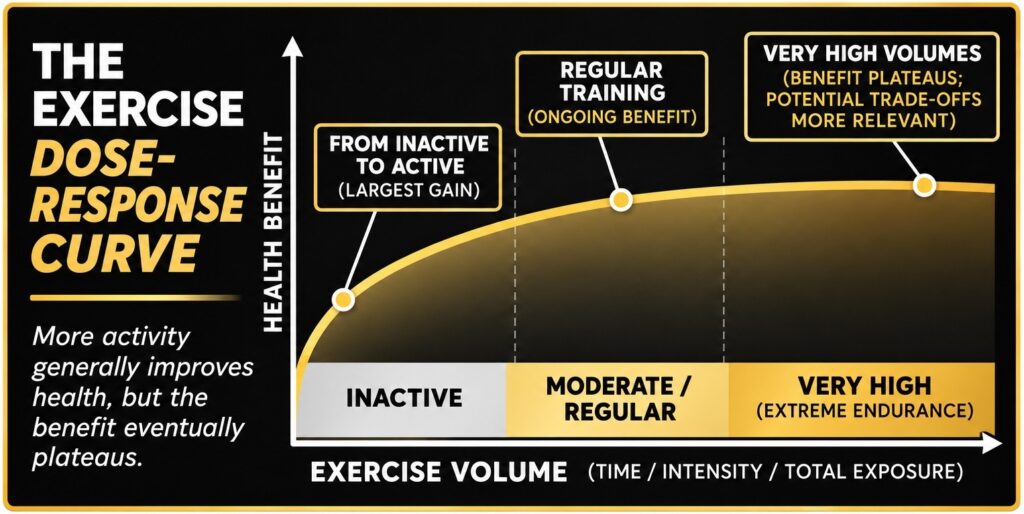
That may be the most useful way to think about it: more can stop meaning better before it necessarily starts meaning worse. If you love endurance sport, additional training may be entirely worthwhile. But if your goal is general health, strength and body composition, spending substantially more time to squeeze out an increasingly small additional benefit may not be the best use of your training resources.
THE COLON-CANCER CLAIM THAT CAUGHT MY ATTENTION
I recently heard an argument on The Human Upgrade podcast suggesting that chronic endurance exercise might increase colon-cancer risk because blood is repeatedly diverted away from the gastrointestinal tract and toward working muscle. That caught my attention immediately because of my family history of colon cancer, something I have discussed previously in I Should Have Been Dead by Now and Meat: A Friend, Not a Foe.
After looking into the claim more closely, however, I would not use it as an argument against cardio. Strenuous endurance exercise certainly changes gastrointestinal blood flow and can cause gastrointestinal symptoms, but that does not establish that endurance exercise increases colon-cancer risk.
The broader epidemiological evidence points in the opposite direction. The National Cancer Institute reports that people with the highest levels of physical activity have had substantially lower colon-cancer risk than the least active, and several plausible mechanisms may contribute, including effects on insulin, inflammation, body weight and gastrointestinal transit time.
The podcast claim was worth investigating, especially given my family history, but the evidence does not support making the leap from temporary changes in blood flow during strenuous exercise to increased colon-cancer risk. That part of the original idea does not belong in the case against excessive cardio.
WHEN SHOULD YOU ADD MORE CARDIO?
If you enjoy running, cycling, swimming, rowing or hiking, keep doing it. Enjoyment is a legitimate reason to exercise. If you compete in an endurance sport, you obviously need endurance training, and if improving VO₂max is a major goal, dedicated aerobic work is the most direct tool. A physician may also recommend aerobic training for specific health reasons.
What I would avoid is adding cardio simply because you believe a workout does not count unless another 30 or 45 minutes is spent on a machine afterward. For the average person who wants to be lean, strong, healthy and functional, my preferred starting point remains simple: lift three or four times a week and walk every day.
From there, assess what is actually missing. You may benefit from more aerobic fitness, mobility work, core training, another walk or simply more recovery. Training should not become a contest to see how much exercise you can tolerate. The goal is to apply enough stress to create the adaptation you want without spending recovery capacity on work that does not move you closer to that goal.
THE BOTTOM LINE
I am not anti-cardio. I am anti-automatic cardio, the idea that more exercise should be added simply because more sounds healthier.
Resistance training gives you a cardiovascular stimulus while accomplishing things traditional cardio cannot. Walking adds low-cost daily activity with very little recovery burden. Together, those habits provide a strong foundation for most people, while dedicated aerobic work can be added when there is a clear reason for it.
At the far end of the endurance spectrum, the picture becomes more complicated. Very high lifetime training volumes may carry cardiovascular and orthopedic trade-offs in some people, even though physical activity as a whole remains strongly associated with better health and longer life.
The goal is not to perform the most exercise. The goal is to get the most from the exercise you perform.
RESEARCH & SOURCES
- An J, Su Z, Meng S. Effect of aerobic training versus resistance training for improving cardiorespiratory fitness and body composition in middle-aged to older adults: A systematic review and meta-analysis of randomized controlled trials. Archives of Gerontology and Geriatrics, 2024.
View study on PubMed - Schumann M, et al. Compatibility of Concurrent Aerobic and Strength Training for Skeletal Muscle Size and Function: An Updated Systematic Review and Meta-Analysis. Sports Medicine, 2022.
View study on PubMed - Engeroff T, Groneberg DA, Wilke J. After Dinner Rest a While, After Supper Walk a Mile? A Systematic Review with Meta-analysis on the Acute Postprandial Glycemic Response to Exercise Before and After Meal Ingestion. Sports Medicine, 2023.
View study on PubMed - Jayedi A, et al. Aerobic Exercise and Weight Loss in Adults: A Systematic Review and Dose-Response Meta-Analysis. JAMA Network Open, 2024.
View study on PubMed - Dhurandhar EJ, et al. Predicting adult weight change in the real world: a systematic review and meta-analysis accounting for compensatory changes in energy intake or expenditure. International Journal of Obesity, 2015.
View study on PubMed - Eddens L, van Someren K, Howatson G. The Role of Intra-Session Exercise Sequence in the Interference Effect: A Systematic Review with Meta-Analysis. Sports Medicine, 2018.
View study on PubMed - Alentorn-Geli E, et al. The Association of Recreational and Competitive Running With Hip and Knee Osteoarthritis: A Systematic Review and Meta-analysis. Journal of Orthopaedic & Sports Physical Therapy, 2017.
View study on PubMed - Abdullah SM, et al. Extreme endurance training and coronary artery disease: A systematic review and a meta-analysis. International Journal of Cardiology, 2025.
View study on PubMed - Saulicz A, Abernethy D, Wraith D. Can too much exercise kill you? A systematic review of the risk of a cardiovascular event or death from long term strenuous exercise. European Journal of Epidemiology, 2026.
View study on PubMed - National Cancer Institute. Physical Activity and Cancer Fact Sheet.
View the National Cancer Institute resource

The Ultimate Warm-Up: Stabilize, Mobilize, Potentiate
Most warm-ups either do too little or become workouts of their own. This three-stage system combines core stability, dynamic mobility and explosive potentiation to prepare you for more productive strength training without creating unnecessary fatigue.

How Old Is Your Balance? What the One-Leg Stand Test Can and Can’t Tell You
Can standing on one leg reveal your ‘balance age’? Learn what the one-leg stand test really tells you about aging, fall risk and balance, and why strength still matters.

One Set, More Often: The Low-Volume, High-Frequency Method for Strength and Muscle
Can one hard set build serious strength and muscle? Discover how low-volume, high-frequency training uses quality work, faster recovery and frequent exposure to keep progress moving.