
Sleep hygiene can help you fall asleep. Sleep maintenance is what keeps you there.
If you’ve ever said, “I can fall asleep just fine, but I can’t stay asleep,” you’re not alone.
That complaint becomes increasingly common with age. You drift off without much trouble, only to find yourself staring at the ceiling at 2:00 or 3:00 in the morning wondering what happened. Sometimes you fall back asleep. Sometimes you don’t. Either way, you wake up feeling like you only rented your sleep instead of owning it.
That distinction matters because falling asleep and staying asleep are not always the same problem.
I’ve written a lot over the years about basic sleep hygiene and foundational sleep strategies. If you need a refresher, start with The Power of Sleep: The Most Crucial Intervention for Athletic Recovery and Performance, 6 Tips for a Good Night’s Sleep, 3 Tips to Improve Your Sleep, and Enhance Your Sleep Quality: The Simple Sleep Hack of Opening Your Window.
Those principles still matter. A lot. But this article is different. This one is about sleep maintenance: what helps you stay asleep once your head hits the pillow.
Why Staying Asleep Gets Harder With Age
For many people, the first sleep battle is getting into bed on time. The second is quieting the mind enough to drift off. As the years go by, a third battle often appears: remaining asleep through the night.
There are several reasons for this. Stress chemistry tends to run higher in some people as they age. Cortisol and adrenaline can remain elevated into the evening, especially in hard-driving personalities with busy brains. Sleep also becomes lighter and more fragmented. Add in late fluid intake, alcohol, a heavy dinner, blood-sugar swings, room temperature, light exposure and bathroom trips, and you have the perfect recipe for broken sleep.
The point is simple: if you only attack sleep onset and ignore sleep maintenance, you may solve only half the problem.
Start With the Basics First
Before you chase advanced solutions, make sure the obvious sleep hygiene pieces are in place.
Start dimming lights at night. Use blue blockers after sunset if needed. Shut down stimulating electronics a couple of hours before bed. Reduce caffeine and other stimulants later in the day. Open the windows for cool, fresh air if conditions allow. Take a hot shower or bath before bed. Read a book or listen to relaxing music to unwind. Make the bedroom as cave-like as possible: dark, cool and quiet. And keep a regular schedule. When the sun goes down, so should you. When the sun rises, so should you.
These strategies often do a good job of helping people fall asleep. In fact, many sleep problems begin improving when you simply become more disciplined with evening habits. Articles like Evening Yoga Improves REM Sleep and Intense Sunlight Promotes Deep Sleep reinforce just how powerfully lifestyle can influence sleep quality.
Still, none of that guarantees you will stay asleep.
Falling Asleep and Staying Asleep Are Two Different Problems
This is where many people get tripped up.
If your main issue is a racing mind before bed, the solution may be to reduce stimulation, lower stress chemistry and create a calmer transition into sleep. If your main issue is waking up during the night, however, the solution may have more to do with fluid balance, digestion, alcohol intake, nighttime blood-sugar stability or the specific supplements you use.
In other words, you need to identify the right mechanism.
That is why treating every sleep complaint with the same old advice can miss the mark.
The Biggest Reasons People Wake Up in the Middle of the Night
A few culprits show up again and again.
Too much fluid before bed
This is the obvious one. If you pound fluids late at night, don’t be surprised if your bladder clocks in for an overnight shift. For some people, even “healthy hydration” can become unhealthy timing.
Some people experiment with a small amount of salt before bed in an attempt to improve fluid retention, but I would not treat this as a universal strategy. If nighttime urination is a recurring problem, fluid timing and the underlying cause deserve more attention, particularly if you have high blood pressure, kidney issues or have been advised to restrict sodium.
Alcohol
Alcohol may help you fall asleep, but it does not help you sleep well. It has a sedative effect up front, but sleep quality often deteriorates as the night progresses. In particular, alcohol is known to disrupt normal sleep architecture and REM sleep, which is one reason people often wake feeling unrefreshed after drinking, even if they were “out” quickly.
A heavy or late meal
A full stomach right before bed is another common sleep wrecking ball. Digestion is work. If you go to bed stuffed, your body is forced to keep working when it should be shifting more fully into recovery mode. Many people notice that sleep becomes more continuous when dinner is finished at least two to three hours before bed.
Blood-sugar instability
Some people wake up because their overnight energy availability drops. This is not the only reason people wake up, but it can be one of them. If your brain perceives an energy shortfall, your body may respond by nudging stress hormones upward. That can be enough to wake you or keep you hovering in lighter sleep.
Dinner Timing and Composition Matter
What you eat for dinner, and when you eat it, can influence sleep far more than most people realize.
For many people, having some carbohydrate at dinner can help facilitate sleep. Carbohydrates can support serotonin production and help shift the nervous system toward a more restful state. That doesn’t mean turning dinner into a dessert buffet. It simply means that a sensible amount of carbohydrate in the evening may actually work better for sleep than saving all your carbs for breakfast and wondering why you feel sleepy mid-morning.
Timing matters too. In general, I prefer that people finish dinner at least two hours before bed, and often closer to three if digestion is slow. Not everyone needs that much space, but many people sleep better when they do not crawl into bed with a full digestive workload.
Some people can eat right before bed and have no problem. Others will feel uncomfortably full, warm and restless. Know your own response.
If You Need a Bedtime Snack, Keep It Small
Going to bed in a fasted state often works well for sleep, but not everyone likes it. If you feel genuinely hungry before bed, a small dairy-based snack can be a good middle ground.
This is one reason foods like ricotta cheese or cottage cheese can work nicely. They provide protein without the fluid volume of a shake. A whey/casein drink may have some anabolic appeal, but if the extra fluid makes you wake up in the middle of the night, the tradeoff is not worth it. In that case, use food rather than a bedtime shake.
My Default Sleep Supplement: Magnesium
If I had to pick the first sleep supplement I recommend for most people, it would be magnesium. The one we use is Catanzaro Supplements Magnesium Formula.
Magnesium is often helpful because it supports relaxation without feeling like a hammer. It is a sensible first-line option, especially for people who are tense, run down or generally under-recovered. Other common tools include melatonin, theanine, glycine and lemon balm. Different people respond differently, but these can all be useful depending on the situation.
For people whose main complaint is sleep maintenance, time-release melatonin and GABA may also help. Again, these are not universal fixes, but they are worth considering when staying asleep is the main issue rather than falling asleep.
My Go-To for the Busy Brain: PS
For people who lie down and cannot shut off their brain, phosphatidylserine, or PS, can be a game-changer.
I especially like it for individuals who are under a lot of stress, tend to run high cortisol and adrenaline, or simply cannot put the brakes on mentally at night. In practice, this often looks like the person who is exhausted physically but still mentally “on.”
The amount needed can vary considerably, but I have a protocol that has worked extremely well in practice: start conservatively, split the daily amount between dinner and bedtime, and work your way up only if necessary. If you want to try it, the one we use is Catanzaro Supplements Phosphatidylserine.
It is important to note, however, that PS tends to shine more for the stress-driven, busy-brain side of sleep difficulty. That may help you fall asleep more easily and may reduce some nighttime waking if elevated stress chemistry is the cause, but it is not the answer to every sleep-maintenance problem.
An Energy Drink Before Bed?
Now for the counterintuitive part. On a recent podcast with Anthony Castore, I came across a strategy that initially sounded backward: using a caffeine-free exogenous ketone drink before bed to help stay asleep.
Let me be clear: I am not talking about a stimulant-heavy energy drink. I’m referring to a caffeine-free ketone product, such as Ketone-IQ or KetoneAid.
Castore specifically recommended KetoneAid, which caught my attention because a 2023 sleep study used a ketone monoester supplied by KetoneAid Inc. That doesn’t mean the commercial products or bedtime protocols are interchangeable with the research, but it does make the connection worth exploring.
The theory is simple. Exogenous ketones may provide an alternate fuel source for the brain and body during the night. For people whose sleep is disrupted by an overnight energy dip, that could potentially help maintain more stable sleep rather than allowing metabolic stress to contribute to a wake-up. Whether it helps you depends on whether that is actually part of your problem.
What the Science Says
The evidence is promising but early. In a 2023 randomized crossover study, researchers gave 10 well-trained male cyclists a ketone monoester after strenuous exercise and again 30 minutes before bed. The ketone ester improved sleep efficiency, reduced wakefulness after sleep onset and counteracted the exercise-induced reduction in REM sleep. The ketone monoester used in the study was supplied by KetoneAid Inc.
A separate 2025 randomized, double-blind, placebo-controlled study found that D-BHB improved several subjective sleep-quality measures in healthy adults after 14 days. In addition, an ongoing Johns Hopkins trial is investigating the effects of exogenous ketones on sleep disruption in vulnerable populations.
That does not mean we can declare bedtime ketones a proven sleep treatment. The 2023 study involved young, trained athletes recovering from an unusually strenuous exercise protocol, and the broader research base is still small. What it does show is that the concept has moved beyond speculation and into controlled human research.
That puts bedtime ketones in the category of a smart experiment, not an established universal therapy.
How to Try the Ketone Experiment
If you want to experiment with this approach, start conservatively with a caffeine-free ketone product about 30 minutes before bed, using the low end of the manufacturer’s suggested serving. There is no reason to jump to a larger amount right away. Start small, assess your tolerance and sleep response, and adjust only if necessary.
A few points matter here:
- This is not meant to knock you out like a sedative.
- The goal is sleep continuity, not sedation.
- Use the non-caffeinated version only.
- If it bothers your stomach, back off or stop.
- Because the taste can be strong, a small sip of water afterward may help.
- It can be expensive, so it is best reserved for people who have already handled the basics and are looking for another lever to pull.
If you are at the point where you would gladly pay for a full night of uninterrupted sleep, and if your problem is the kind that this mechanism might actually address, it may be worth a shot or two.
A Practical Stay-Asleep Plan
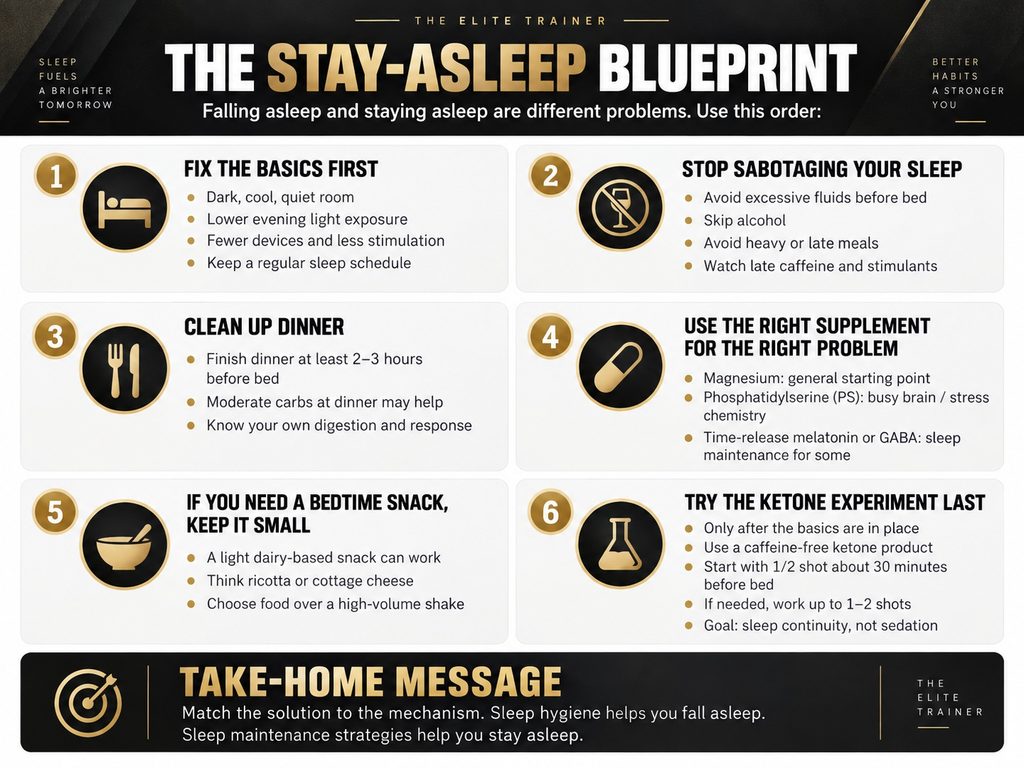
If you are serious about improving sleep maintenance, here is the order I would follow:
- Fix the basics first
Dark room, cool room, consistent bedtime, lower evening light exposure, fewer devices, less stimulation. - Stop sabotaging yourself at night
Avoid excessive fluids, alcohol and heavy late meals. - Clean up dinner
Moderate carbs at dinner often help. Finish eating at least two hours before bed. - Use the right supplement for the right problem
Magnesium for general support. PS for the busy brain and stress chemistry. Time-release melatonin or GABA for sleep maintenance in some individuals. - Use a light food snack if needed
If hunger is the issue, consider a small dairy-based snack rather than a high-volume shake. - Experiment only after the foundation is in place
This is where the caffeine-free ketone strategy belongs.
And if you do everything right and still find yourself awake in the middle of the night, what you do next matters.
IF YOU WAKE UP, DON’T LOOK AT THE CLOCK
One of the simplest pieces of sleep advice I’ve heard comes from sleep researcher Matthew Walker. When someone tells him, “I wake up at 3:00 every night,” his response is essentially: How do you know?
Think about what happens when you check the clock. You wake briefly, see 3:07 a.m., calculate how many hours remain before the alarm goes off, start wondering whether you’ll be exhausted tomorrow, and suddenly a relatively harmless awakening has become an event. Check again 20 minutes later and now you’re monitoring your failure to fall asleep.
There is research behind this. Clock monitoring has been associated with greater worry and more difficulty falling asleep. The problem is not that knowing the time somehow programs your biological clock to wake at exactly 3:00 a.m.; the more plausible issue is conditioning and expectation. If waking, checking the time and worrying repeatedly occur together, the brain can begin attaching significance to the awakening.
So if you wake during the night, resist the urge to check the time. Don’t grab your phone, don’t start calculating how much sleep you have left and don’t turn on bright lights unless you genuinely need them. The goal is to keep a small awakening small rather than giving your brain a reason to become fully alert.
For a much deeper look at the science of sleep, Walker’s Why We Sleep is well worth reading.
TWO WAYS TO HELP YOURSELF FALL BACK ASLEEP
If you are awake despite doing all of that, neuroscientist Andrew Huberman has discussed two simple techniques that he personally uses to help fall back asleep.
The first is long-exhale breathing. This is not the traditional box-breathing protocol. Instead, take roughly 10 slow, deliberate breaths with particular emphasis on a long, relaxed exhalation. The objective is simple: reduce physiological arousal and give the nervous system a chance to settle rather than allowing your mind to start racing.
The second technique is more unusual. Keep your eyelids closed and slowly move your eyes from one side to the other, then up and down. Next, make a slow circle in one direction and then the other. Finally, with your eyes still closed, gently direct them toward your nose and finish with a long exhale. Repeat the sequence two or three times and then stop trying to make anything happen. Huberman says this is the sequence he uses himself when he wakes during the night.
I would treat the eye-movement technique as a low-risk experiment rather than established insomnia therapy. Huberman himself describes the scientific support as indirect, so I would not oversell the mechanism. But it costs nothing, takes only a minute or two, and is considerably better than reaching for your phone and scrolling at 3:00 in the morning.
One other point is worth knowing: if you are clearly awake and becoming frustrated, don’t spend an hour fighting with the mattress. Stimulus-control therapy, a core component of cognitive behavioral therapy for insomnia, recommends getting out of bed when you cannot return to sleep, keeping the environment dim and quiet, doing something relaxing, and returning to bed once you feel sleepy again. Importantly, the recommendation is based on your perception that you’ve been awake for a while—not checking the clock to time yourself.
Huberman covers sleep, stress control and other practical health tools in Protocols: An Operating Manual for the Human Body.
The Take-Home Message
Sleep advice gets lazy when it assumes every sleep problem is the same. It isn’t. If you cannot fall asleep, your problem may be overstimulation, poor sleep hygiene or stress chemistry. If you cannot stay asleep, the issue may be fluid timing, alcohol, meal timing, digestion, nighttime energy instability or a supplement mismatch.
That is why the solution has to match the mechanism. For many people, the fundamentals will still do the heavy lifting. For others, a more targeted approach is needed. Start with the obvious. Fix dinner. Fix fluid timing. Fix the room. Use magnesium or phosphatidylserine intelligently. And if you are still waking up in the middle of the night, the bedtime ketone experiment is one of the more interesting new strategies I’ve seen.
It may not be the answer for everyone, but for the right person, it may be the difference between sleeping through the night and meeting the ceiling fan at 3:00 a.m.
Additional Reading
The Power of Sleep: The Most Crucial Intervention for Athletic Recovery and Performance
Enhance Your Sleep Quality: The Simple Sleep Hack of Opening Your Window
6 Tips for a Good Night’s Sleep
How to Prevent a Long Night Without Sleep
Evening Yoga Improves REM Sleep
Update Your iPhone iOS and Sleep Better
Intense Sunlight Promotes Deep Sleep
Selected References
Katsuya S, et al. Effect of d-β-hydroxybutyrate on sleep quality in healthy participants: a randomized, double-blind, placebo-controlled study. Bioscience, Biotechnology, and Biochemistry. 2025. PubMed
Robberechts R, Albouy G, Hespel P, Poffé C. Exogenous Ketosis Improves Sleep Efficiency and Counteracts the Decline in REM Sleep after Strenuous Exercise. Medicine & Science in Sports & Exercise. 2023;55(11):2064–2074. PubMed
Johns Hopkins University. Impact of Exogenous Ketones on Sleep Disruption in Vulnerable Populations (KETO-SLEEP 1). ClinicalTrials.gov NCT06655649. ClinicalTrials.gov
Li J, Vitiello MV, Gooneratne NS. Sleep in Normal Aging. Sleep Medicine Clinics. 2022;17(2):161–171. PubMed
Mah J, Pitre T. Oral magnesium supplementation for insomnia in older adults: a Systematic Review & Meta-Analysis. BMC Complementary Medicine and Therapies. 2021;21(1):125. PubMed
Ebrahim IO, Shapiro CM, Williams AJ, Fenwick PB. Alcohol and sleep I: effects on normal sleep. Alcoholism: Clinical and Experimental Research. 2013;37(4):539–549. PubMed
Monteleone P, Maj M, Beinat L, Natale M, Kemali D. Blunting by chronic phosphatidylserine administration of the stress-induced activation of the hypothalamo-pituitary-adrenal axis in healthy men. European Journal of Clinical Pharmacology. 1992;42(4):385–388. PubMed
Wade AG, Ford I, Crawford G, et al. Efficacy of prolonged release melatonin in insomnia patients aged 55–80 years: quality of sleep and next-day alertness outcomes. Current Medical Research and Opinion. 2007;23(10):2597–2605. PubMed
Edinger JD, Arnedt JT, Bertisch SM, et al. Behavioral and psychological treatments for chronic insomnia disorder in adults: an American Academy of Sleep Medicine clinical practice guideline. Journal of Clinical Sleep Medicine. 2021;17(2):255–262. PubMed
Tang NKY, Schmidt DA, Harvey AG. Sleeping with the enemy: Clock monitoring in the maintenance of insomnia. Journal of Behavior Therapy and Experimental Psychiatry. 2007;38(1):40–55. PubMed
Testosterone Therapy: The Goal Is Optimal, Not Maximal
Testosterone therapy can improve strength, body composition, sexual function and quality of life, but more is not always better. Learn what the latest evidence says about optimal testosterone levels, estradiol, injections, creams, gels, pellets, cardiovascular and prostate health, fertility, tendon risk and intelligent TRT monitoring.

Dirty Dozen, Clean Fifteen: When Is Organic Produce Really Worth It?
Not all produce carries the same pesticide burden. Learn when buying organic makes the biggest difference, what the 2026 Dirty Dozen and Clean Fifteen reveal, and how to reduce pesticide exposure without eating fewer fruits and vegetables.

55: Don’t Let the Old Man In
At 55, the grey hair may suggest one thing, but strength, leanness and physical capability can tell another story. A personal look at aging, health, discipline and the habits that keep the “old man” outside the door.