
A tape measure may tell you something the bathroom scale cannot: where you are carrying your weight, and why that matters for metabolic health.
You already own almost all the equipment you need for this health assessment: a tape measure. Measure your waist. Measure your height. Divide your waist circumference by your height. If the result is less than 0.5—in other words, if your waist is less than half your height—you are generally in a more favourable range for central adiposity. That does not mean a ratio above 0.5 diagnoses diabetes, insulin resistance, fatty liver or cardiovascular disease. It does mean there may be more abdominal fat than is ideal, and that is useful information because where you carry excess fat matters.
This simple calculation is called the waist-to-height ratio, and it addresses one of the major shortcomings of the measurement most people are far more familiar with: body mass index.
BMI TELLS YOU HOW HEAVY YOU ARE, NOT WHAT THE WEIGHT IS
Body mass index, or BMI, is calculated by dividing body weight in kilograms by height in metres squared. It is inexpensive, convenient and useful when researchers want to compare large populations. The problem begins when we assume that a number designed primarily for population screening tells us everything we need to know about an individual.
BMI does not distinguish muscle from fat. A muscular athlete and a sedentary person of the same height and weight can have exactly the same BMI while possessing dramatically different body compositions. Anyone who has worked around strength athletes has seen the problem. A heavily muscled football player, sprinter or bodybuilder can fall into the overweight—and sometimes even obesity—range according to BMI despite carrying relatively little excess body fat.
That does not make BMI worthless; it makes it incomplete. NICE guidance explicitly recognizes this limitation, recommending that BMI be interpreted with caution because it is not a direct measure of central adiposity. Waist-to-height ratio and body-composition assessment can add useful context, including in adults with high muscle mass for whom BMI may be less accurate.
BMI tells you how much mass you carry relative to your height. Body composition tells you what that mass is made of. Waist measurements start to tell you where some of that mass is being stored. That final question is particularly important, which is why I cover these assessment methods in more detail in my Body Composition Strategies webinar.
WHERE YOU CARRY FAT MATTERS
Imagine two people with the same height, weight and BMI. One stores relatively little fat around the abdomen. The other carries considerably more weight through the midsection. Their BMI may be identical, but their metabolic risk may not be.
Abdominal fat, particularly visceral fat stored around the organs, is associated with insulin resistance, abnormal blood lipids, fatty liver and cardiovascular disease. This is one reason measurements of central adiposity can add useful information that total body weight cannot.
A 2026 meta-analysis involving 68,629 participants provides a good example. Measures of central adiposity—including waist circumference and waist-to-hip ratio—showed stronger associations with coronary calcification than BMI. That does not mean a tape measure can predict who will have a heart attack. It means the distribution of body fat appears to matter in ways that BMI cannot fully capture.
This is why I would not throw BMI away; I would qualify it. If someone’s BMI is elevated, the next question should not automatically be, “How much weight do you need to lose?” A better question is, Where is the weight coming from?
If much of it is muscle, the BMI may be misleading. If much of it is fat, the next question becomes where that fat is being carried, which is where waist-to-height ratio becomes useful.
THE HALF-YOUR-HEIGHT RULE
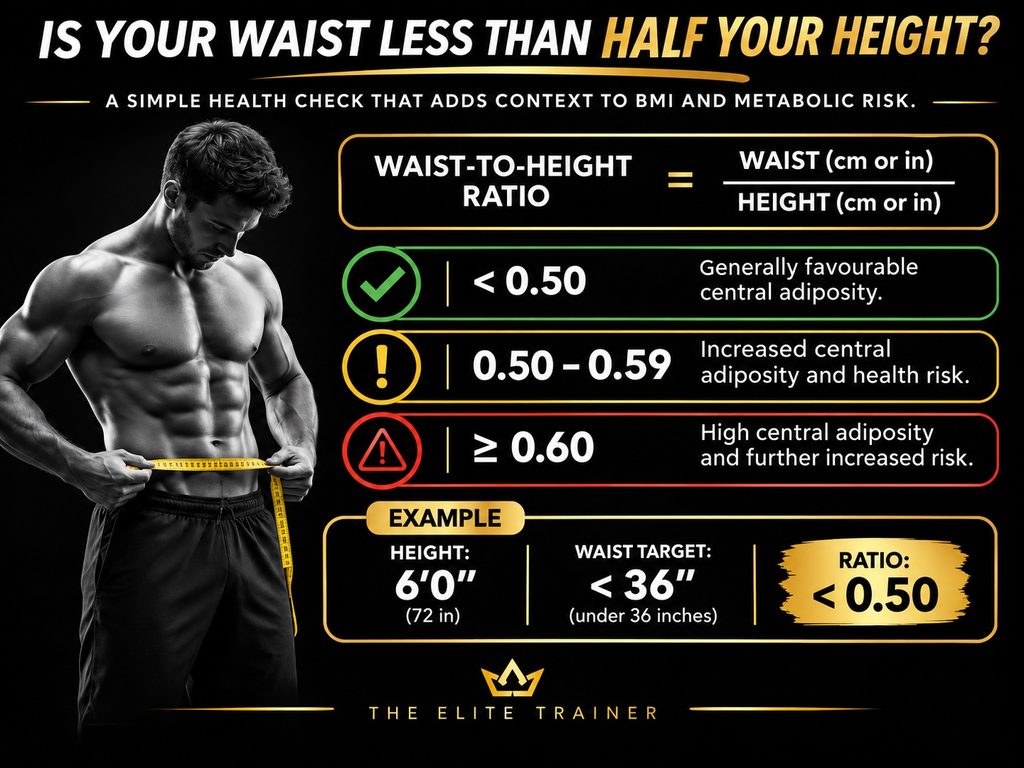
The appeal of waist-to-height ratio is its simplicity. You do not need a complicated chart, an app or a calculator once you understand the basic rule:
Try to keep your waist circumference below half your height.
If you are 6 feet tall, you are 72 inches tall. Half of that is 36 inches, so a waist below roughly 36 inches places you under a waist-to-height ratio of 0.5. If you prefer centimetres, exactly the same rule applies.
| Height | Approximate half-height waist |
|---|---|
| 5’4″ / 64 in | 32 in |
| 5’8″ / 68 in | 34 in |
| 6’0″ / 72 in | 36 in |
| 160 cm | 80 cm |
| 170 cm | 85 cm |
| 180 cm | 90 cm |
The rule is memorable, but it is not merely a social-media shortcut. Current NICE guidance recommends keeping waist circumference to less than half of height and uses waist-to-height ratio to classify central adiposity. A ratio from approximately 0.4 to 0.49 is considered the healthier range; 0.5 to 0.59 indicates increased central adiposity and increased health risk; and 0.6 or greater indicates still greater central adiposity and risk.
One caveat: NICE recommends waist-to-height ratio primarily as a practical estimate of central adiposity in adults with a BMI below 35 kg/m². At higher BMIs, the ratio becomes less useful for distinguishing risk because it is likely already elevated.
The 2026 ADA standards also discuss waist-to-height ratio as part of a more complete assessment of excess adiposity and cardiometabolic risk rather than relying on BMI alone.
In other words, “keep your waist below half your height” is a useful screening rule, not a fitness gimmick.
MEASURE THE RIGHT WAIST
Before you start interpreting the number, make sure you measure it properly.
Do not use the size printed inside your pants. Clothing sizes are inconsistent, and “vanity sizing” makes them even less useful as a health measurement. You need an actual anatomical waist measurement.
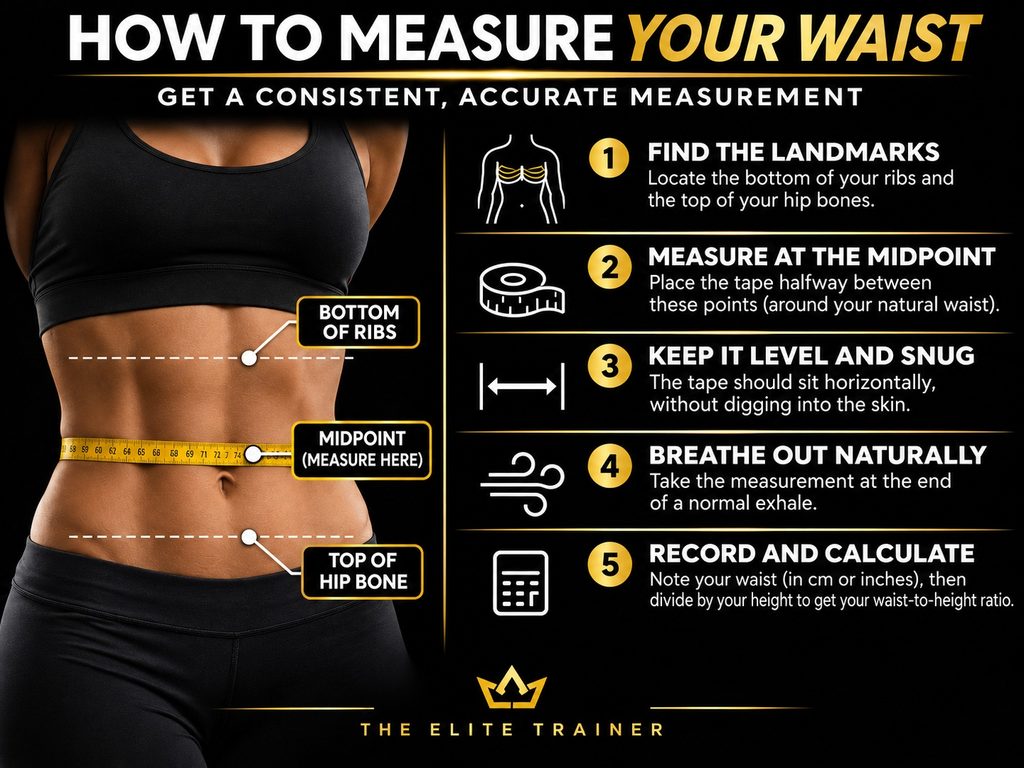
One accepted method is to locate the bottom of the ribs and the top of the hip bones, then place the tape midway between those points. Keep the tape horizontal around the body without pulling it tightly into the skin. Stand normally, breathe out naturally and record the measurement. Your waist and height must be expressed in the same units before you calculate the ratio.
For example, if your waist measures 34 inches and you are 70 inches tall, 34 ÷ 70 = 0.486, which puts you below 0.5.
The exact procedure matters even more when you are tracking change over time. A trainer who measures a client slightly higher one month and slightly lower the next can manufacture “progress” that never occurred. Use the same anatomical landmarks, similar conditions and the same technique every time.
This is also why I devote considerable attention to measurement technique in How to Measure Your Clients. The sophistication of the calculation does not matter if the original measurement is inconsistent.
A SCREENING TOOL IS NOT A BLOOD TEST
This is probably the most important qualification in the article: having a waist-to-height ratio above 0.5 does not prove that your blood sugar is high, that you are insulin resistant, or that you have fatty liver or metabolic syndrome. Nothing magical happens when a ratio moves from 0.49 to 0.50; health risk exists on a continuum.
What an elevated ratio tells you is that central adiposity is increasing, and greater central adiposity is associated with a less favourable metabolic profile. Research comparing different anthropometric measures has repeatedly found waist-to-height ratio to be useful for identifying increased risk of problems such as diabetes, hypertension and abnormal blood lipids.
Think of it as a dashboard warning light. The light does not tell you exactly what is happening under the hood. It tells you that it may be worth looking.
If your waist-to-height ratio is high—or gradually increasing—the next step is not panic. It is context. Look at your blood pressure, fasting glucose or A1C, triglycerides, HDL cholesterol, activity level, nutrition, sleep, family history and other relevant health information. One measurement should prompt better questions, not supply every answer.
WHY THE UNWIN AND FUNG CONVERSATIONS MATTER
Two conversations on The Primal Podcast recently brought waist-to-height ratio back onto my radar.
Dr. David Unwin describes it as a simple way to monitor metabolic health and uses the same basic benchmark: keep the waist below half of height. What I particularly like about his approach is that he does not stop at the tape measure. He discusses waist size alongside markers such as triglycerides, blood pressure and blood glucose.
He also makes an important point about nutrition: start with baseline measurements, make a change, and then determine whether those measurements improve. In other words, the intervention should be judged by what actually happens to the person rather than by how closely the diet matches somebody else’s preferred label.
That gives us a much better framework than simply telling everyone with a large waist to “cut carbs”:
Measure. Interpret. Intervene. Re-measure.
Dr. Jason Fung discusses the same half-your-height rule when talking about abdominal adiposity and metabolic syndrome. The practical message is useful, although I would be more cautious about treating a ratio above 0.5 as a direct measurement of high insulin. Waist-to-height ratio can flag increased metabolic risk; it cannot tell you exactly what someone’s insulin concentration is without actually measuring it.
WHILE THE TAPE IS OUT, MEASURE YOUR HIPS
There is another useful piece of information available before you put the tape away: measure your hips. Divide waist circumference by hip circumference and you have the waist-to-hip ratio, another long-standing marker of body-fat distribution and cardiovascular risk.
A person who carries proportionally more weight through the abdomen will generally have a higher waist-to-hip ratio than someone who carries more weight through the hips and lower body. Again, this is not because abdominal fat is dangerous simply because it sits physically closer to the heart. The issue is that greater central and visceral adiposity is associated with a different metabolic environment.
Waist-to-hip ratio has plenty of supporting research, and I think it is useful. For the average person, however, waist-to-height ratio has an enormous practical advantage: almost everyone can remember the instruction “keep your waist below half your height.” You do not need separate sex-specific cutoffs or another table—just a tape measure and your height.
WHAT IF YOUR WAIST IS MORE THAN HALF YOUR HEIGHT?
The answer is not to become obsessed with making your waist smaller as quickly as possible. The objective is to improve the underlying health picture.
Start by establishing your baseline. Record your waist, body weight and waist-to-height ratio. If you have access to other useful information—blood pressure, glucose, A1C, triglycerides, HDL, body-fat measurements—record those as well.
Then make changes that you can maintain long enough to evaluate. A sensible plan will usually include resistance training, regular physical activity, adequate protein, improved food quality, sufficient sleep and an eating strategy that creates an appropriate energy balance. If excess abdominal fat is present, reducing it generally requires consuming less energy than is being expended over time, but how you achieve that can vary considerably from one person to another.
Then measure again. This is where the tape can become more informative than the bathroom scale. Someone may lose very little total body weight while reducing waist circumference because fat is being lost and lean tissue is being maintained—or possibly gained. Conversely, a person may lose weight rapidly while also losing muscle and strength.
Those are not equivalent outcomes, which is why I have always preferred thinking in terms of body composition rather than simply body weight.
DO YOU NEED TO CUT CARBS?
Not necessarily. Carbohydrate reduction can be an effective strategy, particularly for people with poor glucose control, prediabetes, type 2 diabetes or a dietary pattern dominated by refined carbohydrate and processed food. The ADA recognizes lower-carbohydrate eating patterns as one possible option for improving glycemic control in appropriate individuals, but waist-to-height ratio cannot tell you how many grams of carbohydrate you should eat.
Dr. Unwin’s comments on the podcast are useful here. Rather than selecting one universal carbohydrate target, he talks about establishing baseline measurements, reducing carbohydrate intake where appropriate and then reassessing whether the person’s waist, blood glucose, triglycerides or other markers actually improve. Some people may need a substantial reduction. Others may achieve their goals with a much more moderate change. That is a more intelligent approach than diet tribalism.
If your current intake includes large amounts of sugary drinks, sweets, refined starches and ultra-processed food, reducing those foods is an obvious starting point regardless of whether you ultimately describe your diet as low-carb, Mediterranean, whole-food or something else. Eat enough protein. Base most meals around nutrient-dense foods. Strength train. Move regularly. Control total energy intake. Sleep properly. Then adjust the details according to your response.
I go through a number of body-composition approaches in Lean & Mean, but the underlying principle remains the same: apply the strategy, track the outcome and let the response determine whether the plan needs to change.
DO NOT TURN THE TAPE MEASURE INTO ANOTHER SCALE
There is one final trap worth avoiding: whenever the fitness industry discovers a useful measurement, we have a tendency to turn the measurement itself into the goal.
A smaller waist can be a very positive sign when excess abdominal fat is being reduced. But the purpose of training and nutrition is not to own the smallest possible tape measurement. The purpose is to become healthier, stronger and more physically capable while reducing unnecessary body fat.
Waist circumference is one piece of that puzzle. BMI and body composition add others, while blood markers, blood pressure, strength, fitness and lifestyle complete more of the picture. No single number deserves to become your entire definition of health.
THE BOTTOM LINE
BMI is useful, but incomplete. It tells you how heavy you are relative to your height without telling you whether that weight is primarily muscle or fat, and it provides little information about where excess fat is stored. Waist-to-height ratio adds an important piece of context and requires almost nothing to measure.
Take your waist circumference and divide it by your height. If your waist is less than half your height, you are generally below the threshold used to flag increased central adiposity. If it is not, do not treat the result as a diagnosis; treat it as information worth acting on. Look at the rest of the picture, improve the factors you can control, give the plan enough time to work and then measure again.
A tape measure will never replace a proper health assessment. But for something that costs almost nothing, takes less than a minute and can be repeated anywhere, it can tell you an awful lot.
REFERENCES & FURTHER READING
- National Institute for Health and Care Excellence (NICE). Identifying and assessing overweight, obesity and central adiposity. Overweight and obesity management.
- American Diabetes Association Professional Practice Committee for Obesity. Screening, Diagnosis, Evaluation, and Staging of Obesity in Adults: Standards of Care in Overweight and Obesity—2026. Diabetes, Obesity, and Cardiometabolic CARE. 2026;1(4):536–571.
- Khanna S, Mann G, Virk S, et al. Associations of Central Adiposity With Subclinical Coronary Calcification and Disease Progression: Meta-Analysis of 68,629 Participants. JACC: Advances. 2026;5(6 Pt 2):102844.
- Ashwell M, Gunn P, Gibson S. Waist-to-height ratio is a better screening tool than waist circumference and BMI for adult cardiometabolic risk factors: systematic review and meta-analysis. Obesity Reviews. 2012;13(3):275–286.
- American Diabetes Association Professional Practice Committee for Diabetes. Facilitating Positive Health Behaviors and Well-being to Improve Health Outcomes: Standards of Care in Diabetes—2026. Diabetes Care. 2026;49(Suppl. 1)–S131.

Testosterone Therapy: The Goal Is Optimal, Not Maximal
Testosterone therapy can improve strength, body composition, sexual function and quality of life, but more is not always better. Learn what the latest evidence says about optimal testosterone levels, estradiol, injections, creams, gels, pellets, cardiovascular and prostate health, fertility, tendon risk and intelligent TRT monitoring.

Dirty Dozen, Clean Fifteen: When Is Organic Produce Really Worth It?
Not all produce carries the same pesticide burden. Learn when buying organic makes the biggest difference, what the 2026 Dirty Dozen and Clean Fifteen reveal, and how to reduce pesticide exposure without eating fewer fruits and vegetables.

Why You Wake Up at 3 A.M.: The Ultimate Guide to Staying Asleep All Night
Waking up in the middle of the night becomes more common with age, and the fix is not always the same as the one for falling asleep. Learn the most effective strategies for sleep maintenance, from dinner timing and supplement support to a promising new ketone experiment for people who cannot stay asleep.