
Three clips. Nearly eight years. Same squat. The fact that almost nothing changed is the story.
Before you read any further, watch the video.
There are three separate clips. The camera angle changes. The clothes change. The music changes. There may be a slight difference in the weight on the bar, and if you look closely enough, you can probably find a few other small differences.
But there is one major difference that you probably won’t notice.
Can you guess what it is?
The first clip was recorded on December 12, 2018. The second was recorded on March 10, 2023. The third was recorded on October 17, 2026.
That’s almost eight years.
I was 47 years old in the first video and 55 in the last. There may be a few more grey hairs now, but when you look at the front squat itself — the range of motion, technique, control and amount of weight being moved — not much has changed.
That’s the point.
We tend to notice what changes as people get older: more wrinkles, more grey hair, maybe less hair, maybe a few extra pounds. But when it comes to healthy aging, sometimes the more impressive story is what doesn’t change. My strength hasn’t disappeared. My muscle hasn’t disappeared. My ability to squat deeply under load hasn’t disappeared. I haven’t had to replace a demanding exercise with a watered-down version simply because another birthday appeared on the calendar.
The years went by. The function stayed.
THE SECRET NOBODY WANTS TO HEAR
I’ve been asked some version of the same question many times lately: What’s your secret? How do you stay in that kind of shape? How can I get the results you have?
People expect there to be something interesting behind the answer — a special program, a supplement, a recovery technology, a new training method or some clever anti-aging protocol that most people haven’t heard about yet.
Unfortunately, my answer is much more boring than that.
Put in the time. Put in the effort. Do it day after day, week after week, year after year and decade after decade. Then keep going.
I’ve written before about Punch-the-Clock Workouts because most successful training isn’t spectacular. Some workouts are great, some are average, and occasionally you would rather be doing just about anything else. What matters is accumulating enough productive sessions over enough years that ordinary workouts produce an extraordinary long-term result.
That’s really what those three videos show. They don’t capture eight years of training. They capture three moments separated by thousands of workouts that nobody saw.
TRAINING IS AN INVESTMENT
Think about strength training the same way you would think about building wealth. You go to work, earn money and invest some of it. One deposit doesn’t change your life, and staring at the account balance the next morning probably won’t impress you. But you keep depositing, month after month and year after year, and eventually compounding does something that no individual deposit ever could.
Training works much the same way. One workout won’t transform you. Neither will one perfect program, one great month or even one spectacular year. The return comes from repeatedly investing time and effort into your body and allowing those deposits to accumulate over decades.
The payoff isn’t merely a bigger bench press or better-looking arms at 30. The real return may be what you can still do at 50, 60, 70 and beyond.
I wrote in Growing Older Is Inevitable. Growing Weaker Doesn’t Have to Be that you’re not simply training for next week or next summer. You’re training for the person you’re going to become 10, 20 or even 40 years from now. The videos above are a small example of that investment paying a dividend.
THE FRONT SQUAT DOESN’T CARE HOW OLD YOU ARE
There’s another reason the front squat is such a useful movement for this comparison: it’s demanding.
A proper full-range front squat asks a lot from the body at once. You need sufficient strength to control and reverse the load, enough mobility to reach depth, enough trunk strength to maintain position and enough coordination to put everything together. If one of those qualities deteriorates significantly, the movement usually tells on you.
That’s why I’m skeptical when people automatically blame age for losing the ability to perform exercises they once did. Sometimes age is part of the equation. Recovery changes. Connective tissue changes. Power tends to decline. There are physiological realities of getting older that no motivational slogan can erase.
But aging and disuse are not the same thing.
If you stop squatting deeply, don’t be surprised when deep squatting becomes difficult. If you stop lifting challenging weights, don’t be surprised when heavy things begin to feel heavier. If you stop asking your muscles to produce strength, eventually they become less capable of producing it.
The body is constantly responding to the demands placed upon it — and to the demands you stop placing upon it.
“USE IT OR LOSE IT” IS MORE THAN A SAYING
Years ago, I came across research examining an important question: how much of the muscle loss commonly associated with aging is actually the result of aging itself, and how much is related to chronic disuse?
Researchers studied recreational masters athletes between 40 and 81 years old who had continued exercising four or five times per week. They found no significant age-related decline in mid-thigh muscle area or quadriceps peak torque across the studied age range and argued that some of what we routinely describe as age-related muscle loss may actually reflect chronic disuse.
The message stuck with me: use it or lose it.
That doesn’t mean exercise makes you biologically immortal, nor does it mean a highly active 80-year-old has the same physiology as a 40-year-old. More recent research on masters athletes still shows genuine age-related changes, particularly in muscular power. The distinction is that getting older and becoming physically incapable are not necessarily the same process occurring at the same rate.
Resistance training remains remarkably effective later in life. A large 2025 systematic review and network meta-analysis examined 151 randomized trials involving more than 6,300 older adults and found improvements in physical function, lean body mass, muscle size and strength. Even relatively modest amounts of resistance training produced meaningful benefits, while greater training volumes tended to provide additional advantages when maximizing strength was the goal.
A newer 2026 systematic review reached a similar conclusion: resistance training can improve muscle mass, strength and physical function in older adults.
In other words, getting older doesn’t make strength training irrelevant.
It makes preserving strength increasingly valuable.
MAINTENANCE IS NOT FAILURE
The fitness industry conditions us to think that improvement must always mean more: more weight, more muscle, more repetitions, a faster time, another personal record.
That’s useful when you’re building something, but eventually there is another kind of victory: keeping it.
If the final front squat video looked much better than the first, this would make an obvious transformation story. But that isn’t this story. The squat looks similar, and at this stage of life, I’m happy with that.
I don’t need my 55-year-old body to outperform my 47-year-old body at everything. I want my 55-year-old body to remain capable of doing the things I’ve spent decades teaching it to do. Muscle, strength, mobility and physical function are assets, and preserving them matters.
Maintaining what most people lose is progress.
Unfortunately, people sometimes begin surrendering those assets before they have to. They decide they’re “too old” for certain exercises, stop squatting deeply, stop lifting challenging weights, stop doing chin-ups, stop moving explosively or stop participating in activities that once demanded something from them. Over time, the body becomes very good at meeting those reduced expectations.
Research on detraining supports the same principle. Strength adaptations can remain for a period after resistance training stops, particularly in people with longer training histories, but they progressively erode without continued training. Studies in older adults have also shown that recently acquired improvements in strength and physical function can decline substantially after periods of detraining.
Of course, intelligent training isn’t about stubbornly doing the same thing regardless of circumstances. Injuries happen. Illness happens. Life happens. Recovery becomes increasingly important, and there will be times when exercises, loads, volume or frequency need to change.
But adjusting isn’t quitting. There is a difference between respecting age and surrendering to it.
DON’T LET THE OLD MAN IN
When I turned 55, I wrote Don’t Let the Old Man In. I didn’t mean that we should pretend aging isn’t happening. I’m not trying to be 25. The grey hair can stay. The wrinkles can stay too.
What I’m not willing to surrender voluntarily is my strength, muscle, mobility and ability to perform.
That’s the real lesson in these three clips. December 2018. March 2023. October 2026. The calendar kept moving, and I kept training.
There was no miracle workout, anti-aging hack or shortcut. There were simply years of consistent work — the routine sessions that accumulate quietly until enough time has passed to reveal what they accomplished.
So if you’re waiting for the perfect program, stop waiting. If you’ve convinced yourself you’re too old to get stronger, reconsider. And if you’re capable of doing something today that you still want to be capable of doing ten years from now, don’t stop doing it.
Your body is listening to the message you send it.
Make sure it’s the right one.
Use it or lose it.
REFERENCES
Wroblewski AP, Amati F, Smiley MA, Goodpaster B, Wright V. Chronic exercise preserves lean muscle mass in masters athletes. The Physician and Sportsmedicine. 2011;39(3):172–178.
Radaelli R, Rech A, Molinari T, et al. Effects of resistance training volume on physical function, lean body mass and lower-body muscle hypertrophy and strength in older adults: A systematic review and network meta-analysis of 151 randomised trials. Sports Medicine. 2025;55(1):167–192.
Tao M, Liao K, Yin M, et al. Effects of maximal versus submaximal intended velocity resistance training on muscular fitness adaptations in older adults: A systematic review and meta-analysis. Sports Medicine and Health Science. 2026;8(4):365–376. doi:10.1016/j.smhs.2026.03.001.
Yang Y, Chen SC, Chen CN, Hsu CW, Zhou WS, Chien KY. Training session and detraining duration affect lower limb muscle strength maintenance in middle-aged and older adults: A systematic review and meta-analysis. Journal of Aging and Physical Activity. 2022;30(3):552–566. doi:10.1123/japa.2020-0493.
Kalapotharakos VI, Diamantopoulos K, Tokmakidis SP. Effects of resistance training and detraining on muscle strength and functional performance of older adults aged 80 to 88 years. Aging Clinical and Experimental Research. 2010;22(2):134–140. doi:10.1007/BF03324786.
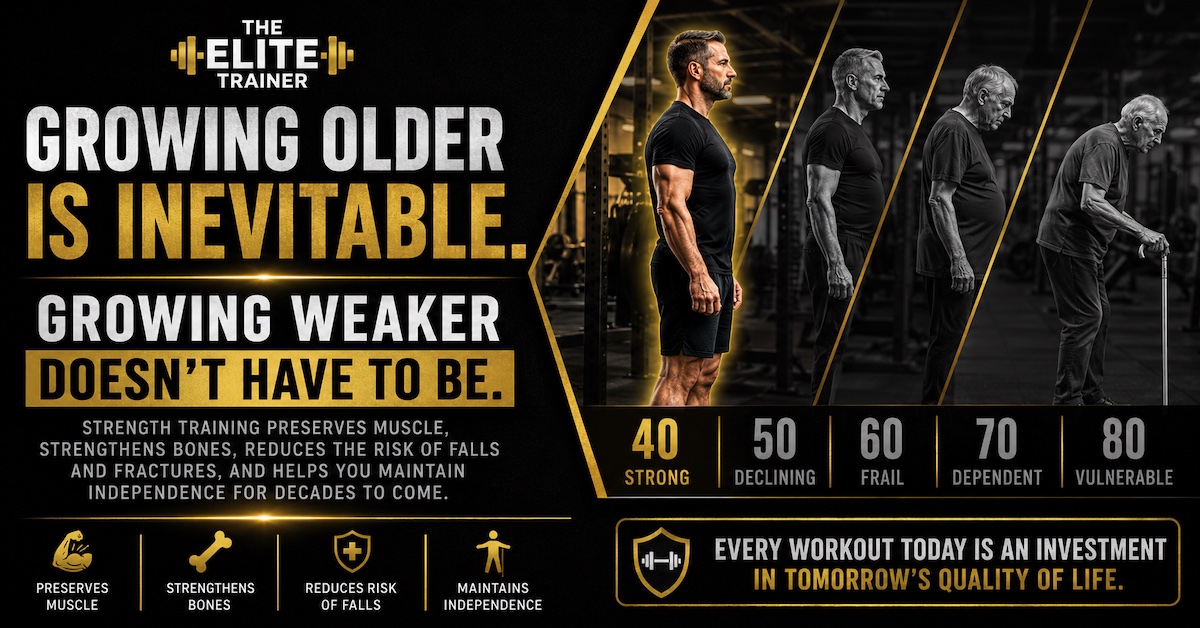
Growing Older Is Inevitable. Growing Weaker Doesn’t Have to Be.
Growing older is inevitable, but growing weaker doesn’t have to be. Discover how strength training preserves muscle and bone, reduces fall risk, and protects your independence for decades to come.
The Interference Effect: How to Maximize Strength and Endurance Gains
Strength and endurance can coexist, but programming matters. Timing, volume, intensity, and exercise selection all influence whether cardio helps your goals or interferes with them.

Stop Abdominal Hollowing! It Weakens Your Lifts and Increases Injury Risk
Abdominal hollowing may look neat in theory, but heavy lifting needs real bracing. Learn why a stronger core strategy can improve stability when the weight gets serious.
follow
Error: No feed with the ID 2 found.
Please go to the Instagram Feed settings page to create a feed.