
What Extra-Virgin Really Means, How Olive Oil Fraud Happens and Why Your Refrigerator Can Fool You
We’re constantly told to eat healthy fats, and olive oil usually sits near the top of the list. There’s good reason for that. Extra-virgin olive oil has an impressive nutritional profile and a substantial body of research behind it.
But there’s an obvious catch: you need to be getting what you paid for.
Real extra-virgin olive oil costs more to produce than lower-grade oils. That creates a powerful financial incentive to mislabel inferior olive oil, blend it with cheaper oils or sell something as “extra virgin” that doesn’t actually meet the standard.
You don’t need conspiracy theories to establish that olive-oil fraud exists. In its latest targeted food-fraud testing, the Canadian Food Inspection Agency found olive oil had the lowest compliance rate of any commodity it tested for authenticity. Of 85 higher-risk imported samples, 28 were unsatisfactory, and CFIA prevented 7,245 litres of adulterated olive oil from entering the Canadian market. Again, those were deliberately targeted samples—not a random survey of every bottle on the grocery-store shelf—but the numbers are enough to demonstrate that this is a legitimate problem.
So yes, you should care about what’s inside that bottle. And here’s where the story gets interesting: I thought I knew a ridiculously simple way to find out.
Why Extra-Virgin Olive Oil Deserves the Hype
Extra-virgin olive oil—or EVOO—is predominantly a monounsaturated fat, meaning most of its fatty acids contain a single double bond. Its dominant fatty acid is oleic acid, but EVOO also contains smaller quantities of biologically active compounds, including polyphenols and vitamin E.
Those minor compounds are part of what distinguishes good EVOO from highly refined oils. Research has linked EVOO-rich Mediterranean dietary patterns with favourable cardiovascular outcomes, and studies have identified antioxidant, anti-inflammatory and vascular effects associated with its phenolic compounds. In PREDIMED, higher extra-virgin olive-oil intake was associated with lower cardiovascular risk among adults already at elevated risk.
Olive oil isn’t medicine in a bottle, and pouring it over an otherwise terrible diet won’t rescue you. But as part of a nutrient-dense diet, good EVOO is one of the fats I want in my kitchen.
I use a small amount every day on my Beast of a Salad, and I’ll often use it with vegetables or for cooking.
What “Extra Virgin” Actually Means
“Extra virgin” isn’t supposed to be decorative language dreamed up by the marketing department. It’s a genuine grade.
The International Olive Council defines extra-virgin olive oil as virgin olive oil obtained from olives by mechanical or physical processes without refining, with free acidity no higher than 0.8 grams per 100 grams and specific chemical and sensory requirements. In Canada, products represented as extra virgin must meet recognized IOC/Codex standards and cannot secretly contain refined olive oil, olive-pomace oil or another type of oil.
That also means some commonly repeated shopping advice needs clarification. “First pressed” isn’t particularly useful anymore because most modern olive oil isn’t literally pressed; the olives are crushed and the oil is separated using centrifugation. “Cold extraction” can be meaningful, but EVOO quality depends on much more than one phrase on the front label.
Organic is desirable, but it isn’t proof that an olive oil is authentic, fresh or high in polyphenols. I care more about the actual grade, freshness, producer, traceability and storage.
Freshness is especially important because olive oil does not improve with age. Oxygen, heat and light gradually oxidize the oil and deplete some of the compounds you’re paying extra to get. A harvest date is therefore far more informative than fancy artwork on the label. Dark glass, metal or other light-protective packaging is preferable, and once opened, buy quantities you’ll actually use rather than letting a huge bottle sit around for a year.
Can You Cook With Extra-Virgin Olive Oil?
Absolutely. I tend to use EVOO at low to moderate temperatures because I want to preserve as much flavour and phenolic content as possible. Eggs, vegetables and thinner cuts of meat are good examples.
But the claim that olive oil suddenly becomes dangerous when heated is another exaggeration. Its high monounsaturated-fat content and natural antioxidants make olive oil comparatively resistant to oxidation, and studies have found it performs well even under frying conditions. Higher and prolonged heat will degrade some phenolic compounds, so there is still a nutritional argument for gentler cooking when possible—but EVOO isn’t a fragile oil that must never see a frying pan.
No Congeal, No Deal? Not So Fast
This is where my original article was going to get very simple.
I came across a refrigerator test that sounded almost too good to be true: pour some olive oil into a small dish, refrigerate it overnight and check it the following morning. If it thickens or solidifies, you’ve supposedly got real olive oil. If it remains liquid, you’ve supposedly got an oil diluted with cheaper vegetable oils. So I tried it myself.
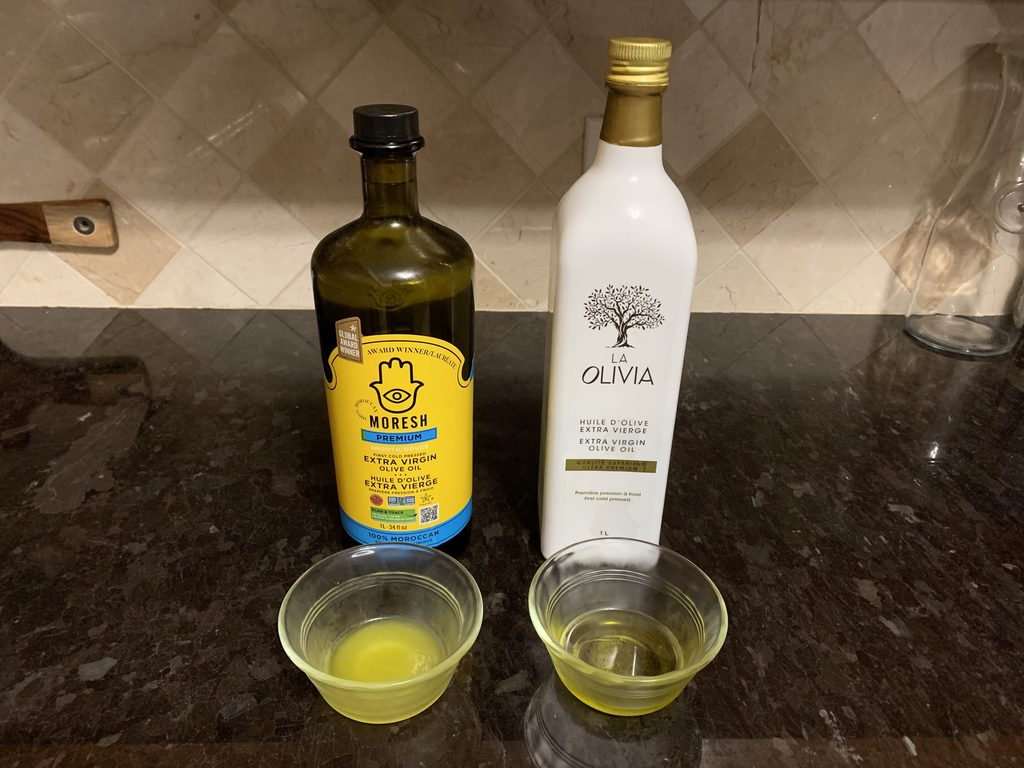
I tested two bottles from our pantry. The Moresh Premium Extra Virgin Olive Oil on the left is one we purchase regularly. The La Olivia EVOO on the right came to us in a gift basket.
The next morning, the difference was dramatic. One had become cloudy, thick and almost jelly-like, while the other remained substantially more liquid. If I had stopped there, I would have written “No congeal, no deal!” It certainly looked convincing.
Then I investigated the test itself—and that’s when the article changed.
The Refrigerator Test Does Not Prove Authenticity
UC Davis’s Olive Center tested the refrigerator theory using extra-virgin olive oils, regular olive oil, canola oil, safflower oil and blends. Some developed minor crystallization; others didn’t. Even after prolonged refrigeration, the behaviour was not consistent enough to distinguish genuine olive oil from adulterated oil.
Why? Because olive oil isn’t chemically identical from bottle to bottle. Olive variety, growing conditions, region, harvest timing and natural differences in fatty-acid and wax composition all influence when and how the oil crystallizes.
So what did my experiment actually demonstrate? Only that the two oils behave differently when chilled. It does not establish that the liquid oil is fake, nor does the thickened oil prove that it’s authentic extra virgin. That’s an important distinction, and frankly, I’m glad I discovered it before telling thousands of people otherwise.
So How Do You Find the Real Deal?
Unfortunately, there isn’t a kitchen trick that can replace a laboratory. Chemical and sensory testing is how regulators identify adulteration. But you can substantially improve your odds as a consumer by knowing what to look for:
- Choose extra virgin rather than vague descriptions such as “light” or simply “olive oil” when you want the least-refined product.
- Look for a harvest date, and favour fresher oil rather than obsessing over the distant best-before date.
- Choose dark or opaque packaging that protects the oil from light.
- Buy from a reputable producer or retailer, ideally with meaningful certification or traceability information.
- Be suspicious of an EVOO priced dramatically below comparable oils. High-quality olive oil is expensive to grow, harvest and produce.
- Once opened, store it cool and dark and use it, rather than treating it like a bottle of wine you’re saving for a special occasion.
UC Davis specifically recommends paying attention to harvest date, credible certification and protection from light rather than relying on the refrigerator test.
Check Your Fridge—Just Not for the Reason You Think
Sun-dried tomatoes are a good example of why ingredient awareness still matters.
The ones I use regularly in my salad are Derlea Julienne Sun Dried Tomatoes. Turn the package over and you’ll find something I like:
Ingredients: sun dried tomato, sea salt. That’s it.
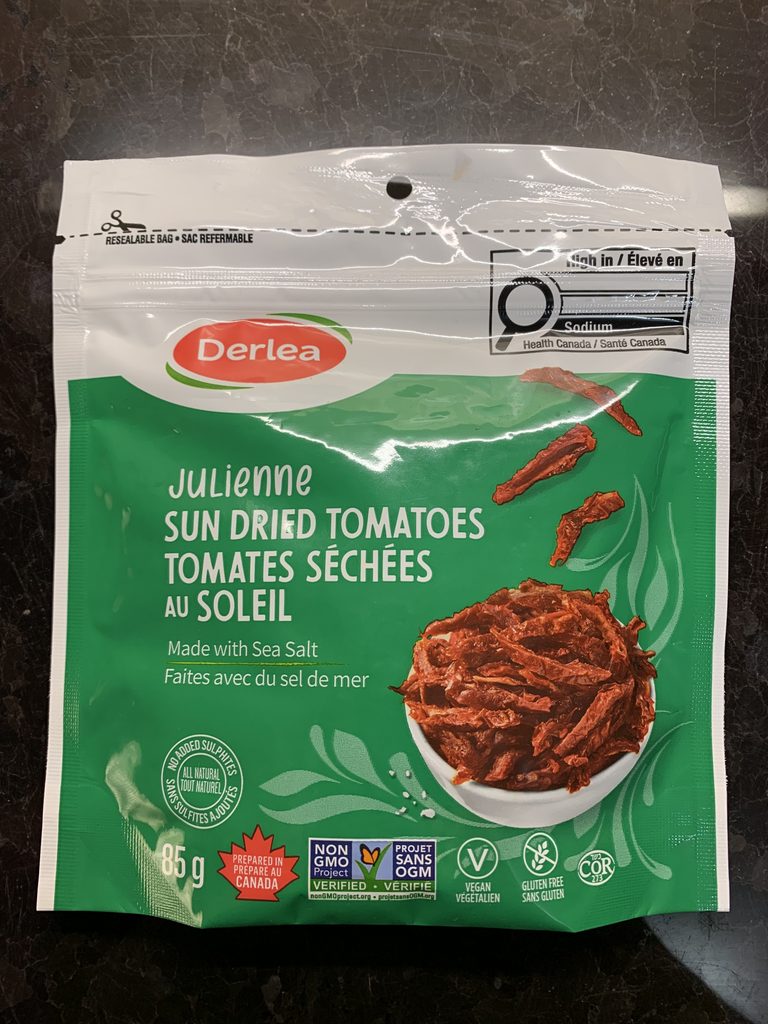
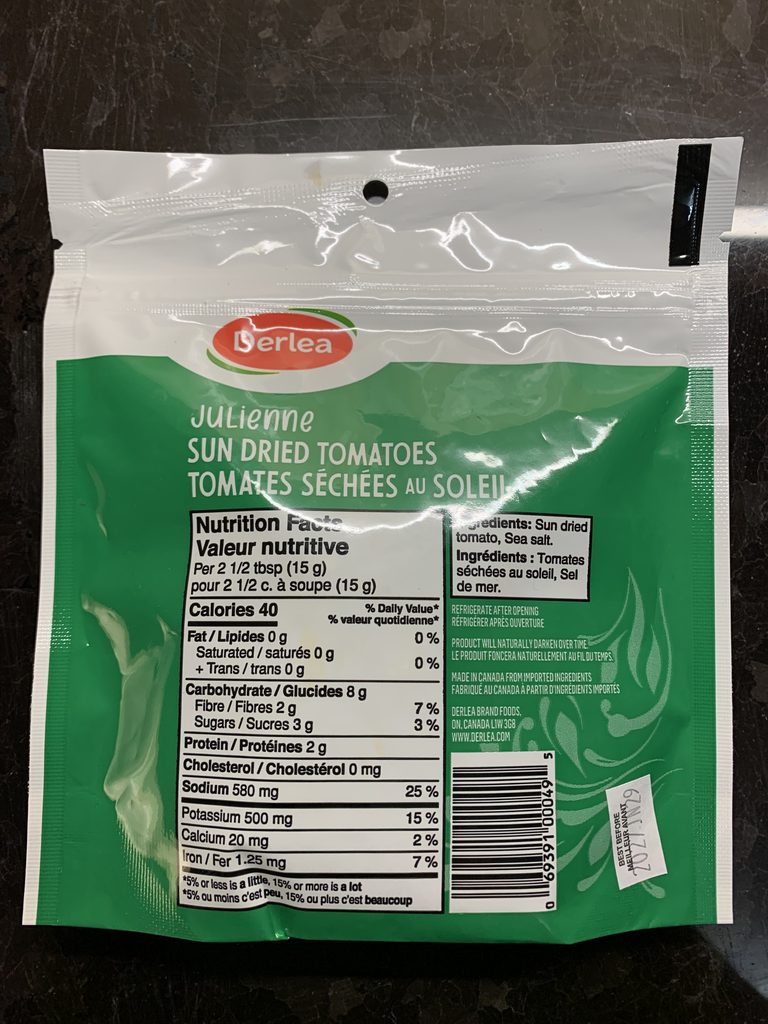
No oil means I don’t have to wonder what oil was used.
If you buy sun-dried tomatoes packed in oil, check the ingredient list. If the manufacturer intentionally uses olive oil plus sunflower, canola or another oil, those ingredients should be disclosed. And if a product is represented as containing only olive oil but secretly contains another oil, that’s adulteration—not because it failed a refrigerator trick, but because the product isn’t what the label says it is. In Canada, adding other oils to a product represented as olive oil is prohibited.
Ask the Waiter
Restaurants make this considerably harder. A few years ago, I noticed that after eating at a popular steakhouse chain, I’d sometimes leave feeling unusually bloated. My meals weren’t particularly extravagant—usually salad, steak and vegetables—and I wasn’t overeating.
I can’t prove what caused the bloating, but it prompted me to start asking questions.
On a later visit I requested that my meal be prepared only with butter or olive oil. That’s when I learned that the restaurant’s “olive oil” cooking option wasn’t 100% olive oil; it was an oil blend.
I’ve encountered something similar at a breakfast chain. I requested that an omelet be cooked in butter only to learn that they didn’t have butter available for cooking—only margarine. Olive oil was another option, but I had no way of knowing exactly what oil they were using.
That’s one of the realities of eating out. You surrender a certain amount of control over ingredients, oils, preparation and portion sizes. I enjoy restaurants as much as anyone, but if food quality is important to you, the majority of your meals should probably come from a kitchen where you know what’s going into the pan.
A Word About Seed Oils
Seed oils are another area where the discussion gets heated quickly. In Dark Calories: How Vegetable Oils Destroy Our Health and How We Can Get It Back, Dr. Catherine Shanahan presents a strong case against industrial seed oils. One of her most striking comparisons is that a large serving of French fries cooked in vegetable oil can create an oxidative burden similar to smoking 24 cigarettes. It’s not meant as a literal clinical equivalence, but as a vivid illustration of the oxidative stress produced by repeatedly heated vegetable oils.
Her argument against refined seed oils is its own discussion—and separate from the issue at hand. Whether you choose to consume canola, sunflower, or soybean oil is one question. Whether someone can quietly slip those oils into a bottle labeled extra‑virgin olive oil is another.
They can’t. If you’re paying for extra‑virgin olive oil, you should get extra‑virgin olive oil.
The Take-Home Message
The original version of this article was going to end with a catchy rule: “If it doesn’t congeal, there’s no deal!” It would have made a great headline. It just wouldn’t have been true.
Olive-oil fraud is real. Mislabeling is real. Adulteration is real. The latest Canadian enforcement data give consumers legitimate reason to pay attention to what they’re buying. But a bottle thickening in your refrigerator cannot certify purity, and a bottle remaining liquid doesn’t convict it of fraud.
So take your health into your own hands—but do it with good information. Buy extra virgin from sources you trust. Look for freshness and traceability. Protect it from heat and light. Read ingredient lists. Ask questions at restaurants. And remember that no clever kitchen experiment can replace proper chemical and sensory testing when authenticity genuinely needs to be established.
Your refrigerator can tell you how an olive oil behaves in the cold. It can’t tell you whether the producer told you the truth.
That distinction is the real deal.
Selected References
Canadian Food Inspection Agency — Food Fraud Annual Report 2024–2025: latest Canadian olive-oil authenticity and enforcement data. CFIA Food Fraud Annual Report 2024–2025
Canadian Food Inspection Agency — Olive Oil Compliance: Canadian requirements for olive oil and EVOO. CFIA Olive Oil Compliance
UC Davis Olive Center — Refrigerator Test: why refrigeration cannot reliably establish authenticity. UC Davis on the Olive Oil Fridge Test
UC Davis Food Quality — Olive Oil Myths and Facts: freshness, storage and consumer buying guidance. UC Davis Olive Oil Myths and Facts
PREDIMED — Olive Oil and Cardiovascular Risk: research examining olive-oil consumption and cardiovascular outcomes. PREDIMED Olive Oil Study
Virgin Olive Oil as Frying Oil: review of olive oil performance during frying. Virgin Olive Oil as Frying Oil
Dirty Dozen, Clean Fifteen: When Is Organic Produce Really Worth It?
Not all produce carries the same pesticide burden. Learn when buying organic makes the biggest difference, what the 2026 Dirty Dozen and Clean Fifteen reveal, and how to reduce pesticide exposure without eating fewer fruits and vegetables.

Have Your “Meatza” and Eat It Too!
Pizza cravings do not have to mean a carb crash. Meatza swaps the crust for a protein-packed base, giving low-carb eaters a satisfying way to keep the flavour and ditch the flour.
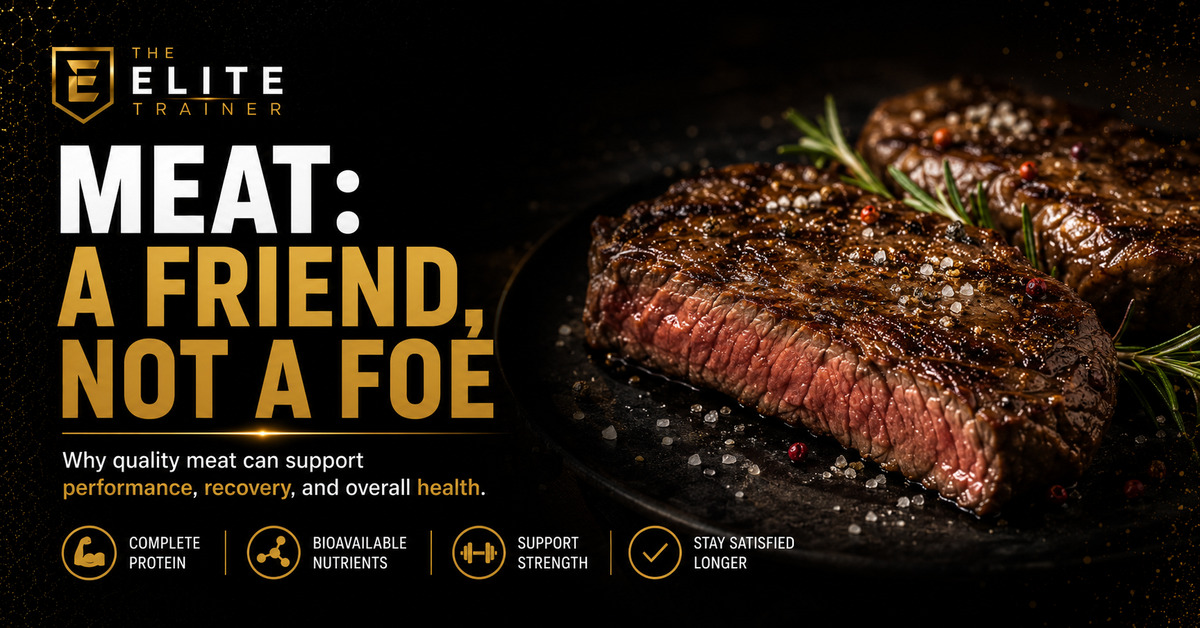
Meat: A Friend, Not a Foe
Red meat gets blamed for a lot, but quality and context matter. This piece makes the case for nutrient-dense, minimally processed meat as part of a serious health and performance diet.