
Medication May Help You Lose Weight. Only Lifestyle Can Build a Strong, Healthy Body.
Medications based on semaglutide and tirzepatide—sold under different brand names and for different medical indications, including Ozempic®, Wegovy®, Mounjaro® and Zepbound®—have transformed the treatment of diabetes and obesity.
For many people, these medications are valuable tools. They can reduce appetite, improve blood-sugar control, produce clinically meaningful weight loss and, in appropriately selected patients, reduce serious health risks. In the STEP 1 trial, once-weekly semaglutide produced an average body-weight reduction of 14.9% at 68 weeks. In SURMOUNT-1, the highest tirzepatide dose produced an average reduction of 20.9% at 72 weeks. The SELECT trial also showed a 20% relative reduction in major cardiovascular events among adults with overweight or obesity and established cardiovascular disease but without diabetes.1, 4, 5
That is not a minor achievement, and this article is not an argument against medically appropriate treatment.
The problem begins when weight loss becomes the entire goal—and the number on the scale becomes the only measure of success.
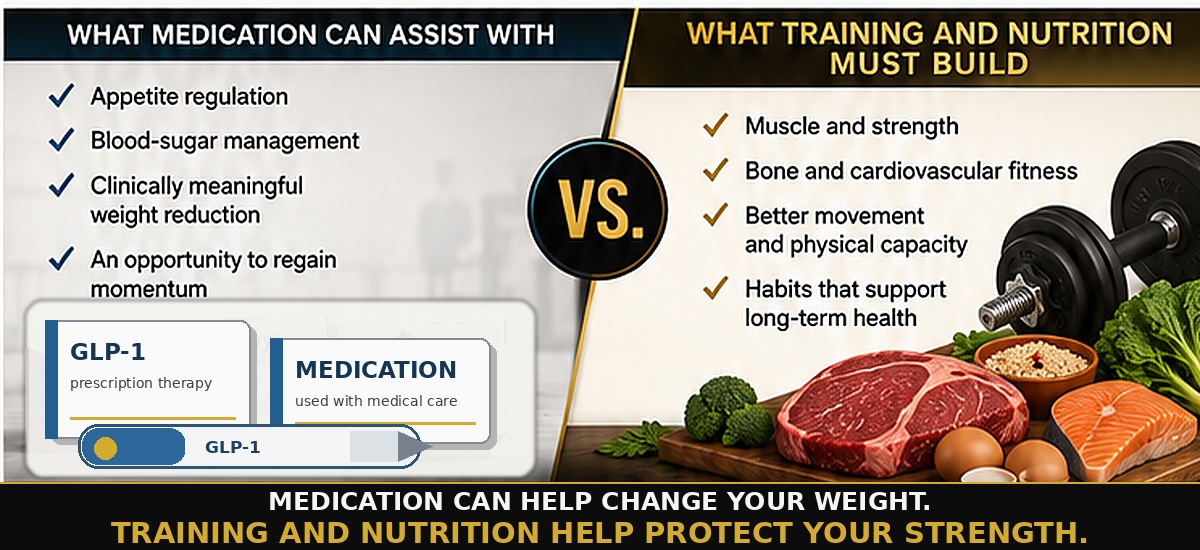
Medication may help change your appetite and body weight. It cannot perform a squat, stimulate a muscle through progressive overload, strengthen your bones, improve your movement skills, prepare a nutrient-dense meal or create the habits that support health for decades.
A prescription may change the scale. Only the life you build can change your future.
The Scale Doesn’t Tell the Whole Story
For decades, people have been conditioned to judge progress by one number: body weight. Step on the scale, see the number drop and assume that health has improved.
Sometimes it has. Losing excess body fat can improve mobility, blood pressure, blood-sugar control, sleep and many other health markers. But the scale cannot distinguish between fat, muscle, water, glycogen, bone or the contents of your digestive system. It reports only total mass.
That is why body composition matters.
The objective should not simply be to become lighter. It should be to reduce excess body fat while preserving as much muscle, strength and physical function as possible. As I demonstrated in Tighten Up Your Physique, two people can lose the same amount of scale weight and achieve very different outcomes. One may become smaller and weaker. The other may become leaner, stronger and more capable.
Clinical trials of GLP-1–based therapies have raised legitimate questions about lean-mass loss. In a DXA substudy of SURMOUNT-1, approximately three-quarters of the weight lost with tirzepatide came from fat mass and approximately one-quarter from lean mass.7 That finding requires context.
Lean mass is not identical to skeletal muscle. It includes muscle, organs, connective tissue, body water and other non-fat tissues. Some reduction in lean mass commonly accompanies substantial weight loss, regardless of the method used. The responsible conclusion is not that these medications “melt muscle.” It is that muscle, strength and function should be deliberately protected during any major weight-loss phase.
The scale tells you how much total weight changed. It does not tell you what you lost, what you preserved or what your body can now do.
Build Health First—Then Let Body Composition Follow
One of the central ideas I have taught throughout my career is to focus on the cause, not merely the symptom. That principle still matters, but obesity deserves a more complete explanation than “eat less and move more.”
Obesity is a chronic, complex and often relapsing condition influenced by genetics, appetite biology, environment, food availability, medications, sleep, stress, physical activity, socioeconomic circumstances and learned behaviour. Medication can address part of that biology. Lifestyle can address many of the modifiable factors surrounding it. For some people, the best long-term strategy will include both.
My philosophy is therefore not “medication or lifestyle.” It is this:
Build health first. Improved body composition follows.
Feed the body high-quality food and it receives the raw materials needed to repair tissue, support immune function and maintain muscle. Challenge it with progressive resistance training and it adapts by becoming stronger. Improve cardiovascular fitness and daily movement and the heart, lungs and circulatory system become more capable. Prioritize sleep and recovery and the body becomes better able to regulate appetite, perform, repair and adapt.
These improvements are not cosmetic side effects. They are the substance of health.
Why Muscle Matters More Than the Number on the Scale
Muscle is not merely tissue that improves appearance. It is essential for movement, posture, balance, joint stability, glucose disposal and physical independence. Contracting muscle also releases signalling molecules called myokines, which help explain why exercise affects systems throughout the body.12
Muscle becomes even more important with age. Sarcopenia—the progressive loss of muscle strength and quantity—is associated with falls, fractures, disability and loss of independence. Modern consensus places particular emphasis on declining strength, not just declining muscle size.11
That is why I call muscle a metabolic insurance policy.
It gives you reserve capacity when illness, injury, surgery or aging places greater demands on the body. It helps you rise from a chair, carry groceries, climb stairs, play with your children or grandchildren and remain independent later in life.
Losing 40 pounds while becoming weaker is not the same achievement as losing 40 pounds while preserving strength, improving mobility and reducing waist circumference.
One result simply changes your size.
The other changes what your body is capable of doing.
Food Is More Than Fuel
The body is built from what you repeatedly provide it.
Food supplies amino acids for tissue repair, essential fatty acids for cellular function, carbohydrates for training and daily activity, and vitamins and minerals that support thousands of biochemical reactions. When appetite is greatly reduced, food quality becomes even more important because every meal has to do more work.
As discussed in Meat: A Friend, Not a Foe, nutrient-dense, minimally processed foods can provide substantial amounts of protein, iron, zinc, vitamin B12 and other important nutrients. A strong diet may include meat, poultry, fish, eggs, dairy products, legumes, vegetables, fruit, nuts, seeds and minimally processed carbohydrates according to individual preferences, tolerances and medical needs.
No single food caused the obesity epidemic, and no single food will solve it. The larger problem is often a dietary pattern dominated by highly processed, easy-to-overconsume foods that provide abundant calories with relatively little protein, fibre or satiety.
Protein Deserves Special Attention
Protein helps preserve lean tissue, supports recovery from training and improves satiety. This becomes particularly relevant when a medication substantially reduces appetite and total food intake.
A commonly used evidence-informed range for active adults trying to preserve or build muscle is approximately 1.2–1.6 grams of protein per kilogram of body weight per day, although needs vary with age, body size, training status, energy intake, medical conditions and kidney function.8, 10 That number should not be treated as a universal prescription. Individuals using GLP-1–based medication should discuss nutrition with their healthcare provider.
Practical strategies may include:
- Prioritizing a high-quality protein source at each meal.
- Eating the protein portion first when appetite is limited.
- Distributing protein across the day rather than relying on one large serving.
- Choosing foods that provide protein along with vitamins and minerals.
- Maintaining adequate fluids and fibre while managing gastrointestinal side effects with the medical team.
The better question is not, “How little can I eat and still lose weight?”
It is, “How can I make every calorie support the body I am trying to preserve?”
Exercise Still Does What Medication Cannot
Medication can change appetite and energy intake. Exercise creates adaptations that require physical work.
Resistance training stimulates the body to retain and build muscle. It strengthens connective tissue, challenges bone, improves balance and develops the skill of producing force. During caloric restriction, adding resistance training can substantially reduce the loss of lean mass compared with dieting alone.9, 14
Cardiovascular exercise provides a different set of benefits. It improves aerobic capacity, circulation, work capacity and heart health. Daily walking and other forms of general activity also help maintain mobility and reduce the amount of time spent sedentary.
Public-health guidelines recommend at least 150 minutes of moderate-intensity aerobic activity each week and muscle-strengthening work for all major muscle groups on at least two days.13 A personalized program may involve more or less depending on health status, experience, recovery and goals.
For time-efficient approaches, see Training Economy: How Weight Training Can Be Your All-in-One Fitness Solution. More advanced trainees interested in combining resistance work with conditioning can also review 3 Methods of Circuit Training to Shed Body Fat Quickly.
The important point is not that everyone must train like an athlete. It is that every capable person should send the body a regular signal to retain strength and physical function.
A Practical Muscle-Preservation Framework
Anyone using a GLP-1–based medication should follow the plan developed with their prescribing clinician. Within that medical plan, these principles can help keep the focus on health rather than scale weight alone:
- Resistance train consistently. Use exercises and loads appropriate for your experience, joints and medical status. Progress gradually.
- Prioritize protein and nutrient density. Reduced appetite makes food quality more—not less—important.
- Keep moving. Walk regularly and include cardiovascular work you can recover from and sustain.
- Track more than body weight. Monitor waist circumference, strength, repetitions, walking capacity, energy, sleep and relevant medical markers.
- Recover. Sleep, hydration and stress management affect appetite, performance and adherence.
- Review the plan. Significant fatigue, rapid functional decline, persistent gastrointestinal symptoms or difficulty meeting nutritional needs should be discussed with the healthcare team.
The goal is not to preserve every ounce of lean mass at any cost. The goal is to preserve the muscle, strength and function that support a healthy life.
Medication Is a Tool—Not a Moral Test
It is easy for this discussion to become polarized. One side treats medication as a miracle that makes lifestyle irrelevant. The other treats anyone using medication as though they lacked discipline.
Both positions are wrong.
Obesity treatment is medical care, not a character test. For some people, medication may be the intervention that finally reduces relentless hunger, improves metabolic health and makes movement easier. That opportunity should not be dismissed.
At the same time, medication works best as part of a comprehensive strategy. The World Health Organization’s current guidance describes GLP-1–based therapy as a potential long-term treatment option for eligible adults with obesity and emphasizes its use within broader care that includes healthy eating, physical activity and professional support.15
Use the reduction in appetite to improve food quality.
Use the reduction in body weight to make walking and training more manageable.
Use early improvements in health as momentum to build habits that strengthen the body rather than merely shrink it.
What Happens If the Medication Stops?
This is where the “temporary tool” language requires caution.
Some people may eventually discontinue medication. Others may require long-term treatment, just as long-term therapy is used for many chronic conditions. That decision belongs with the prescribing clinician.
Withdrawal trials show why this matters. In STEP 4, participants who continued semaglutide after the initial treatment period lost additional weight, while those switched to placebo regained weight.2 In the STEP 1 extension, participants regained roughly two-thirds of their previous weight loss during the year after treatment and structured lifestyle support ended.3 SURMOUNT-4 found a similar pattern with tirzepatide: continued treatment maintained and extended weight reduction, while withdrawal led to substantial regain.6
That does not mean lifestyle is useless. It means biology does not disappear when a prescription ends.
Healthy habits may not guarantee that every pound remains off, but they still determine whether a person is stronger, fitter, better nourished and more physically capable—whether medication is continued, adjusted or discontinued.
Redefine What Success Looks Like
Scale weight is useful information, but it should not be the entire scoreboard.
A more complete definition of progress may include:
- Reduced waist circumference and body fat.
- Preserved or improved strength.
- Better blood pressure, blood glucose and lipid levels.
- Greater walking capacity and less joint discomfort.
- Improved sleep, energy and confidence.
- A healthier relationship with food.
- Habits that can be repeated consistently.
This is the difference between chasing a smaller number and building a better life.
The Bottom Line
Ozempic, Wegovy, Mounjaro, Zepbound and related therapies represent a major advance in medicine. Used appropriately, they can produce substantial weight loss and meaningful health benefits. They deserve an honest discussion—not blind enthusiasm and not reflexive dismissal.
But medication cannot lift weights for you.
It cannot create the mechanical tension that tells muscle to stay. It cannot strengthen your bones, improve your balance, expand your aerobic capacity or teach you how to nourish your body when appetite is low.
Those adaptations still require action.
If you and your physician decide that medication is appropriate, use the opportunity wisely. Pair it with progressive resistance training. Prioritize protein and nutrient-dense food. Walk. Condition your heart and lungs. Sleep. Recover. Track what your body can do—not merely what it weighs.
The goal was never simply to lose weight.
The goal is to build a body that allows you to live the longest, healthiest, strongest and most independent life possible.
Medication can help change your weight.
Only the life you build can change your future.
Frequently Asked Questions
Does Ozempic cause muscle loss?
Substantial weight loss commonly includes some reduction in lean mass, whether it is achieved through medication, diet or surgery. Lean mass is not the same as skeletal muscle. Resistance training, adequate protein, appropriate calorie intake and clinical monitoring can help protect muscle and physical function.
Should I lift weights while taking a GLP-1 medication?
Resistance training is generally valuable for preserving strength and lean tissue during weight loss, but the program should match your health, experience and medical status. Obtain clearance and individualized guidance when necessary.
How much protein should I eat while taking Ozempic or another GLP-1 medication?
There is no single target for everyone. Approximately 1.2–1.6 g/kg/day is a commonly used range for active adults seeking to preserve muscle, but age, body size, kidney function, total energy intake and medical history matter. Your healthcare provider can help you determine an appropriate target.
Will I regain weight if I stop taking the medication?
Weight regain is common after GLP-1–based medications are discontinued, although individual outcomes vary. Do not change or stop treatment without speaking with the prescribing clinician. Lifestyle habits remain important whether treatment continues or ends.
References
- Wilding JPH, Batterham RL, Calanna S, et al. Once-Weekly Semaglutide in Adults with Overweight or Obesity. N Engl J Med. 2021;384:989–1002.
- Rubino D, Abrahamsson N, Davies M, et al. Effect of Continued Weekly Subcutaneous Semaglutide vs Placebo on Weight Loss Maintenance in Adults With Overweight or Obesity. JAMA. 2021;325(14):1414–1425.
- Wilding JPH, Batterham RL, Davies M, et al. Weight Regain and Cardiometabolic Effects After Withdrawal of Semaglutide: The STEP 1 Trial Extension. Diabetes Obes Metab. 2022;24(8):1553–1564.
- Lincoff AM, Brown-Frandsen K, Colhoun HM, et al. Semaglutide and Cardiovascular Outcomes in Obesity without Diabetes. N Engl J Med. 2023;389:2221–2232.
- Jastreboff AM, Aronne LJ, Ahmad NN, et al. Tirzepatide Once Weekly for the Treatment of Obesity. N Engl J Med. 2022;387:205–216.
- Aronne LJ, Sattar N, Horn DB, et al. Continued Treatment With Tirzepatide for Maintenance of Weight Reduction in Adults With Obesity. JAMA. 2024;331(1):38–48.
- Look M, Dunn JP, Kushner RF, et al. Body Composition Changes During Weight Reduction With Tirzepatide in the SURMOUNT-1 Study. Diabetes Obes Metab. 2025;27(5):2720–2729.
- Mozaffarian D, et al. Nutritional Priorities to Support GLP-1 Therapy for Obesity: A Joint Advisory. Am J Clin Nutr. 2025.
- Sardeli AV, Komatsu TR, Mori MA, Gáspari AF, Chacon-Mikahil MPT. Resistance Training Prevents Muscle Loss Induced by Caloric Restriction in Obese Elderly Individuals. Nutrients. 2018;10(4):423.
- Morton RW, Murphy KT, McKellar SR, et al. A Systematic Review, Meta-analysis and Meta-regression of Protein Supplementation and Resistance Training. Br J Sports Med. 2018;52:376–384.
- Cruz-Jentoft AJ, Bahat G, Bauer J, et al. Sarcopenia: Revised European Consensus on Definition and Diagnosis. Age Ageing. 2019;48(1):16–31.
- Pedersen BK, Febbraio MA. Muscles, Exercise and Obesity: Skeletal Muscle as a Secretory Organ. Nat Rev Endocrinol. 2012;8:457–465.
- U.S. Department of Health and Human Services. Physical Activity Guidelines for Americans, 2nd Edition. 2018.
- Lopez P, Taaffe DR, Galvão DA, et al. Resistance Training Effectiveness on Body Composition and Body Weight Outcomes in Individuals With Overweight and Obesity Across the Lifespan. Obes Rev. 2022.
- World Health Organization. WHO Guideline on the Use of GLP-1 Medicines in Treating Obesity. 2025.
Medical disclaimer: This article is for educational purposes only and is not a substitute for individualized medical advice. Decisions about prescription medication, nutrition and exercise should be made with qualified healthcare professionals.
Testosterone Therapy: The Goal Is Optimal, Not Maximal
Testosterone therapy can improve strength, body composition, sexual function and quality of life, but more is not always better. Learn what the latest evidence says about optimal testosterone levels, estradiol, injections, creams, gels, pellets, cardiovascular and prostate health, fertility, tendon risk and intelligent TRT monitoring.

Dirty Dozen, Clean Fifteen: When Is Organic Produce Really Worth It?
Not all produce carries the same pesticide burden. Learn when buying organic makes the biggest difference, what the 2026 Dirty Dozen and Clean Fifteen reveal, and how to reduce pesticide exposure without eating fewer fruits and vegetables.
Why You Wake Up at 3 A.M.: The Ultimate Guide to Staying Asleep All Night
Waking up in the middle of the night becomes more common with age, and the fix is not always the same as the one for falling asleep. Learn the most effective strategies for sleep maintenance, from dinner timing and supplement support to a promising new ketone experiment for people who cannot stay asleep.