
Two Similar-Looking Ab Exercises With Very Different Demands
Core training has a strange habit of drifting toward extremes. At one end, you have endless crunches performed with little thought beyond accumulating repetitions; at the other, you have people holding planks for several minutes simply because the clock is still running.
There is another option.
Two abdominal exercises I’ve used for years—Ab 45s and the Reclining Field Goal—rely heavily on position, tension and controlled isometric holds rather than mindless repetition. They may look like close relatives, but they don’t create exactly the same challenge, and I don’t necessarily use them with the same people.
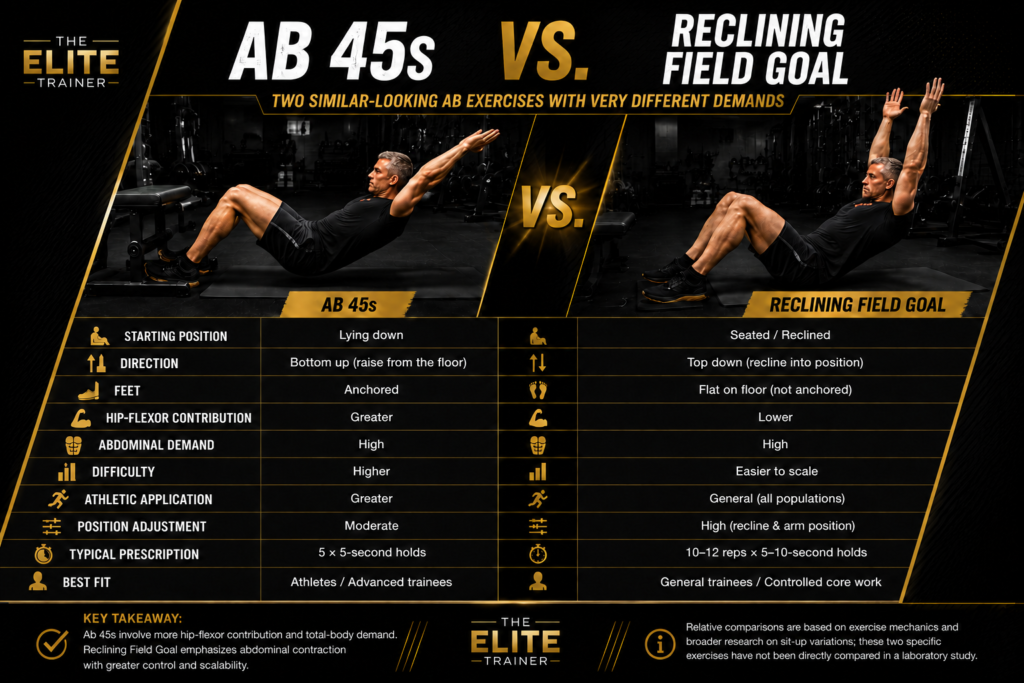
Ab 45s are the more aggressive of the two. Anchoring the feet and raising the torso from the floor introduces a greater hip-flexion component and makes them an excellent option for stronger trainees and athletes who can use that contribution productively. The Reclining Field Goal approaches the challenge from the opposite direction: rather than coming from the bottom up, you establish the abdominal contraction from the top down and progressively manipulate the exercise through torso and arm position.
That distinction is the entire point of this comparison. The goal isn’t to decide which exercise is universally “better.” It’s to understand what each one does best and choose accordingly.
TWO EXERCISES, TWO DIFFERENT JOBS
Ab 45s have been part of my training toolbox for years. I originally picked up the concept through sprint coach Barry Ross. The setup is deceptively simple: anchor the feet, extend the arms overhead in line with the torso, raise the head and trunk until the torso is approximately 45 degrees from the floor, hold the position, and return under control. My original progression was to work toward 5 sets of 5 repetitions with 5-second holds, eventually extending those holds toward 10 seconds.
Simple doesn’t mean easy.
The Reclining Field Goal came to me through Nelson Montana’s work. I originally referred to it as the Montana Ab Stabilizer before eventually giving it a name that was a little easier to remember. To perform it, sit with the knees bent to roughly 90 degrees and the feet flat on the floor, tuck the chin, round the back slightly and grasp the outside of the thighs near the knees. Lean backward into position, establish the abdominal contraction, and then raise the arms until they point straight upward—vertical and perpendicular to the floor—while the torso remains reclined.
On paper, both exercises involve reclining the torso and maintaining abdominal tension. In practice, how you arrive at that position changes the exercise.
AB 45s: THE MORE ATHLETIC OPTION
With Ab 45s, you begin supine and raise the trunk against gravity while the feet remain secured. That fixed lower-body position is important because it gives the hip flexors considerably more opportunity to contribute as the torso comes off the floor.
The abdominals certainly work hard, but this is not an isolation exercise in which every other contributor needs to be eliminated. Research comparing traditional sit-up patterns with more trunk-flexion-focused variations supports the broader principle that movements involving more hip flexion generally increase hip-flexor activity, whereas modified variations can shift more of the demand toward the abdominal musculature.
That does not make hip-flexor involvement a defect. For an athlete who runs, accelerates, changes direction, kicks or repeatedly drives the thigh toward the torso, strong hip flexors are part of the package. The more useful question is whether substantial hip-flexor involvement is something you want from this particular exercise.
For many athletes, the answer may be yes. That’s one reason I view Ab 45s as the more athletic of these two movements: you’re creating abdominal stiffness within a pattern that demands greater cooperation between the trunk and hips.
There is no published head-to-head study comparing Ab 45s with the Reclining Field Goal, so I would not pretend we have laboratory EMG data establishing an exact difference between them. The comparison here is based on their mechanics and on broader research examining anchored sit-up patterns and hip-flexor involvement.
HOW TO PERFORM AB 45s
Secure your feet beneath a stable support and lie on your back with the knees bent. Extend the arms fully overhead so they remain approximately in line with the torso rather than reaching forward to generate momentum.
From there, raise the head and trunk until your torso reaches roughly 45 degrees from the floor. Bring the arms with you so the arms and torso continue to function as one long lever. Hold that position under tension, then lower yourself under control.
A practical starting progression is 3 sets of 3–5 repetitions with 5-second holds, eventually building toward 5 sets of 5 repetitions with 5-second holds. More advanced trainees can gradually extend the holds toward 10 seconds once the position is solid.
The exact numbers aren’t sacred; the quality of the position is. If the torso keeps climbing toward upright as fatigue sets in, or the arms start swinging forward to escape the hardest portion of the repetition, Ab 45s have turned into something else.
Own the 45-degree position first. Then progress it.
WHO SHOULD CONSIDER AB 45s?
I particularly like Ab 45s for athletes, stronger trainees and people who already have a good foundation of abdominal strength. They also work well when you deliberately want the trunk and hip flexors cooperating rather than trying to remove the hip flexors from the exercise as much as possible.
That doesn’t mean every athlete automatically needs Ab 45s, nor does it mean they’re appropriate for everyone with a history of back discomfort. Exercise selection should depend on tolerance, training history and objective.
For some people, the very characteristics that make Ab 45s attractive—the anchored feet, bottom-up initiation and greater hip-flexor contribution—are precisely why another exercise may be more appropriate.
That’s where the Reclining Field Goal earns its place.
THE RECLINING FIELD GOAL: START FROM THE TOP
In my older Three Exercises That Beat Boring Planks article, I described the distinction rather simply: if working from the bottom up isn’t the effect you want, approach the challenge from the top down with the Reclining Field Goal.
You aren’t lying flat and trying to pull the entire trunk upward against gravity. Instead, you begin seated and deliberately recline into a position you can control. Once the abdominal contraction is established, the torso angle and arm position allow you to manipulate the difficulty without necessarily adding external resistance.
That makes the exercise highly adjustable. If a particular recline is too demanding, sit slightly more upright; if it’s too easy, recline farther. The arms then move from the initial support position to a vertical finish while you prevent the torso from following them forward.
You adjust the exercise to the individual rather than forcing the individual to fit the exercise.
HOW TO PERFORM THE RECLINING FIELD GOAL
Sit on the floor with the knees bent approximately 90 degrees and the feet flat, but not anchored. Tuck the chin slightly, round the back and grasp the outside of the thighs close to the knees. Using the thighs initially for support, lean backward until the arms straighten and you find a position where the abdominal wall is working hard without losing control.
Once you’re stable, release the thighs and raise both arms straight upward until they are vertical and perpendicular to the floor. The torso should remain reclined; it should not follow the arms forward.
I generally use 1–3 sets of 10–12 repetitions with 5–10-second holds. As strength improves, you can manipulate the amount of recline, the hold duration or other loading variables, but there is no reason to rush the progression. Correctly performed, the Reclining Field Goal becomes surprisingly difficult without requiring much equipment at all.
SEE THE DIFFERENCE IN ACTION
In the video below, Amanda demonstrates both exercises so you can see the difference rather than just read about it. The first half shows Ab 45s: the feet are anchored and the arms remain in line with the trunk as she rises toward the 45-degree position. In the second half, she performs the Reclining Field Goal: the feet are not anchored, the torso is established from the top down, and the arms finish vertically—perpendicular to the floor—while the reclined torso remains controlled.
THE BIG DIFFERENCE: HIP FLEXION VS. ABDOMINAL EMPHASIS
Both exercises demand considerable abdominal tension and positional control, but they arrive at that challenge differently. With Ab 45s, the feet are anchored and the trunk rises from the floor, creating an environment in which the hip flexors have considerably more opportunity to contribute.
With the Reclining Field Goal, you establish the torso position from above and maintain that position while manipulating the arms and amount of recline. You aren’t repeatedly pulling the torso upward from the floor against an anchored lower body.
That makes the Reclining Field Goal my preferred choice when the objective is to emphasize abdominal control while reducing the need for aggressive hip-flexor involvement. Less hip-flexor involvement isn’t automatically better—it is simply a different training effect.
This is where exercise discussions often go wrong. A legitimate biomechanical difference gets turned into a moral judgment: hip flexors are bad, spinal flexion is bad, sit-ups are bad, planks are good. Human movement isn’t that simple.
An exercise is useful when its demands match the person and the objective.
AB 45s VS. RECLINING FIELD GOAL
WHAT ABOUT THE LOWER BACK?
This deserves more nuance than declaring one exercise safe and the other dangerous.
Traditional sit-up variations can produce substantial hip-flexor activity. The psoas, in particular, crosses the hip and has attachments involving the lumbar region, which is one reason researchers and clinicians have long been interested in how different abdominal exercise configurations affect hip-flexor recruitment and spinal loading.
For someone who dislikes aggressive hip-flexion-based abdominal work—or who simply wants a more easily controlled starting point—the Reclining Field Goal may therefore be the more sensible option. For the average trainee whose objective is general fitness and abdominal strength rather than a specific high-performance athletic demand, I often don’t need to involve more musculature than the exercise requires.
The Reclining Field Goal allows me to create a strong abdominal contraction, regulate the torso angle easily and keep the emphasis where I want it. For someone with active low-back pain, however, neither this article nor any single exercise should be treated as a diagnosis or rehabilitation prescription. Individual tolerance, symptoms and clinical circumstances always matter.
My practical distinction is simple: the Reclining Field Goal may be more suitable for many people who don’t tolerate hip-flexor-dominant abdominal exercises well because it is easier to regulate and requires less aggressive bottom-up hip flexion.
DON’T CONFUSE LESS MOVEMENT WITH LESS WORK
One of the interesting things about both exercises is how unimpressive they can look from across the gym. Nobody is throwing a massive weight around or bouncing through 100 repetitions, and neither exercise creates much of a dramatic highlight reel.
That becomes irrelevant once you understand the objective. The goal is to create and maintain tension in the position you want to strengthen.
The Reclining Field Goal in particular demonstrates how leverage can alter difficulty dramatically without requiring a plate or dumbbell. A small adjustment to torso position can make the exercise significantly harder while the abdominal wall continues to maintain control.
The same principle appears throughout strength training: sometimes you don’t need more weight. You need more demanding leverage.
ATHLETES SHOULD NOT AUTOMATICALLY AVOID HIP FLEXORS
“Hip-flexor involvement” is too often discussed as though it represents contamination of an abdominal exercise. That makes little sense when you consider what many athletes are actually required to do.
If you’re a sprinter, soccer player, hockey player, martial artist or athlete whose sport repeatedly requires rapid hip flexion, there is no obvious reason to build a core-training program around the assumption that the hip flexors must always be removed from the equation. What you ultimately need is the ability to create trunk stiffness while the hips are producing force.
That’s one of the conceptual reasons I like Ab 45s for athletic populations. It isn’t because Ab 45s magically improve sprint speed by themselves; it’s because their demands can fit an athlete’s broader requirement to coordinate the trunk and hips under tension.
That is a programming decision, not a claim that one abdominal exercise transfers directly to every sport.
THE AVERAGE TRAINEE MAY NEED SOMETHING DIFFERENT
The average trainee isn’t necessarily trying to maximize sprint acceleration. More often, the goal is to develop stronger abdominals, better trunk control and a more resilient midsection using an exercise that requires little equipment and offers something more challenging than another basic crunch or endless plank.
For that person, I would often introduce the Reclining Field Goal first. It teaches the trainee to establish abdominal tension and maintain it while the exercise is manipulated through body position. The difficulty is easy to adjust, and you don’t need to win a wrestling match with the hip flexors simply to reach the working position.
Once someone becomes stronger and demonstrates good control, Ab 45s can become another useful option if their additional demands fit the individual.
CAN YOU USE BOTH?
Absolutely. Exercise selection doesn’t have to become a custody battle.
If both movements feel good and both serve a purpose, use them at different points in the program. One simple approach is to spend 3–4 weeks emphasizing the Reclining Field Goal, developing control and sustained abdominal tension, followed by 3–4 weeks of Ab 45s, introducing the more demanding bottom-up pattern and building stronger 5–10-second holds.
From there, you can repeat the cycle at a more advanced level or rotate into another abdominal exercise. This follows a principle I’ve emphasized repeatedly in training: variation works best when it has a reason.
Change exercises because you want to alter the training stimulus, not simply because you became bored after three workouts.
DON’T FORGET THE OTHER SIDE
If you’re going to spend time strengthening trunk flexion and the anterior core, don’t forget the posterior side of the body.
I’ve long used the Superman Back Extension as an antagonist movement for exercises such as Ab 45s and the Reclining Field Goal. It gives the posterior chain and spinal extensors their own focused work rather than allowing “core training” to become synonymous with abdominal training.
That doesn’t mean every abdominal exercise needs to be immediately supersetted with a back extension. It simply means core development should be broader than whichever muscles you can see in the mirror.
COMMON MISTAKES WITH AB 45s
Swinging the arms. The long arm position is part of what makes Ab 45s difficult. Throwing the arms forward to initiate the repetition removes some of the challenge you’re trying to create.
Going too high. These are Ab 45s for a reason. Once the torso continues climbing well beyond roughly 45 degrees toward upright, you’re changing the mechanical emphasis of the movement.
Losing tension during the hold. Five seconds spent gradually collapsing isn’t a five-second quality hold. Maintain the position for the entire prescribed duration.
Progressing the hold before owning the position. Earn five clean seconds before chasing ten ugly ones.
Assuming hip-flexor contribution is automatically bad. In the right trainee, that involvement may be part of the reason Ab 45s were selected in the first place.
COMMON MISTAKES WITH THE RECLINING FIELD GOAL
Reclining too far too soon. Find the hardest position you can genuinely control rather than the lowest position you can survive.
Allowing the torso to follow the arms. As the arms rise toward vertical, the reclined torso position should remain controlled rather than moving forward with them.
Letting the arms finish in the wrong position. At the finish, the arms should point straight upward, perpendicular to the floor. They should not remain in line with the torso as they do during Ab 45s.
Moving too quickly. Slow, deliberate movement makes it much easier to determine whether the abdominal position is actually being maintained.
Assuming bodyweight means beginner. Correct positioning and leverage can make a no-equipment exercise extremely demanding.
SO WHICH ONE SHOULD YOU CHOOSE?
If you’re an athlete or advanced trainee who wants a more aggressive abdominal exercise and tolerates anchored hip-flexion patterns well, Ab 45s are an excellent option. If you’re a general trainee who wants strong abdominal tension with greater control over difficulty and less reliance on aggressive hip flexion, the Reclining Field Goal may be the better starting point.
If one exercise bothers your back, hips or another joint, don’t force it simply because an article says you should be able to perform it. And if both work well, there is no reason they cannot both appear in your program at different times.
They don’t need to compete; they need to earn their place in the program.
THE BOTTOM LINE
The best abdominal exercise isn’t necessarily the one that burns the most, lasts the longest or looks the hardest on social media. It’s the one that creates the training effect you actually want.
Ab 45s and the Reclining Field Goal share the same basic philosophy—create tension, control the position and make every second count—but they accomplish it differently. Ab 45s incorporate a greater hip-flexion demand and lend themselves particularly well to stronger and more athletic trainees, while the Reclining Field Goal allows you to emphasize abdominal control with greater scalability and less reliance on aggressive hip flexion.
Neither exercise is universally superior.
Two similar-looking exercises. Two different jobs. Choose the one that fits yours.

Learn to Use Your Back When Doing Chin-Ups
Chin-ups are a back exercise first, but many lifters turn them into an arm-dominant grind. Better intent, setup, and execution help the lats do the job they are built to do.
Standing Band Pressdowns: The Joint-Friendly Triceps Builder
Standing band pressdowns give the triceps hard work without beating up the elbows. The setup is simple, portable, and useful for lifters who need a joint-friendlier arm option.

Target Your Rear Delts Like Never Before
Rear delts are easy to miss when shoulder training gets dominated by presses and side raises. A better angle and tighter setup can bring this stubborn muscle group to life.