
WHY STRENGTH TRAINING IS THE CLOSEST THING WE HAVE TO A FOUNTAIN OF YOUTH
Growing older is inevitable. Losing the strength to climb stairs, carry groceries, maintain your balance, and live independently does not have to define the process.
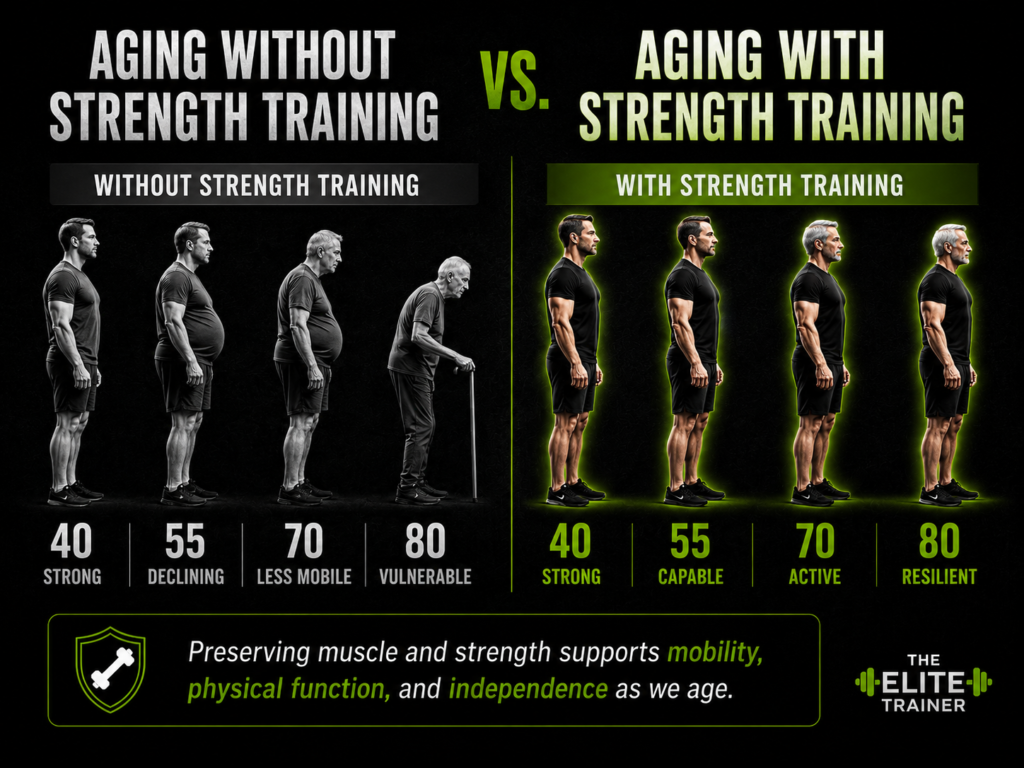
Certain physiological changes naturally occur with age, but many people assume that becoming weaker, slower, and less capable is unavoidable. In reality, prolonged inactivity can accelerate much of the decline commonly associated with aging. When the body is no longer asked to produce force, stabilize joints, support weight, or move through challenging ranges of motion, it adapts by becoming less capable.
The encouraging news is that this process remains highly responsive to training.
Resistance exercise cannot stop the passage of time, but it can profoundly influence how well your body functions as the years pass. Regular strength training helps preserve muscle, support bone health, improve balance, and maintain the physical reserve needed to continue performing everyday activities confidently.
You are not simply training for next week or next summer. You are training for the person you will become 10, 20, or even 40 years from now.
MUSCLE IS MORE THAN JUST APPEARANCE
When most people think about strength training, they picture bigger muscles, toned arms, or improved athletic performance. While those are worthwhile benefits, they represent only part of the story.
Muscle is one of the most metabolically active and functionally important tissues in the human body. It allows you to rise from a chair, climb stairs, carry groceries, lift luggage, maintain your posture, and continue participating in the activities you enjoy. It also provides a reserve of strength that becomes increasingly valuable during periods of illness, injury, or physical stress.
Most importantly, muscle helps you remain independent.
Beginning as early as the fourth decade of life, adults may gradually lose muscle mass and strength, particularly when resistance training and regular physical activity are absent. This process, known as sarcopenia, can accelerate with each passing decade.
The consequences extend far beyond appearance. Reduced muscle mass and strength can contribute to slower movement, impaired balance, reduced mobility, difficulty performing daily tasks, and a greater risk of falls and physical disability.
Recognizing the importance of preserving muscle throughout the lifespan, the European Working Group on Sarcopenia in Older People identifies low muscle strength as a central characteristic of sarcopenia and recommends resistance training as a primary strategy for its prevention and management.¹
Fortunately, muscle remains remarkably adaptable throughout life.
One of the landmark studies in this area found that nursing-home residents in their nineties experienced dramatic improvements in strength after participating in a progressive resistance-training program for only eight weeks.² Subsequent research has repeatedly demonstrated that meaningful improvements in muscle strength, balance, mobility, and functional capacity can occur well into the seventh, eighth, and ninth decades of life.
Age is not the only reason strength declines. A lack of meaningful physical challenge is one of the most modifiable factors.
I’VE GOT A BONE TO PICK WITH YOU
One of the most overlooked benefits of strength training has very little to do with building visible muscle. It has everything to do with preserving bone.
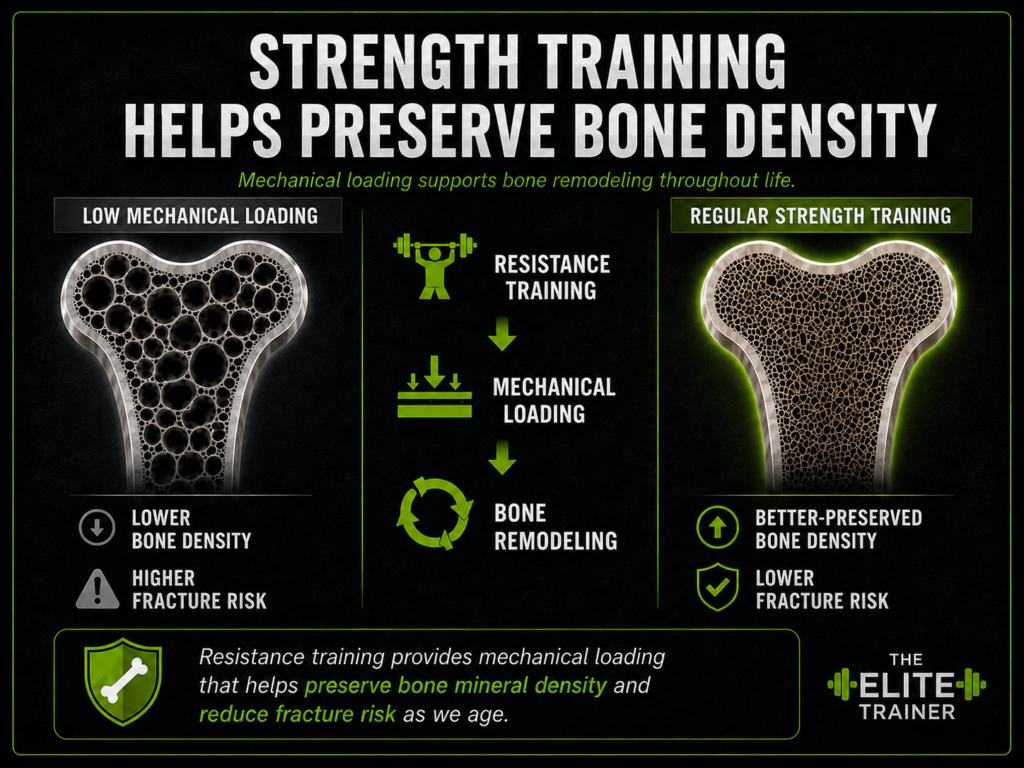
Bone is living tissue. Throughout your life, it is continuously broken down and rebuilt through a process known as bone remodeling.
Like muscle, bone responds to the demands placed upon it. When your muscles contract against resistance, they generate forces that place stress on your skeleton. In response, specialized bone cells are stimulated to reinforce the bone and help maintain its strength and mineral density.
Without sufficient mechanical loading, bones can gradually become weaker and more porous.
This becomes increasingly important as we age. Osteoporosis and age-related bone loss raise the risk of fractures, particularly in the hip, spine, and wrist. These injuries are not always isolated events. A serious fracture can mark the beginning of reduced mobility, greater dependence on others, and a significant decline in quality of life.
Appropriately prescribed resistance training is an important non-pharmacological strategy for supporting bone health. When combined with suitable weight-bearing and impact-loading activities, it can help slow age-related bone loss and reduce several risk factors associated with osteoporotic fractures.³
If not for your appearance…
If not for your athletic performance…
If not even for your muscles…
Do it for your bones.
Stronger bones provide greater resilience, reduce vulnerability to fractures, and help protect your ability to remain active for years to come.
STRENGTH IS INDEPENDENCE
One of the greatest benefits of strength training is not reflected in the mirror. It is reflected in your ability to continue doing the things you enjoy without constantly relying on others for assistance.
Strength allows you to lift your luggage while travelling, work in the garden, carry groceries in from the car, climb a flight of stairs, and get down on the floor to play with your grandchildren—and get back up again.
These tasks may seem ordinary when they require little effort. Their importance becomes much clearer when they begin to feel difficult or impossible.
Maintaining strength is not simply about lifting heavier weights in the gym. It is about preserving the physical capacity to perform the activities of daily living safely, efficiently, and confidently.
Large systematic reviews have found that progressive resistance training can improve physical function, enhance mobility, and reduce physical disability in older adults.⁴ These improvements can make the difference between managing daily life independently and requiring assistance with tasks that were once taken for granted.
The goal of strength training is not simply to build larger muscles.
It is to preserve your freedom.
Strength gives you options: the option to travel, remain in your own home, continue enjoying your hobbies, and live life on your own terms.
Every workout you complete today helps protect those options tomorrow.
DON’T JUST ADD YEARS TO YOUR LIFE—ADD LIFE TO YOUR YEARS
Living longer is only part of the goal. The greater challenge is ensuring that those additional years are healthy, active, and enjoyable.
A longer lifespan means very little when the later years are dominated by frailty, chronic pain, poor mobility, or dependence on others for basic activities of daily living. The objective should not simply be to increase lifespan. It should also be to increase healthspan: the number of years you remain healthy, capable, and physically independent.
Resistance training can benefit multiple systems throughout the body. In addition to supporting muscle and bone, it may improve insulin sensitivity, glucose regulation, joint stability, posture, balance, coordination, and overall physical function.⁶
It can also improve confidence. When you trust your body to support you, catch you, and carry you through daily life, you are more likely to remain active and engaged.
Research has also found an association between regular muscle-strengthening activity and a lower risk of all-cause mortality, cardiovascular disease, type 2 diabetes, and certain cancers.⁵ Although observational research cannot prove that strength training alone causes these outcomes, the overall pattern suggests that maintaining muscular fitness is an important part of long-term health.
In many ways, resistance training is like a retirement plan for your body. The earlier you begin making deposits, the more physical capacity you may have available later in life.
Unlike a financial retirement plan, however, it is never too late to start.
Whether you are 25, 55, or 85 years old, your body retains an impressive ability to adapt when it is challenged appropriately.
HOW TO START BUILDING STRENGTH FOR LIFE
You do not need to train like a competitive bodybuilder or spend every day in the gym to benefit from resistance exercise.
For many adults, a practical starting point is two non-consecutive full-body strength-training sessions per week. Each session should address the major movement patterns used in everyday life, including squatting or sitting and standing, pushing, pulling, bending at the hips, carrying, and stabilizing the trunk.
The equipment you use is less important than the quality and consistency of the training. Free weights, machines, resistance bands, cables, and bodyweight exercises can all be effective when they are performed with control and gradually made more challenging.
Begin with a resistance that allows you to maintain proper technique through a comfortable range of motion. Avoid turning every workout into a test of your limits. Once an exercise becomes consistently manageable, progress by adding a small amount of resistance, performing additional repetitions, or improving the range and control of the movement.
Consistency matters more than exhaustion.
Older adults may also benefit from including balance work and appropriate weight-bearing activities alongside resistance training. Anyone beginning after a long period of inactivity—or managing significant pain, a recent injury, severe osteoporosis, or a medical condition—should consider seeking guidance from a qualified healthcare or fitness professional.
The safest and most effective program is one that matches your current abilities while providing enough challenge to encourage adaptation.
THE BOTTOM LINE
Strength training is not about pretending that aging does not exist. It is about refusing to surrender your physical capacity without a fight.
You may not be able to control the passage of time, but you can influence how prepared your body is to meet it.
Building and maintaining muscle, supporting bone density, improving balance, and preserving mobility are among the most valuable investments you can make in your future quality of life. The goal is not simply to look younger. It is to remain capable.
Strength allows you to continue travelling, hiking, gardening, carrying your own groceries, playing with your grandchildren, and getting out of a chair without assistance. It gives you the confidence and resilience to continue living the life you want.
Growing older is inevitable.
Growing weaker does not have to be accepted without resistance.
Start making deposits into your future today.
Your future self will thank you for it.
Train today. Stay strong for life.
REFERENCES
- Cruz-Jentoft AJ, Bahat G, Bauer J, et al. Sarcopenia: Revised European consensus on definition and diagnosis. Age and Ageing. 2019;48(1):16–31.
- Fiatarone MA, Marks EC, Ryan ND, Meredith CN, Lipsitz LA, Evans WJ. High-intensity strength training in nonagenarians: Effects on skeletal muscle. JAMA. 1990;263(22):3029–3034.
- Zhao R, Zhang M, Zhang Q. The effectiveness of combined exercise interventions for preventing postmenopausal bone loss: A systematic review and meta-analysis. Journal of Bone and Mineral Research. 2015;30(1):159–179.
- Liu CJ, Latham NK. Progressive resistance strength training for improving physical function in older adults. Cochrane Database of Systematic Reviews. 2009;(3):CD002759.
- Momma H, Kawakami R, Honda T, Sawada SS. Muscle-strengthening activities are associated with lower risk and mortality in major non-communicable diseases: A systematic review and meta-analysis of cohort studies. British Journal of Sports Medicine. 2022;56:755–763.
- Westcott WL. Resistance training is medicine: Effects of strength training on health. Current Sports Medicine Reports. 2012;11(4):209–216.
The Interference Effect: How to Maximize Strength and Endurance Gains
Strength and endurance can coexist, but programming matters. Timing, volume, intensity, and exercise selection all influence whether cardio helps your goals or interferes with them.

Stop Abdominal Hollowing! It Weakens Your Lifts and Increases Injury Risk
Abdominal hollowing may look neat in theory, but heavy lifting needs real bracing. Learn why a stronger core strategy can improve stability when the weight gets serious.
Amanda’s Strength Journey: From 4 to 12 Chin-Ups!
Going from 4 to 12 chin-ups takes more than wishful thinking. Amanda’s progress shows what consistent technique work, smart progression, and full-range reps can do over time.