
Research moves quickly. Sometimes a new paper changes the way we think about training or nutrition. More often, it adds a little more resolution to a picture that was already taking shape. That is what this series is about: nine recent studies and reviews that caught my attention, along with what I think they actually mean for people who train.
BUILDING MUSCLE MAY COST LESS ENERGY THAN WE THOUGHT
A 2026 preprint attempted to estimate the energetic cost of constructing human skeletal muscle. The researchers arrived at a central estimate of roughly 3,500 additional metabolizable calories for every kilogram of wet skeletal muscle built.
Before anyone turns that number into another bulking formula, there is an important caveat: this is a modelling paper and a preprint, not a controlled trial showing that eating exactly 3,500 extra calories will produce a kilogram of muscle. Training status, protein intake, genetics, recovery and the rate at which you try to gain all matter.
Note: What interests me is the larger message. Building muscle requires energy, but that does not mean you need a huge calorie surplus. More food does not automatically equal more muscle. Once the machinery for growth is adequately supplied, a bigger surplus can simply make you bigger in places you did not intend.
SARCOPENIA IS NOT JUST A LOSS OF MUSCLE
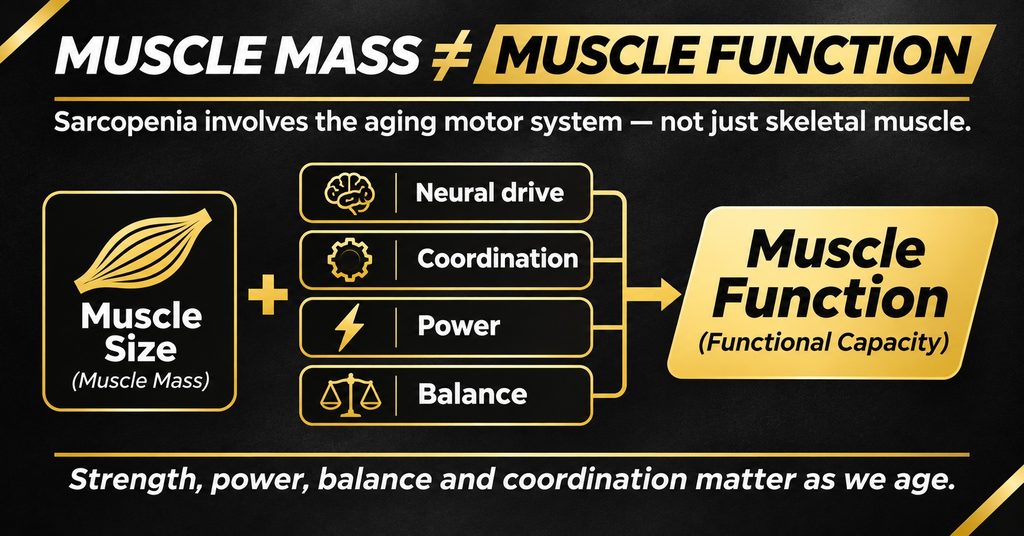
A 2026 paper in The Lancet Healthy Longevity argues that sarcopenia should be viewed more broadly as a disease of the aging motor system, involving not only skeletal muscle but also neural drive, peripheral nerves, the neuromuscular junction and the systems that ultimately allow muscle to produce useful force.
That matters because two people can possess similar amounts of muscle yet differ considerably in strength, power, balance, coordination and physical function.
Note: I have said for years that the goal is not simply to look muscular. Muscle has a job. You need to be able to recruit it, coordinate it and use it. That is why strength, balance, power and functional assessments become increasingly important as we age.
YOU MAY NOT NEED HOURS IN THE GYM TO BUY A LOT OF LONGEVITY
A large 2026 observational study followed more than 147,000 adults and examined resistance-training duration in relation to mortality. Compared with performing none, approximately 90 to 119 minutes per week of resistance training was associated with lower all-cause, cardiovascular and neurological mortality. The study did not find evidence that progressively more resistance training continued producing progressively greater mortality reductions beyond that amount.
This is observational research, so 90 to 119 minutes should not be interpreted as some magical longevity prescription.
Note: The practical point is much simpler. You do not need to live in the gym to gain meaningful health benefits from resistance training. A few well-designed sessions performed consistently can take you a very long way.
YOUR WAIST MAY SAY MORE ABOUT TESTOSTERONE THAN YOUR BIRTHDAY
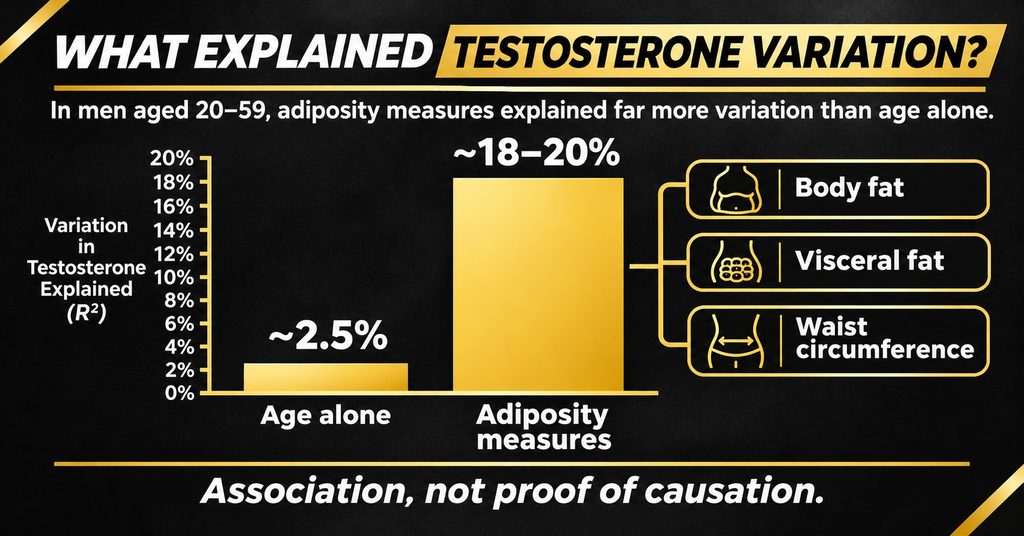
A 2026 analysis of nearly 5,000 men aged 20 to 59 examined the relationships between age, body composition and testosterone. Age explained relatively little of the variation in testosterone, while measures of adiposity, including body fat, visceral adipose tissue and waist circumference, explained substantially more.
It was a cross-sectional analysis, so we cannot conclude that reducing someone’s waist will automatically restore testosterone. But it does challenge the reflexive assumption that lower testosterone in middle age is simply the unavoidable result of another birthday.
Note: Before blaming age for everything, look at the things that changed with age. Body composition, sleep, activity, metabolic health, nutrition and medication use can all change substantially over the decades.
I recently explored one particularly simple body-composition marker in more detail: your waist-to-height ratio.
SAME MUSCLE, DIFFERENT GROWTH
A recent study compared hip-extension and hip-abduction training and used imaging to examine changes across different regions of the gluteus maximus. Both exercises produced growth, but they did not produce identical regional adaptations. Hip extension produced greater overall gluteus maximus hypertrophy in this trial, while the exercises emphasized different regions of the muscle.
Note: Exercise variation should not mean collecting exercises like Pokémon cards. It should mean choosing different movements because they create meaningfully different mechanical demands.
If two exercises train the same muscle from different joint positions, through different lines of pull or at different muscle lengths, there can be a legitimate reason to use both.
HIGH PROTEIN WAS NOT THE BEST EXPLANATION FOR LARGER ORGANS IN BODYBUILDERS
Another recent study compared visceral-organ size in controls, natural bodybuilders consuming high-protein diets, and bodybuilders using appearance- and performance-enhancing drugs. The natural high-protein bodybuilders did not show the same pattern of larger organ volumes seen in the drug-using group.
This was not a randomized experiment, so association should not be confused with proof of causation.
Note: Context matters. “Bodybuilders have bigger organs” and “high-protein diets make your organs grow” are not the same statement.
HOW FAST CAN A DRUG-FREE LIFTER REALISTICALLY GROW?
A 2026 review on fat-free-mass accretion examined realistic rates of gain in drug-free male athletes and lifters. Across the literature, a typical gain was in the neighbourhood of 1.4 kilograms of fat-free mass over approximately 12 weeks, with considerable individual variation.
And remember, fat-free mass is not synonymous with newly manufactured contractile muscle tissue. It includes water, glycogen and other non-fat tissue.
Note: Natural muscle growth is slow. That is not a flaw in the program. It is biology.
The sooner trainees understand that, the less vulnerable they become to programs, supplements and social-media transformations promising results that normal physiology does not support.
PROGRESSIVE OVERLOAD STILL MATTERS
A recent study compared fixed-load and progressive resistance training. Both approaches produced adaptation, which is worth remembering, but systematically progressing the training stimulus produced greater gains in muscle size in the study.
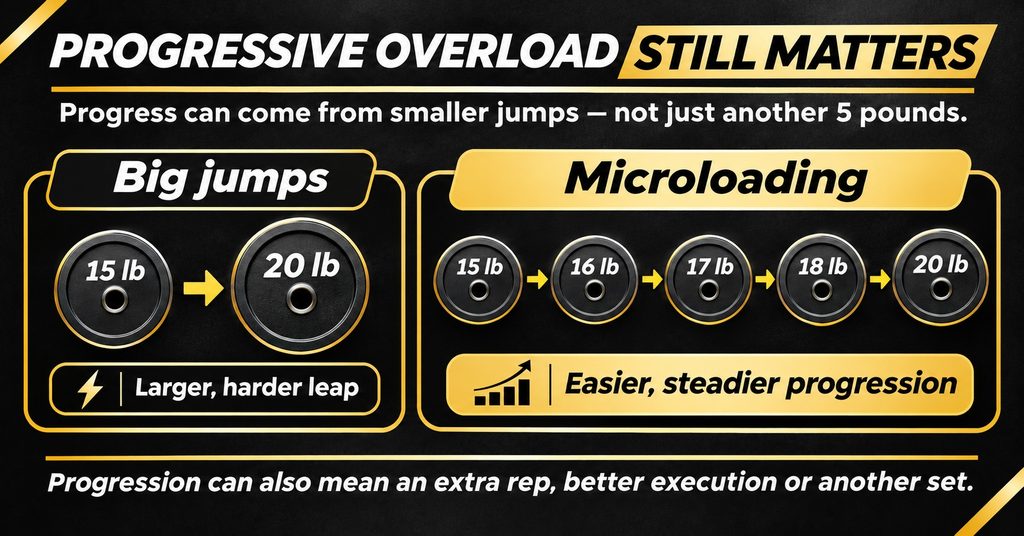
Note: Progressive overload does not mean you must add five pounds every workout until the end of time. Eventually the jumps available in a conventional gym become too large, especially on smaller-muscle exercises.
Sometimes progression means an extra repetition, better execution, more range, more control or an additional set. And sometimes it means adding one or two pounds instead of five. That last problem is exactly why I still consider PlateMate one of the best little inventions in the iron game.
DOES TRAINING AT NIGHT REALLY RUIN YOUR SLEEP?
A 2026 systematic review and meta-analysis looked at exercise timing and sleep. Overall, the evidence did not show a clear universal sleep advantage to morning exercise. Evening exercise was generally compatible with healthy sleep, although harder exercise performed later could modestly increase wakefulness after sleep onset in some circumstances.
Note: Do not abandon the only training time your schedule allows because somebody told you that exercising after 6 p.m. destroys sleep. Train when you can train consistently.
If a very hard late-night workout repeatedly leaves you wired and staring at the ceiling, move it earlier if possible. Your own response still matters.
For more on sleep maintenance, see Why You Wake Up at 3 A.M.: The Ultimate Guide to Staying Asleep All Night.
THE BOTTOM LINE
There are plenty of interesting details in this batch of research, but the larger message is familiar.
Strength train. Progress intelligently. Keep your body composition in check. Maintain useful muscle and the ability to recruit it. Sleep well. Choose exercises for a reason. And be patient enough to let years of good decisions compound.
The science keeps changing around the edges, but the fundamentals remain stubborn.
Upgrade Your Pull-Ups with Swissies-SP Handles
Pull-up handles can change more than grip comfort. Swissies-SP handles create new angles, reduce strain for some lifters, and add fresh variety to chin-ups and pull-ups.
No Time to Walk After a Meal? Do This Instead!
No time for a walk after eating? A short bout of air squats may offer a practical backup plan for getting the body moving and supporting better post-meal habits.
Stay Fit on the Fly: No-Excuse Workouts for Travelers
Travel does not have to wreck your training. With a few bodyweight staples and a no-excuse mindset, hotel rooms, airports, and busy schedules can still support a solid workout.